Wakeshift: push events that wake Claude Code and Cursor
Wakeshift is an MCP server and SDKs that wake Claude Code, Codex, Cursor, or ChatGPT when your app emits an event. Define, attach, emit.
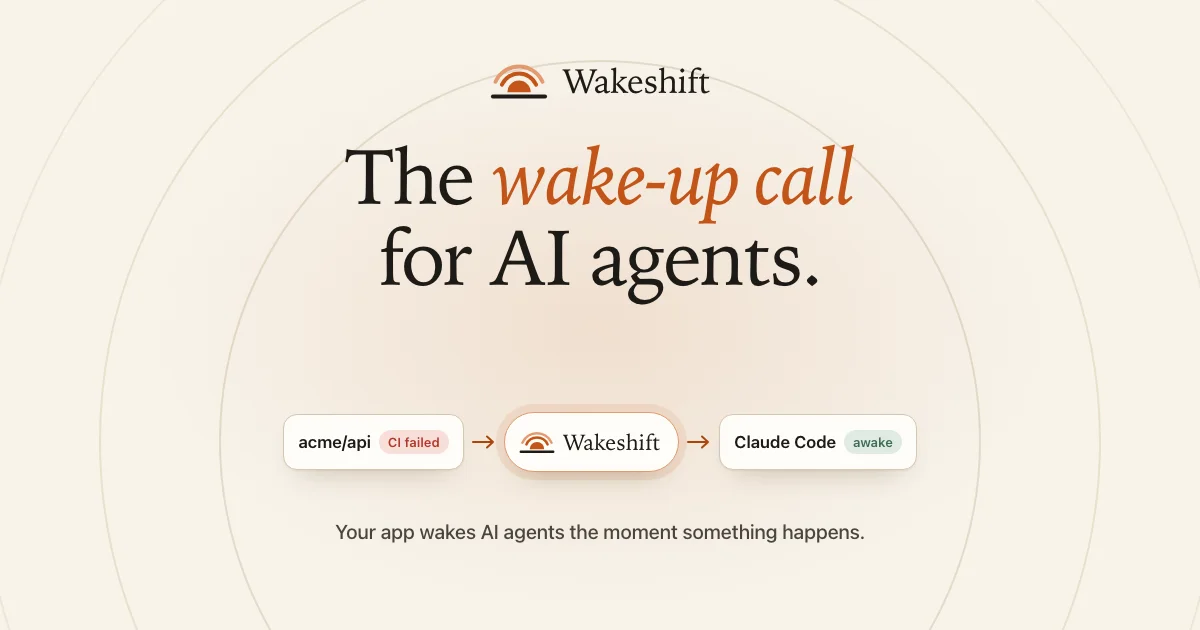
TL;DR: Wakeshift connects your backend to the coding agent your user already runs, so a failed CI run wakes the agent instead of waiting for the next human prompt. You define typed events, attach them to the MCP server you already publish, and call
emitwhen something happens. TypeScript, Python, and Go SDKs are open source under Apache 2.0, and the hosted service starts free with 50,000 deliveries a month.
What it is
Wakeshift is infrastructure for waking AI coding agents from your own backend. You describe the events your app offers (a CI run finished, a payment failed, a deploy went out), and Wakeshift wakes every agent that asked to hear about one. Claude Code, Codex, Cursor, ChatGPT work chats, opencode, GitHub Copilot CLI, Antigravity CLI, OpenClaw, and Hermes Agent are all covered.
The integration is three calls. defineEvent declares a typed event, attach hangs it off the MCP server you already publish, and emit fires it. There is no separate agent-side API to build and no per-agent harness code, because the wiring follows MCP Events (SEP-3415). Clients that speak the spec subscribe natively, and Wakeshift bridges everyone else through a subscribe_events tool it adds to your server.
What you get for the effort:
- Typed events. Arguments and payloads are zod schemas, so a subscriber can route on
ownerandrepoand filter on an optionalbranch. - Per-subscriber authorization. Your
authorizecallback runs before every subscription, so a user cannot watch a repo they cannot see. - Idempotent delivery. Pass the webhook delivery ID to
emitand retries collapse into one occurrence. - Personal events. An event marked
personalroutes a single occurrence to one user instead of broadcasting. - Webhook entry points.
publishUrlreturns a capability URL for services that can only POST, like GitHub or Stripe. - Delivery visibility.
statustells you how many conversations are subscribed and how each one is being reached: stream, poll, hooks, or webhook.
Why it matters
The default shape of a coding agent is pull. It finishes its turn and goes to sleep, and it only wakes when a human types something. That works fine while somebody is at the keyboard, and it falls apart the moment the interesting event happens while nobody is looking. CI goes red at two in the morning. The agent that could fix it is sitting idle next to a green cursor.
Polling is the usual workaround, and it is not a good one. You write a watcher that polls the CI provider, or a cron job that shells out to the agent CLI. Both put provider credentials and agent invocation somewhere you have to maintain, and both miss the window where the agent could have started while the failure was still fresh.
Wakeshift takes the push route instead. Your webhook handler calls emit, the event reaches Wakeshift, and the agent is woken with the failure text attached, framed as information coming from your app rather than as an instruction from the user. That framing is deliberate and it matters, because an agent that treats your event as a command is a prompt-injection problem waiting to happen.
Getting it running
The path of least resistance is a CI bot, because that is the case the docs lead with. Register an app in the Wakeshift console, put the key in your environment, and define the event. The key is shown once and looks like wst_ followed by 50 characters. It never leaves your server: the SDK signs each request with it.
npm install @wakeshift/sdk @modelcontextprotocol/server @modelcontextprotocol/node zodThe TypeScript SDK is ESM only and needs Node 22.18 or later, which runs a .ts file directly. Set "type": "module" in your package.json so your code and the SDK load the same copy of the MCP SDK.
import { McpServer } from "@modelcontextprotocol/server"
import { z } from "zod"
import { Wakeshift } from "@wakeshift/sdk"

const wake = new Wakeshift({ key: process.env.WAKESHIFT_KEY! })

const ciFinished = wake.defineEvent("ci.finished", {
  description: "CI finished on a GitHub repo",
  args: z.object({
    owner: z.string().describe("The repo's owner, lowercase: acme"),
    repo: z.string().describe("The repo's name, lowercase: api"),
    branch: z.string().optional().describe("Only this branch"),
  }),
  payload: z.object({ branch: z.string(), conclusion: z.string(), name: z.string(), url: z.string() }),
  authorize: (subscriber, { owner, repo }) => canSeeRepo(subscriber.user, `${owner}/${repo}`),
  text: (run, { owner, repo }) => `CI ${run.conclusion} on ${owner}/${repo} ${run.branch}: ${run.name}`,
})

function newServer() {
  const server = new McpServer({ name: "ci-bot", version: "1.0.0" })
  wake.attach(server, { identify: (ctx) => ({ user: userOf(ctx.http?.authInfo) }) })
  return server
}
attach adds three tools to your server (subscribe_events, unsubscribe_events, list_subscriptions) and serves events/list, events/subscribe, and events/unsubscribe for clients that speak MCP Events. The identify callback is how your app says who is behind a request, and without it personal events and list_subscriptions refuse to work.
Then emit from wherever the thing happens:
if (req.headers["x-github-event"] === "workflow_run" && body.action === "completed") {
  const run = body.workflow_run
  const [owner, repo] = body.repository.full_name.toLowerCase().split("/")
  await ciFinished.emit(
    { owner, repo },
    { branch: run.head_branch, conclusion: run.conclusion, name: run.name, url: run.html_url },
    { id: String(req.headers["x-github-delivery"]) },
  )
}
The return value tells you what happened: { matched, duplicate, unmatched, ended }. That last field matters. Subscriptions end when a user leaves a team or a game times out, and ended is how you learn to forget them.
Python and Go work the same way. pip install wakeshift or go get github.com/wakeshift/wakeshift-go@latest:
import asyncio
import os
from mcp.server.mcpserver import MCPServer
from pydantic import BaseModel
from wakeshift import Wakeshift

class Repo(BaseModel):
    owner: str
    repo: str

class Run(BaseModel):
    conclusion: str

wake = Wakeshift(os.environ["WAKESHIFT_KEY"])
ci_finished = wake.define_event(
    "ci.finished",
    description="CI finished on a GitHub repo",
    args=Repo,
    payload=Run,
    text=lambda run, r: f"CI {run.conclusion} on {r.owner}/{r.repo}",
)

server = MCPServer("ci-bot")
wake.attach(server)

asyncio.run(ci_finished.emit({"owner": "acme", "repo": "api"}, {"conclusion": "failure"}))
How each agent wakes
Not every agent can be woken the same way, and the differences matter when you are writing documentation for your users.
| Agent | Wakes while idle | Install needed | What the user approves |
|---|---|---|---|
| Claude Code | Yes | None, hooks are optional | Nothing extra, or “don’t ask again” in manual permission mode |
| Codex | Yes | Once | Trusting the new hook after a restart |
| Cursor CLI and IDE | Yes | None, hooks are optional | Cursor asks once before it starts a background command |
| ChatGPT work chats | Yes, each occurrence starts a run | None | The user asks ChatGPT to monitor the event |
| GitHub Copilot CLI | Yes | None | One approval each time it returns to waiting |
| opencode | Yes | Once | Nothing, but opencode needs a restart after the install |
| Antigravity CLI | Yes | None | Antigravity may ask to allow a background command |
| Hermes Agent | Yes, while it runs | Once | Hermes may ask to approve the install command |
| Cursor cloud agents | No | None | Occurrences arrive with the agent’s next call to a Wakeshift tool |
The last row is the one to watch. A cloud agent that is not holding a stream gets its occurrences on its next tool call, so the wake is not instant and a queued event can sit there for a while.
What it costs
| Plan | Price | Included deliveries | Rate limit | Event history |
|---|---|---|---|---|
| Free | $0 | 50,000 a month | 10 per second | 7 days |
| Starter | $29 a month | 50,000, then $0.10 per 1,000 | 50 per second | 30 days |
| Custom | Agreed | Agreed | Agreed | Agreed |
Retries and filtered events never count against the quota, so a flaky provider does not burn your budget.
What to watch for
For agents that cannot subscribe natively, something has to be installed on the user’s machine. Wakeshift’s tool result asks the agent to run a one-time install of the wakeshift program, which contains the hooks and connectors, and the agent asks the user first. The open-source parts are published in the wakeshift/connectors repository under Apache 2.0, with plugins for Hermes Agent and OpenClaw, and the docs page per agent explains exactly what the install touches and how to undo it. Read it before you tell your users to approve it.
The hosted core is the part you are paying for and the part that sits between your events and your users’ agents. The SDK sends requests to app.wakeshift.ai, and WAKESHIFT_CORE only points it at a different console address such as staging. The routing and wake delivery still run through Wakeshift’s core, so if you need that layer inside your network, you should ask what self-hosting looks like before you depend on it.
Events carry whatever you put in the payload, and those payloads pass through Wakeshift’s core. If your events include customer data, set deleteOnDelivery: true on the event so the text and payload are erased once delivered, and use personal events for anything a specific user should not see reflected in another user’s stream.
The SDKs are young. The TypeScript package is at 0.7.1 and the Python package at 0.6.0, the TypeScript build is ESM only, and the zod version constraint catches people out (import from "zod", never "zod/v4", or the MCP SDK rejects the schema with a mixed-zod error). Account sign-ups also fill up, and when that happens you land on a waitlist. An invite link from an existing user skips it.
Security problems go to [email protected] rather than a public issue.
Source and Accuracy Notes
- Project page: https://wakeshift.ai, verified via direct visit
- Quickstart: https://wakeshift.ai/docs/quickstart
- Agent support matrix: https://wakeshift.ai/docs/agents
- Source repositories:
wakeshift/wakeshift-node,wakeshift/wakeshift-python,wakeshift/wakeshift-go,wakeshift/connectors - License: Apache-2.0 across all four repositories, and the npm package
@wakeshift/sdkdeclares Apache-2.0 as well - Pricing and rate limits: read from the pricing section on wakeshift.ai
- HN thread: https://news.ycombinator.com/item?id=50305218 surfaced Wakeshift through one of its own apps, Sketch Stadium. Wakeshift itself has no dedicated launch thread
Related Posts
ai-setup
Recall – Persistent Memory for Claude Code via MCP Hooks
Recall gives Claude Code a permanent memory store that survives session restarts and context compaction. Four hooks capture and restore context automatically — with cloud SaaS or self-hosted options.
2/28/2026
dev-tools
Automotive Skills Suite for AI Engineering
Evaluate Automotive Skills Suite for APQP, ASPICE, HARA, safety-plan, and DIA workflows with setup notes, governance risks, and SME review guidance.
5/28/2026
dev-tools
awesome-agentic-ai-zh Roadmap Guide
Explore awesome-agentic-ai-zh as a Chinese agentic AI learning roadmap, with setup notes, track selection, study workflow, and evaluation guidance.
5/28/2026