Recall – Persistent Memory for Claude Code via MCP Hooks
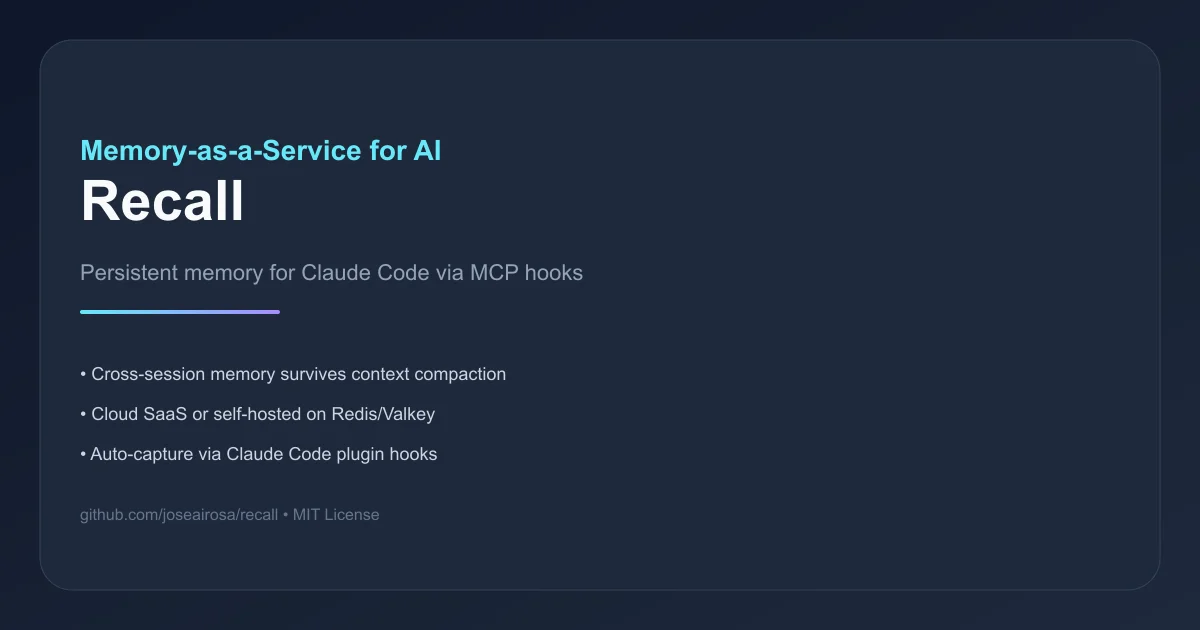
Recall gives Claude Code a permanent memory store that survives session restarts and context compaction. Four hooks capture and restore context automatically — with cloud SaaS or self-hosted options.
TL;DR
TL;DR: Recall is an MCP-based memory service that gives Claude Code persistent cross-session memory — automatically capturing and restoring context via hooks, with both managed cloud and self-hosted options.
Source and Accuracy Notes
- Project page: recallmcp.com
- Source repository: github.com/joseairosa/recall (MIT license, verified via GitHub API)
- License: MIT (verified via GitHub API
license.spdx_id) - HN launch thread: news.ycombinator.com/item?id=47189906
What Is Recall?
Claude Code is powerful, but every new session starts from scratch. Context gets lost when the window fills up and gets summarized. Recall solves this by adding persistent cross-session memory through the Model Context Protocol.
The core product is a memory service with two deployment options:
- Cloud — Managed SaaS at recallmcp.com. Sign up, get an API key, add one MCP config block. Free tier includes 500 memories.
- Self-hosted — Run on your own Redis or Valkey instance. Full data sovereignty, no usage caps, MIT licensed.
The Claude Code plugin works by installing four hooks that run automatically on every session start and end — no prompting required.
Key Features
Auto-memory hooks — Install once with two commands. Four hooks capture context at session start and end, and restore memories automatically.
Cross-session workflows — Named threads that span multiple sessions with automatic memory tagging and context threading.
Auto-consolidation — Automatically clusters and merges similar memories. Keeps originals as history while surfacing consolidated summaries.
Webhook ingestion — Route events from GitHub, Sentry, Slack, Stripe, Linear, PagerDuty, and more directly into Claude’s context. Every event recorded, queued, filtered, or blocked.
Multi-tenant isolation — Each workspace’s memories are isolated. Supports team sharing: one Claude learns something, all others know instantly.
Seven embedding providers — Voyage AI, Cohere, OpenAI, Deepseek, Grok, Anthropic, and Ollama. Also works fully offline with an Anthropic keyword fallback.
Setup Workflow
Step 1: Create an account
Sign up at recallmcp.com. No credit card required for the free tier.
Step 2: Add the MCP configuration
For Claude Desktop, add to your claude_desktop_config.json:
{
  "mcpServers": {
    "recall": {
      "url": "https://recallmcp.com/mcp",
      "headers": { "Authorization": "Bearer YOUR_API_KEY" }
    }
  }
}
```bash

For Claude Code, install the plugin with:

```bash
/plugin marketplace add joseairosa/recall-claude-plugin
/plugin install recall@recall-claude-plugin
```bash

### Step 3: Done

Recall's status bar shows the current version, memory count, and time since last store. Every session now starts with your accumulated memories already loaded.

## Self-Hosted Setup

For full data sovereignty, deploy Recall on your own infrastructure with Docker:

```bash
curl -fsSL https://install.recallmcp.com | bash
The installer detects Docker, configures Redis plus Recall, and prints the MCP config. Requires Redis 6 or Valkey, and Node.js 18 or higher.
Self-hosted features:
- Unlimited memories — no plan caps
- Full data sovereignty — zero cloud dependency
- Air-gapped deployments — works fully offline
- License-key auth with a 7-day grace window
Pricing
| Plan | Memories | Price |
|---|---|---|
| Free | 500 | $0/mo |
| Pro | 5,000 | $4.99/mo |
| Team | 25,000 | $9.99/mo |
How It Works Under the Hood
Recall is structured as an MCP server that implements the full MCP specification. The Claude Code plugin registers four hooks:
- Session start — fetches and restores memories from the last session
- Session end — captures new context and stores it
- Context compaction — when Claude’s window gets summarized, memories survive externally
- Heartbeat — periodic saves during long sessions
The memory store uses Redis for persistence, with semantic search powered by configurable embedding providers. The consolidation engine runs asynchronously to cluster similar memories.
Security Notes
- AES-256-GCM encryption at rest (cloud tier)
- Per-tenant key isolation (cloud tier)
- Self-hosted: zero external API calls for storage
- Webhook payloads verified via HMAC-SHA256 signatures
FAQ
Q: Does Recall work with Claude on the web or Claude API directly? A: The primary integration is Claude Code (desktop plugin) and Claude Desktop (MCP config). The MCP server itself is protocol-compatible, so any MCP client can connect.
Q: What happens to my memories if I stop paying? A: Free tier is permanent at 500 memories. Paid plans retain data for 30 days after a subscription lapses.
Q: Can I export all my memories? A: Yes. The “Export All” tool in the Recall dashboard downloads your full memory history as JSON.
Q: Is the self-hosted version feature-complete? A: The core memory and MCP server are the same. Some cloud-only features include the web dashboard, team sharing UI, and the managed embedding providers.
Conclusion
Recall fills a real gap in AI coding workflows — the context reset problem. Rather than manually pasting context into every new session, or relying on fragile copy-paste workflows, Recall automates memory capture and retrieval at the protocol level. The self-hosted option is particularly compelling for teams with data residency requirements or on-premise setups.
Whether you choose the managed cloud or roll your own with Redis, the setup is genuinely fast: the cloud path takes about two minutes end-to-end.
Related Posts
dev-tools
Automotive Skills Suite for AI Engineering
Evaluate Automotive Skills Suite for APQP, ASPICE, HARA, safety-plan, and DIA workflows with setup notes, governance risks, and SME review guidance.
5/28/2026
dev-tools
awesome-agentic-ai-zh Roadmap Guide
Explore awesome-agentic-ai-zh as a Chinese agentic AI learning roadmap, with setup notes, track selection, study workflow, and evaluation guidance.
5/28/2026
dev-tools
Baguette iOS Simulator Automation Guide
Set up Baguette for iOS Simulator automation, web dashboards, device farms, gesture input, streaming, and camera testing with Xcode caveats.
5/28/2026