SwiftUI-Agent-Skill: SwiftUI guidance for coding agents
A MIT-licensed agent skill giving Claude Code, Codex, and other AI tools SwiftUI-specific guidance. 5.4k stars from a 59 KB repo.
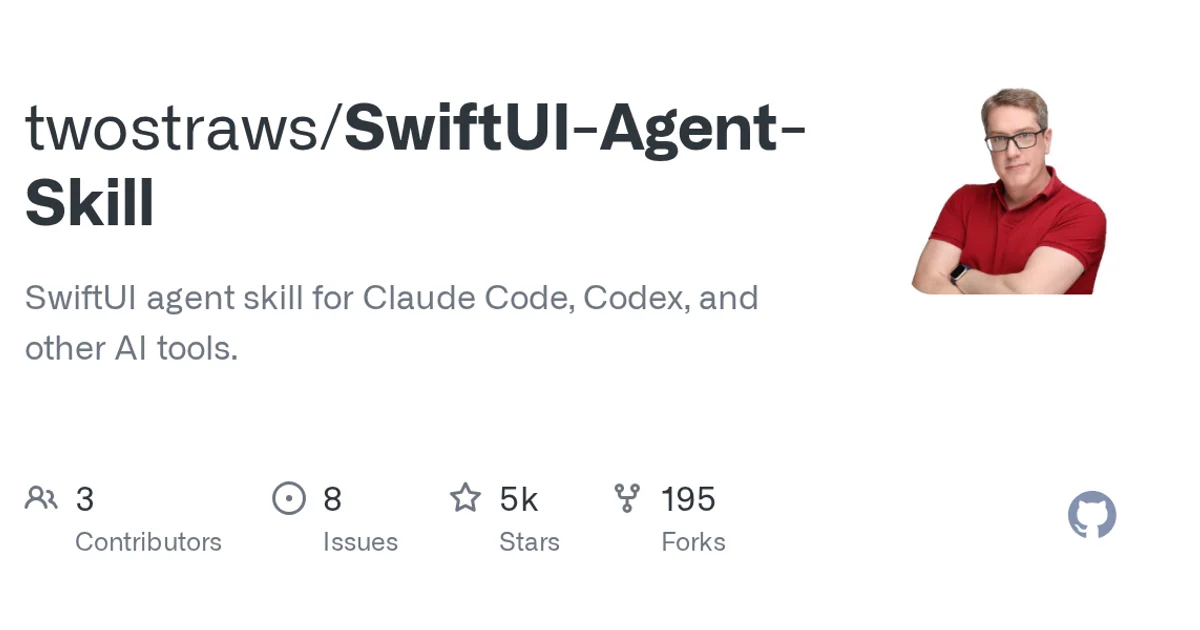
TL;DR: SwiftUI-Agent-Skill packages SwiftUI guidance into the agent skill format so Claude Code, Codex, and similar tools write better iOS code. It is MIT licensed, weighs 59 KB, and has 5,464 stars.
What it is
The description is one sentence: a SwiftUI agent skill for Claude Code, Codex, and other AI tools. That is the entire pitch, and it is worth taking seriously as a design statement.
The repository is owned by twostraws, Paul Hudson’s account, which explains both the audience and the framing. He writes teaching material for Swift developers, so the value proposition is not “give the model more API surface” but “give the model better judgment about how to structure SwiftUI code.”
The repo tells you what kind of thing it is
The metadata here is unusually informative because the repository is tiny.
| Metric | Value |
|---|---|
| Stars | 5,464 |
| Forks | 196 |
| Open issues | 12 |
| Repository size | 59 KB |
| Detected language | None |
| License | MIT |
| Created | March 5, 2026 |
| Last push | October 7, 2026 |
Two rows carry most of the meaning. The repository is 59 KB, so there is no compiled artifact or bundled model inside it. And GitHub detects no primary language, which means the contents are configuration and documentation rather than Swift source.
So this is knowledge, not code. The 5,464 stars are people voting with a bookmark on a set of written instructions, and the fork-to-star ratio of about 3.6 percent is much lower than a tool people deploy. That pattern says read-and-adopt, not run-and-maintain.
Twelve open issues against 5,464 stars is a very quiet maintenance load for something with this reach.
Why skills exist as a format
The agent skill format exists to move instructions out of your prompt and into a file the tool can load on demand. Instead of pasting a framework’s conventions into every conversation, you keep them in a directory the agent knows how to find.
That framing explains what a well-built skill has to do. It cannot be a link dump. It has to be written as instructions, scoped tightly enough to load at the right moment, and phrased in a way that actually changes the output a coding agent produces.
git clone https://github.com/twostraws/SwiftUI-Agent-Skill.git
cd SwiftUI-Agent-Skill
ls -la
The checkout is small enough to read end to end in one sitting, which is the fastest way to judge whether the guidance matches how you write SwiftUI. There is no build step and nothing to install before you can look at it.
When to use it
This is for you if you build iOS apps with an AI coding agent and you have noticed the model produces plausible but generic SwiftUI. State-management advice, view decomposition, and the ongoing churn in Apple’s own recommended patterns are exactly the kind of thing a written skill can pin down.
The MIT license makes adoption frictionless, including in commercial work, and there is no dependency to add to your project.
When not to use it
It will not help if you do not write SwiftUI. The description names Claude Code, Codex, and other AI tools, but the subject matter is narrowly Apple UI framework work, and it does not transfer to backend Swift, Linux, or other platforms.
Also reconsider if you already maintain a house style guide. Loading two sources of opinion about the same framework produces inconsistency rather than clarity, and a conflicting internal convention should win.
Source and Accuracy Notes
- Project page: https://github.com/twostraws/SwiftUI-Agent-Skill
- Source repository: twostraws/SwiftUI-Agent-Skill (verified via GitHub API
html_url) - License: MIT (verified via GitHub API
license.spdx_id) - Stars at time of writing: 5,464
- Repository declares no topics and no homepage URL (verified via GitHub API)
- The repository has no detected primary language; the 59 KB size and absent language detection are verified via GitHub API
sizeandlanguage - No claim is made about the skill’s internal contents, since the README was not fetched for this post
Related Posts
ai-setup
Recall – Persistent Memory for Claude Code via MCP Hooks
Recall gives Claude Code a permanent memory store that survives session restarts and context compaction. Four hooks capture and restore context automatically — with cloud SaaS or self-hosted options.
2/28/2026
dev-tools
Automotive Skills Suite for AI Engineering
Evaluate Automotive Skills Suite for APQP, ASPICE, HARA, safety-plan, and DIA workflows with setup notes, governance risks, and SME review guidance.
5/28/2026
dev-tools
awesome-agentic-ai-zh Roadmap Guide
Explore awesome-agentic-ai-zh as a Chinese agentic AI learning roadmap, with setup notes, track selection, study workflow, and evaluation guidance.
5/28/2026