Orca: run a fleet of coding agents from one place
Orca is a TypeScript workspace for running fleets of coding agents like Grok Bot and Claude Code with your own subscription, on desktop, mobile or remote.
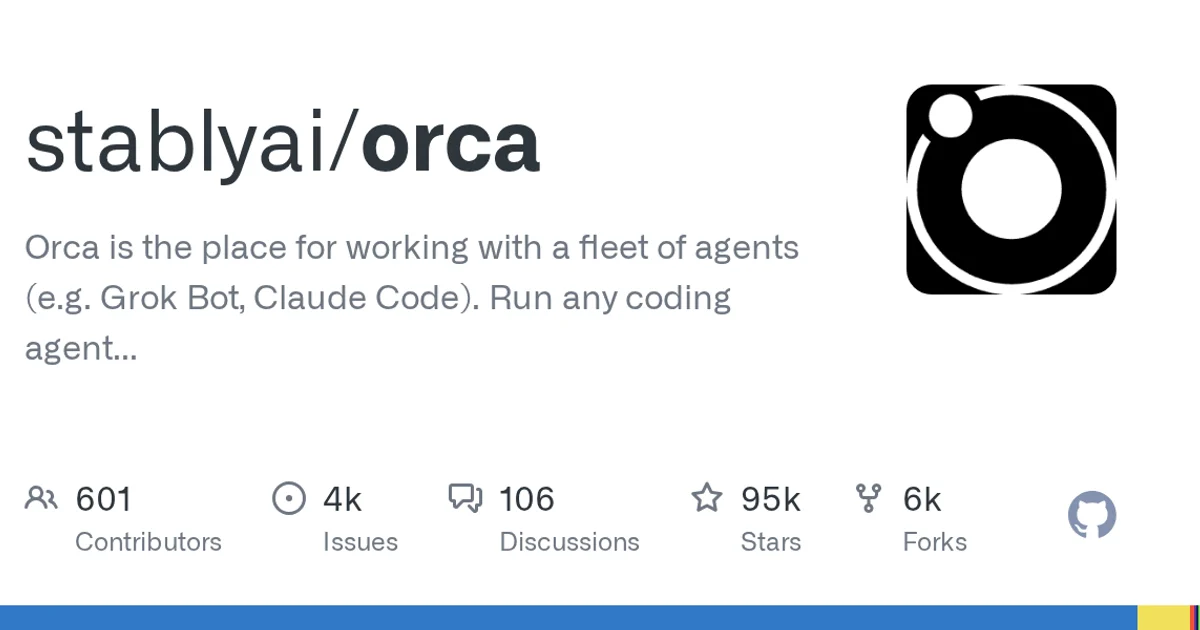
TL;DR: Orca is a TypeScript workspace for running several coding agents at once, and its description names Grok Bot and Claude Code as examples. That description suggests running agents through a subscription you already hold, rather than metering every token through a separate API bill. Orca was MIT licensed with 95,458 stars at the time of writing.
Most people run one coding agent at a time, in one terminal, on one machine. Orca is built for the opposite arrangement. Its description calls it the place for working with a fleet of agents, naming Grok Bot and Claude Code as examples, and it says you can run any coding agent with your own subscription. It is available on desktop, on mobile, and through a remote runtime.
A fleet is the right word, and it is the part worth thinking about before you install anything.
One agent versus many
The single-agent model is a queue. You have a task, you hand it to the CLI, you wait, you read the diff. Parallelism, when you want it, means opening three terminal tabs and keeping track of which one is doing what.
Orca is organised around running several at once, which changes what you are actually managing. The hard part stops being typing prompts and becomes deciding which agent gets which task, what each one is allowed to touch, and how you read three streams of output without losing your place. That is a supervisor problem, not a prompting problem.
The subscription angle
The phrase that stands out in the description is your own subscription. That points at running agents through the plan you already pay a provider for, rather than metering every token through a separate API bill from Orca. If you already hold subscriptions to multiple coding agents, the fleet concept becomes cheaper to justify, because the marginal cost of running one more agent is not a new contract.
What the repository metadata does not tell you is how that works in practice, which agents are wired up, and whether there are limits per plan. Those are questions for the project, not for this post.
Three surfaces, not one
Desktop, mobile, and remote runtime is a more interesting spread than most agent tools claim.
| Surface | What it suggests |
|---|---|
| Desktop | Full local setup, the agents run on your machine |
| Mobile | Review or steer work away from the desk |
| Remote runtime | Agents keep running when the laptop is closed |
The remote runtime is the piece that changes the working day. An agent left running on a machine you are not sitting at is a different animal from a terminal that dies when you close the tab. If long-running refactors or overnight batches are part of how you work, that row is the reason to care.
What the project looks like today
Straight from the GitHub API, no inference:
| Signal | Value |
|---|---|
| Primary language | TypeScript |
| License | MIT |
| Stars | 95,458 |
| Forks | 6,114 |
| Homepage | https://orca.dev |
| Topics | ade, agent-ide, ai-agents, automation, bot, claude-code |
| Last push | 2026-10-18 |
| Owner type | organization |
The topic tags are the self-description worth reading. Alongside ai-agents and automation, the project tags itself agent-ide and ade, which reads as agentic development environment. It is claiming to be the container your agents live in, not another agent.
Ninety-five thousand stars on an MIT license is a lot of attention for a tool that is, underneath, a place to launch other people’s agents. It also means the project has been picked up widely enough that your subscription probably covers the interesting integrations already.
You can confirm any of the above yourself in a second:
gh repo view stablyai/orca
gh api repos/stablyai/orca --jq '.topics, .license.spdx_id, .stargazers_count'
Before you commit to it
The MIT license means you can read the code, and at this size you should. Before moving real work into it, worth checking:
- How agents are isolated, and whether one can reach another’s working directory
- What happens to a run when the connection drops on mobile
- Whether the remote runtime is self-hostable or a hosted service
The third question has the biggest impact on your workflow. If it is self-hosted, Orca is infrastructure. If it is hosted, it is a dependency, and the MIT license covers the client rather than the thing actually running your agents.
When it fits
You are paying for more than one agent subscription, you want them working at the same time, and you lose work whenever a laptop sleeps. That is a real combination of problems and Orca targets it head on.
When it does not
If one agent at a time is genuinely enough, a fleet is overhead you will feel. And if your agents must run on machines you control for compliance reasons, check the remote runtime story first. An MIT client is only reassuring if the runtime is yours.
Source and Accuracy Notes
- Project page: https://github.com/stablyai/orca
- Project site: https://orca.dev (from GitHub API
homepage) - Source repository: stablyai/orca (verified via GitHub API
html_url) - License: MIT (verified via GitHub API
license.spdx_id) - Stars at time of writing: 95,458
- All factual claims come from the GitHub repository API and the repository description. The README was not fetched, so agent lists, pricing, runtime architecture and setup steps are not described here. Confirm those on the project site before relying on them.
Related Posts
ai-setup
Recall – Persistent Memory for Claude Code via MCP Hooks
Recall gives Claude Code a permanent memory store that survives session restarts and context compaction. Four hooks capture and restore context automatically — with cloud SaaS or self-hosted options.
2/28/2026
dev-tools
Automotive Skills Suite for AI Engineering
Evaluate Automotive Skills Suite for APQP, ASPICE, HARA, safety-plan, and DIA workflows with setup notes, governance risks, and SME review guidance.
5/28/2026
dev-tools
awesome-agentic-ai-zh Roadmap Guide
Explore awesome-agentic-ai-zh as a Chinese agentic AI learning roadmap, with setup notes, track selection, study workflow, and evaluation guidance.
5/28/2026