Macro: One Workspace for Chat, Docs, and CRM
Macro is a Rust, AGPL-3.0 unified workspace combining chat, docs, tasks, agents, calls, and CRM with shared AI memory.
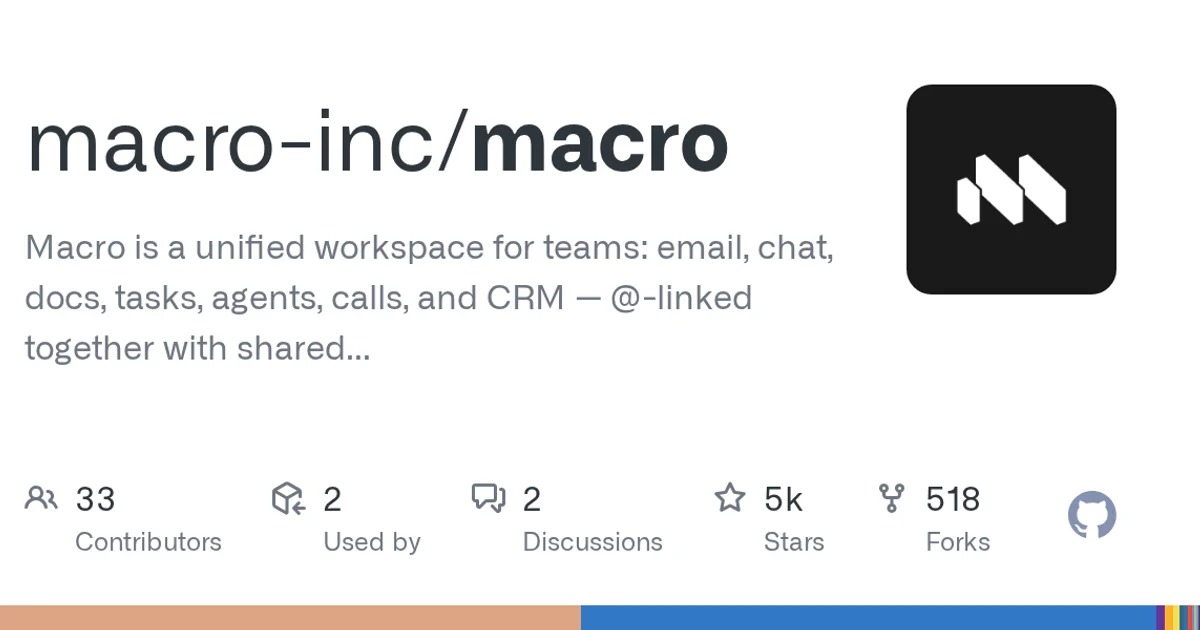
TL;DR: Macro is a unified team workspace spanning email, chat, docs, tasks, agents, calls, and CRM, written mostly in Rust and released under AGPL-3.0. It has 5,452 stars and a 1.9 gigabyte repository.
What it is
The description is the whole pitch: a unified workspace for teams where email, chat, docs, tasks, agents, calls, and CRM are linked together through shared AI memory.
The part that makes it more than a feature list is the linking. It is not seven apps that can import from each other. It is one model of workspace data that all seven surfaces read from, with an AI memory layer sitting underneath so that context follows you from a support call into a doc into a task.
The repository is a monorepo that mixes languages on purpose. Rust for the core, TypeScript for the frontend, Nix for reproducible environments, and Docker for deployment.
The tree shows a serious piece of infrastructure
apps/
crates/
packages/
services/
infra/
tooling/
vendor/
nix/
docker/
docs/
rules/
.agents/  .claude/  .cursor/  .pi/
.mcp.json
Cargo.toml
Cargo.lock
justfile
flake.nix
rust-toolchain.toml
Cross.toml
biome.base.jsonc
bun.lock
bunfig.toml
codebook.toml
sgconfig.yml
.taplo.toml
.sqlx/
deny.toml
clippy.toml
VERSION
Several of those files are worth more than a paragraph of description.
.sqlx/ means the SQL queries are verified at compile time rather than at runtime, so a schema change breaks the build instead of breaking production. deny.toml is a cargo-deny policy file, which is how the project checks dependency licenses and advisories automatically. sgconfig.yml configures ast-grep rules, so structural patterns across the codebase are checked by a tool that understands code as syntax rather than text.
rust-toolchain.toml pins the compiler version, Cross.toml configures cross-compilation, flake.nix and nix-support/ make the build reproducible, and justfile gives the team a task runner.
.mcp.json at the root exposes the project over the Model Context Protocol, and the .claude, .cursor, .pi, and .agents directories mean agent clients are configured inside the repo, not just outside it.
The repository is 1.9 gigabytes. The vendor/ directory is the reason, which is a deliberate choice to vendor dependencies rather than fetch them.
| Metric | Value |
|---|---|
| Stars | 5,452 |
| Forks | 520 |
| Open issues | 339 |
| Primary language | Rust |
| Repository size | 1.9 GB |
| License | AGPL-3.0 |
| Created | 2025-11-08 |
| Last push | 2026-10-29 |
AGPL-3.0 is a deliberate choice, not an accident
For a CRM and team workspace that competes with hosted products, AGPL-3.0 is a statement. If you run a modified version of Macro as a service, the license requires you to publish your modifications. Most companies in this category pick a permissive license instead.
The practical effect: if you want to self-host Macro and change it, you are expected to open source your changes. If you want a closed service built on it, read the license carefully first, because that is exactly the case it was written to cover.
How to try it
git clone https://github.com/macro-inc/macro.git
cd macro
The project site is macro.com, which is the faster route to a working system for most people. For the source path, the justfile is the task runner entry point and flake.nix describes the Nix environment, so those two files are where to start reading.
When to use it
The fit is a team that has outgrown scattered tools and wants one workspace where the same context serves chat, docs, tasks, and the customer record. The shared AI memory is the differentiator: context that does not reset when you switch surfaces.
The engineering setup is worth studying on its own, independent of whether you run it. Compile-time checked SQL, a dependency license policy, pinned toolchains, and reproducible builds are all things teams retrofit painfully later.
When not to use it
The license rules out the closed hosted product path, as above. That is a feature for the people who want it and a blocker for a lot of companies.
Second, watch the velocity mismatch. The repository has 5,452 stars but took only 117 of them today, while the issue tracker holds 339 open entries. A large star count with low daily movement usually means a loud initial spike followed by a smaller steady audience. Judge the project on the second number, not the first.
Source and Accuracy Notes
- Project page: https://macro.com
- Source repository: macro-inc/macro (verified via GitHub API
html_url) - License: AGPL-3.0 (verified via GitHub API
license.spdx_id) - Stars at time of writing: 5452
Related Posts
ai-setup
Recall – Persistent Memory for Claude Code via MCP Hooks
Recall gives Claude Code a permanent memory store that survives session restarts and context compaction. Four hooks capture and restore context automatically — with cloud SaaS or self-hosted options.
2/28/2026
dev-tools
Automotive Skills Suite for AI Engineering
Evaluate Automotive Skills Suite for APQP, ASPICE, HARA, safety-plan, and DIA workflows with setup notes, governance risks, and SME review guidance.
5/28/2026
dev-tools
awesome-agentic-ai-zh Roadmap Guide
Explore awesome-agentic-ai-zh as a Chinese agentic AI learning roadmap, with setup notes, track selection, study workflow, and evaluation guidance.
5/28/2026