Claude Code Game Studios: 49 Agents Mirroring a Real Studio
Claude Code Game Studios is an MIT-licensed template of 49 AI agents, 74 workflow skills, and a studio hierarchy for making games with Claude Code.
TL;DR: Claude Code Game Studios is a project template that fills a
.claudedirectory with 49 role-based agents and 74 workflow skills, organised like a real game studio with producers, directors, engineers, and QA. It is MIT licensed and sits at 29,283 stars after taking 353 new ones today.
What it is
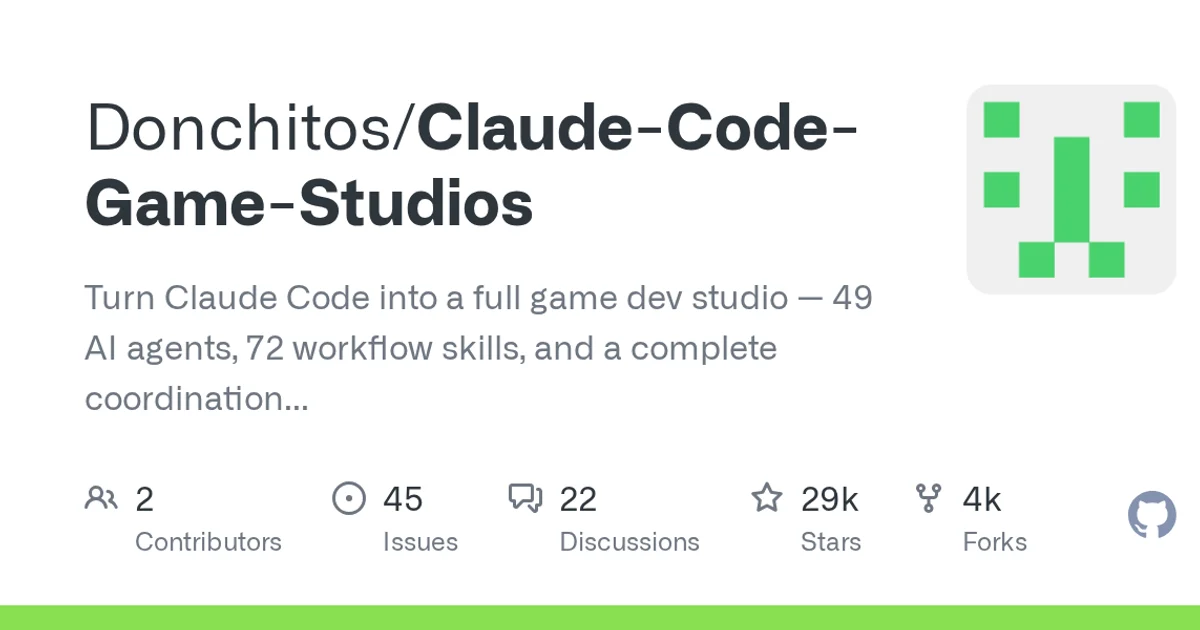
The repository description reads: “Turn Claude Code into a full game dev studio — 49 AI agents, 72 workflow skills, and a complete coordination system mirroring real studio hierarchy.”
Two of those numbers are verifiable from the tree. The .claude/agents directory holds exactly 49 markdown files. The .claude/skills directory holds 74 directories, more than the 72 the description claims, so the description is counting something slightly narrower than the full set. Either way, the numbers are the same order of magnitude, and both are visible in the repository without opening a file.
The name of the repo is the mechanism. This is not a library you install. It is a template you copy into a project so that Claude Code starts with a studio org chart already in place.
$ curl -s https://api.github.com/repos/Donchitos/Claude-Code-Game-Studios \
  | jq '{stars: .stargazers_count, forks: .forks_count, issues: .open_issues_count,
         language, license: .license.spdx_id, topics, created_at, pushed_at}'
{
  "stars": 29283,
  "forks": 4051,
  "issues": 69,
  "language": "Shell",
  "topics": ["ai-agents", "ai-assisted-development", "anthropic", "claude", "claude-code"],
  "created_at": "2026-02-12T05:21:38Z",
  "pushed_at": "2026-10-19T02:43:42Z"
}
The fork count is worth a look: 4,051 forks against 29,283 stars. People are copying this repository into their own projects, which is exactly what you would expect from a template.
The agent roster is a studio org chart
Reading the 49 filenames tells you the whole design. These are not “helper” agents with generic names. Each one owns a discipline, and the set covers both creative and technical roles:
| Layer | Agents |
|---|---|
| Direction | creative-director, art-director, sound-director, narrative-director, technical-director |
| Design | game-designer, systems-designer, level-designer, economy-designer, live-ops-designer |
| Production | producer, prototyper, ai-programmer, release-manager, community-manager |
| Engineering | lead-programmer, gameplay-programmer, engine-programmer, tools-programmer, ui-programmer, network-programmer |
| Quality | qa-lead, qa-tester, security-engineer, performance-analyst, accessibility-specialist |
Underneath sit engine specialists that tell you exactly which targets the template aims at: godot-specialist, godot-csharp-specialist, godot-gdextension-specialist, godot-gdscript-specialist, godot-shader-specialist, ue-specialist, ue-blueprint-specialist, ue-gas-specialist, ue-replication-specialist, ue-umg-specialist, unity-specialist, unity-addressables-specialist, unity-dots-specialist, unity-shader-specialist, and unity-ui-specialist.
Three engines, five specialisms each. That is a template with a declared scope rather than an open-ended promise.
The skills are the workflow, and they are named after the work
The .claude/skills directory is where the coordination system actually lives. The names read like a production pipeline:
# A slice of the skill list, roughly in workflow order
start, onboard, setup-engine, detect-project-stage
brainstorm, map-systems, create-architecture, architecture-decision
create-epics, create-stories, estimate, sprint-plan, sprint-status
dev-story, story-readiness, story-done, code-review, architecture-review
qa-plan, playtest-report, gate-check, smoke-check, regression-suite
release-checklist, launch-checklist, hotfix, day-one-patch
There are 74 of these directories. Beyond the pipeline ones, the set includes balance-check for economy tuning, art-bible and design-system for visual consistency, asset-audit and asset-spec for asset pipelines, perf-profile for performance work, security-audit, regression-suite, soak-test, test-flakiness, test-evidence-review, and tech-debt.
project-stage-detect is the one I would read first. A skill that identifies where a project currently sits implies the others are not all meant to run every time.
Configuration is a single file with strict rules
project.yaml at the root is small, about 1 KB, but it is the most opinionated file in the repository. It calls itself “the single source of truth for project settings” and then spends most of its bytes on what must not go in it.
# CCGS project configuration — single source of truth for project settings.
schema_version: 1

framework:
  version: 1.2.0
  last_upgraded: 2026-10-19
The comments state that a modes: block containing modes.rigor and modes.automation is the expected state of a configured project, but that six specific knobs must never appear there: modes.review_mode, modes.workflow, docs.density, qa.level, modes.story_granularity, and team.size. Seeding any of them pins the value and shadows the rigour expansion that /start infers and saves.
Per-developer preferences go in project.local.yaml, which is gitignored. /settings --local key=value writes there; /settings key=value edits the shared file. There is a documented precedence order in .claude/docs/config-resolution.md.
This is the part of the template that tells you how the author thinks. The system wants to infer a project’s settings from where the project actually is, and it goes out of its way to stop a developer from silently freezing that inference by writing a value down.
The rest of the .claude directory follows the same shape: rules, hooks, scripts, docs, a settings.json, and a statusline.sh.
How to try it
This is a template, so the flow is copy and configure.
git clone https://github.com/Donchitos/Claude-Code-Game-Studios.git
cd Claude-Code-Game-Studios
# copy .claude/ into your own project, then let /start configure it
The docs/ directory holds the orientation material: WORKFLOW-GUIDE.md, COLLABORATIVE-DESIGN-PRINCIPLE.md, skill-flow-diagrams.md, an architecture folder, an engine-reference folder, a registry folder, and a migration guide for v1.1. The UPGRADING.md file at 85 KB and a CHANGELOG.md at 90 KB tell you the template has been through a substantial number of revisions.
When to use it
The fit is a game project where you want the process encoded rather than improvised. If you have ever worked on a team where “who owns the art direction question” was a recurring source of friction, the answer here is a file called art-director.md.
It also suits an engine you already know. The Godot, Unreal, and Unity specialists are specific rather than generic, so if you are on one of those three, the template has actual opinions to give you.
When not to use it
This is a large opinionated template, and it brings that opinion with it. If you want Claude Code to do a single focused task, an org chart of 49 agents is overhead you did not ask for.
The modes.rigor and modes.automation settings also imply a spectrum, which means the template expects to be tuned to the project’s size. The /start command is what does that inference. Skipping it and hand-editing project.yaml works, but the file’s own comments say you will shadow the intended behaviour.
Last thing to check before you start: production/ in the repository holds a .gdignore file and a session-state directory. If your game engine treats those as meaningful, read them before copying.
Source and Accuracy Notes
- Source repository: Donchitos/Claude-Code-Game-Studios (verified via GitHub API
html_url) - License: MIT (verified via GitHub API
license.spdx_id) - Stars at time of writing: 29283
- Agent count: 49 files in
.claude/agents(verified via GitHub API contents listing) - Skill count: 74 directories in
.claude/skills(verified via GitHub API contents listing), against the 72 stated in the repository description
Related Posts
ai-setup
Recall – Persistent Memory for Claude Code via MCP Hooks
Recall gives Claude Code a permanent memory store that survives session restarts and context compaction. Four hooks capture and restore context automatically — with cloud SaaS or self-hosted options.
2/28/2026
dev-tools
Automotive Skills Suite for AI Engineering
Evaluate Automotive Skills Suite for APQP, ASPICE, HARA, safety-plan, and DIA workflows with setup notes, governance risks, and SME review guidance.
5/28/2026
dev-tools
awesome-agentic-ai-zh Roadmap Guide
Explore awesome-agentic-ai-zh as a Chinese agentic AI learning roadmap, with setup notes, track selection, study workflow, and evaluation guidance.
5/28/2026