AI Job Search: A Claude Code Job Application Framework
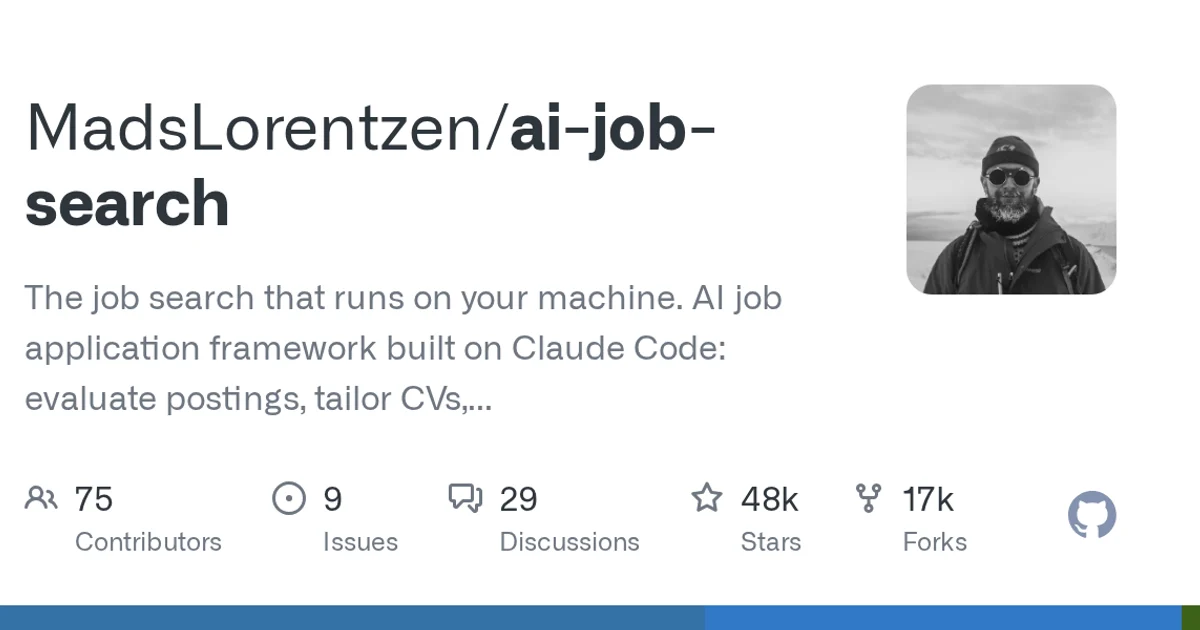
ai-job-search runs job applications on your own machine, using Claude Code to evaluate postings, tailor CVs, write cover letters, and prep interviews.
TL;DR
TL;DR:
ai-job-searchis a Python framework that runs your job search on your own machine instead of handing your CV to a third-party site. It is built on Claude Code and covers four steps: evaluating a posting, tailoring your CV, writing the cover letter, and prepping for the interview. MIT licensed, 48,567 stars.
What it is
The framing in the repository description is the whole pitch: the job search that runs on your machine. It is an AI job application framework built on Claude Code, and the last line of the description is an instruction rather than a suggestion. Fork it and own it.
That design choice does most of the work. The tools that sit between you and a job application are usually the ones holding your CV, your salary expectations, and your interview notes. A self-hosted framework keeps that material on hardware you control.
The repository is Python, MIT licensed, and sits under a single user account with master as its default branch. It was created on 18 March 2026 and last pushed on 15 October 2026. At the time of writing it has 48,567 stars, 16,644 forks, and 45 open issues. That fork count is worth noting on its own: roughly a third as many forks as stars is the signature of a repository people intend to run their own copy of, which is exactly what the description asks them to do.
Its GitHub topics are ai, ai-agents, career, claude-code, and cover-letter, so the repository’s own metadata puts it in the agent tooling space rather than the job board space.
What it covers
The description names four distinct jobs, and they map onto a real application loop:
| Stage | What the framework does |
|---|---|
| Evaluate | Read a posting and judge whether it is worth your time |
| Tailor | Adjust your CV to fit that specific role |
| Cover letter | Draft the written half of the application |
| Prep interviews | Get ready for the conversation that follows |
Each step feeds the next. Evaluating a posting is only useful if the tailoring step knows what it decided, and the interview prep is far better when it started from the same reading of the job description that produced the CV.
How to try it
The repository’s own setup steps are not described in its GitHub metadata, so treat this as the standard fork workflow rather than documented project setup:
gh repo fork MadsLorentzen/ai-job-search --clone
cd ai-job-search
Because the intended deployment is your own copy, tracking the original alongside yours is the useful part:
git remote add upstream https://github.com/MadsLorentzen/ai-job-search.git
git fetch upstream
git merge upstream/master
You need a working Claude Code setup for the framework to do anything, since that is the engine it is built on.
When to use it
Reach for this if you are applying to a lot of roles that share a shape but differ in wording. A framework that evaluates the posting first will tell you which applications deserve a tailored CV rather than making you tailor all of them.
The interview step is the one most people would not build for themselves. Having a framework hold the same context that produced your CV and cover letter, so you can rehearse against the actual job, is the part that saves the most time.
When NOT to use it
You need a Claude Code account and a local setup for any of this to work. If you are not willing to run it on your own machine, the value of the project drops sharply, since running it locally is the reason it exists.
It is also a fork-and-own framework, not a managed service. Nobody is shipping you updates, so you own the maintenance, including keeping it merged with upstream as the original changes.
Source and Accuracy Notes
- Project page: https://github.com/MadsLorentzen/ai-job-search
- Source repository:
MadsLorentzen/ai-job-search(verified via GitHub APIhtml_url) - License: MIT (verified via GitHub API
license.spdx_id) - Stars at time of writing: 48,567
- Capability descriptions come from the repository’s GitHub API description field. Setup commands above are the generic GitHub fork workflow, not documented instructions from this repository.
Related Posts
ai-setup
Recall – Persistent Memory for Claude Code via MCP Hooks
Recall gives Claude Code a permanent memory store that survives session restarts and context compaction. Four hooks capture and restore context automatically — with cloud SaaS or self-hosted options.
2/28/2026
dev-tools
Automotive Skills Suite for AI Engineering
Evaluate Automotive Skills Suite for APQP, ASPICE, HARA, safety-plan, and DIA workflows with setup notes, governance risks, and SME review guidance.
5/28/2026
dev-tools
awesome-agentic-ai-zh Roadmap Guide
Explore awesome-agentic-ai-zh as a Chinese agentic AI learning roadmap, with setup notes, track selection, study workflow, and evaluation guidance.
5/28/2026