ZenStack V3 — Modular TypeScript ORM Built on Kysely
ZenStack V3 rewrites its ORM engine on Kysely while keeping Prisma-compatible APIs. Pure TypeScript, fine-grained access control, and automatic API generation.
TL;DR
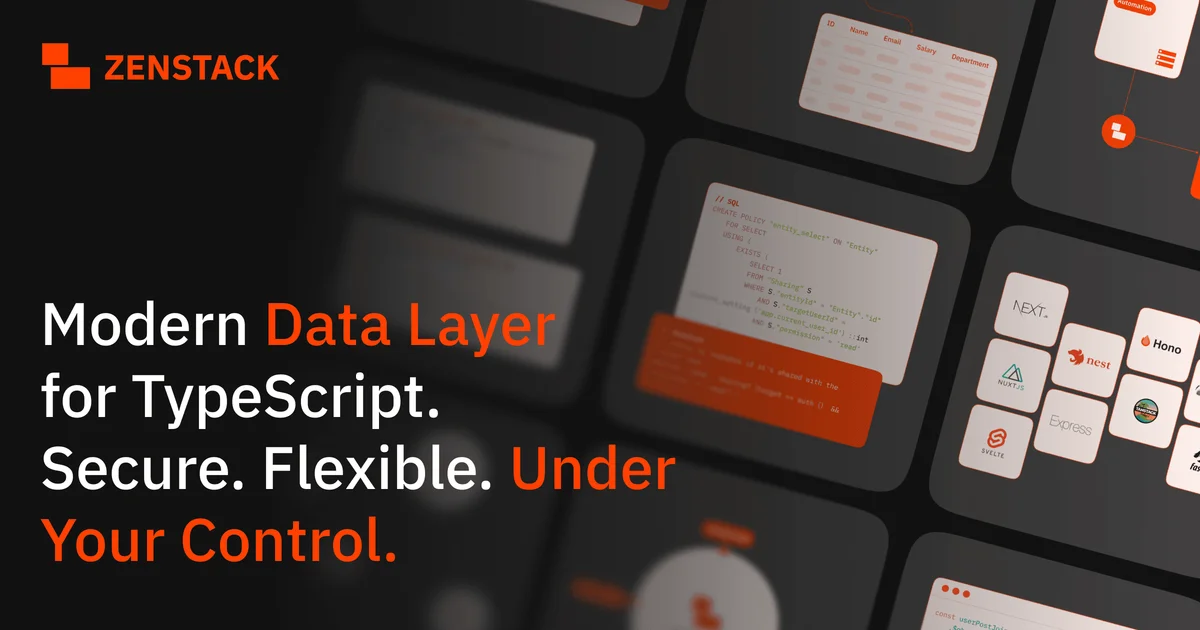
TL;DR: ZenStack V3 is a TypeScript database toolkit that rewrites its ORM on Kysely while keeping Prisma-compatible query APIs — giving you type-safe ORM, row-level security, and auto-generated CRUD APIs in one package.
Source and Accuracy Notes
- Project page: zenstack.dev
- Source repository: github.com/zenstackhq/zenstack
- License: MIT
- Latest version: v3.8.3 (verified via
git ls-remote --tags) - Stars: 2,924 (verified via GitHub REST API)
- HN launch thread: news.ycombinator.com/item?id=40205699 (V2 launch)
What Is ZenStack?
ZenStack is a TypeScript database toolkit for building full-stack or backend Node.js and Bun applications. Its core is a schema-first ORM that uses a domain-specific language called ZModel to define data models and access rules.
ZenStack’s own description:
ZenStack is a TypeScript database toolkit for developing full-stack or backend Node.js/Bun applications. It provides a unified data modeling and query solution.
The project launched on HN as ZenStack V1 in 2023, pivoted to a Prisma-based V2 in 2024, and now ships V3 as a ground-up rewrite on top of the Kysely query builder — while keeping a Prisma-compatible query API for drop-in migration.
Key architecture decisions in V3
V3 replaced the Prisma ORM foundation with a custom engine built on Kysely. The team documented the rationale on their blog, citing constraints they hit with Prisma at scale.
Even without using ZenStack’s advanced features, V3 serves as a drop-in replacement for Prisma with these benefits:
- Pure TypeScript — no Rust or WASM components
- Better type inference — less code generation, more compile-time safety
- Fully-typed query builder — an escape hatch that Prisma’s raw SQL support doesn’t match
Setup Workflow
Step 1: Create a new project
npm create zenstack@latest my-project
```bash

### Step 2: Initialize an existing project

```bash
npx @zenstackhq/cli@latest init
```bash

### Step 3: Manual installation

```bash
npm install -D @zenstackhq/cli
npm install @zenstackhq/schema @zenstackhq/orm
```bash

Then create a `zenstack` folder with a `schema.zmodel` file.

### Step 4: Define your schema

ZenStack uses ZModel, a DSL that extends Prisma's schema syntax with access-control decorators:

```zmodel
// schema.zmodel
model User {
    id    String @id @default(uuid())
    email String @unique
    posts Post[]

    @@allow('all', auth() == this)
}

model Post {
    id        String  @id @default(uuid())
    title     String
    published Boolean @default(false)
    author    User    @relation(fields: [authorId], references: [id])
    authorId  String

    @@allow('read', published || auth() == author)
}
```bash

### Step 5: Generate and use

```bash
npx zenstack generate
ZenStack outputs a fully-typed ORM, auto-generated REST/GraphQL APIs, and TanStack Query hooks for the frontend.
Feature Overview
- Schema-first ORM — Prisma-compatible
schema.zmodelsyntax - Dual API surface — high-level ORM queries and low-level Kysely query builder
- Built-in access control — declarative
@@allowrules per model - Polymorphic modeling — supports inheritance patterns Prisma doesn’t
- Auto-generated APIs — CRUD web APIs for Express, Fastify, Next.js, and more
- TanStack Query hooks — frontend data fetching generated from schema
- Zod schema generation — input/output validation out of the box
Comparison with Prisma
| Feature | Prisma | ZenStack V3 |
|---|---|---|
| Query API | Prisma Client | Prisma-compatible + Kysely escape hatch |
| Language | Rust engine + TypeScript | Pure TypeScript |
| Access control | None built-in | Declarative @@allow rules |
| Polymorphism | Limited | Full support |
| API generation | None | Auto REST/GraphQL |
| Frontend hooks | None | TanStack Query |
| Type inference | Generated | Better inference, less codegen |
ZenStack V3 is not a fork of Prisma — it shares no code with Prisma. It started as a Prisma wrapper but V3 is a clean rewrite.
Deeper Analysis
When to choose ZenStack V3 over Prisma
ZenStack makes sense when you need fine-grained row-level security without wiring up a separate auth layer. The @@allow rules in ZModel compile to predicates injected into every database query — a security boundary that’s hard to get right manually.
It’s also attractive for full-stack TypeScript teams that want auto-generated API stubs and TanStack Query hooks from a single schema definition, reducing the boilerplate between database and frontend.
When to stick with Prisma
Prisma has a larger community, more tutorials, broader hosting support, and a stable Rust engine that has been hardened by years of production use. If you don’t need ZenStack’s extra features, Prisma’s simplicity wins.
Developer experience
ZenStack uses its own CLI (@zenstackhq/cli) rather than prisma. The npm create zenstack@latest scaffold works well. The Kysely-backed query builder is fully typed — no any escapes — and you can drop to raw SQL when you need it.
FAQ
Q: Does ZenStack work with existing Prisma schemas? A: Yes. ZenStack’s ZModel is compatible with Prisma’s schema syntax, so many existing schemas work with minimal modification. The team provides a migration guide.
Q: What databases does ZenStack support? A: PostgreSQL, MySQL, SQLite, and PlanetScale via Kysely’s adapter layer.
Q: Is ZenStack V3 production-ready? A: The project is at v3.8.3 and lists production users like MermaidChart. As with any relatively young ORM, audit the release notes and test thoroughly before migrating a critical system.
Q: How does pricing work? A: ZenStack is open source under the MIT license. The core ORM and CLI are free. Commercial support options are available via the project’s sponsor links.
Conclusion
ZenStack V3 is a serious attempt to solve the gap between Prisma’s ease-of-use and the fine-grained security and flexibility that production SaaS backends demand. With a pure TypeScript stack, Kysely-backed query power, and Prisma-compatible syntax, it lowers the migration cost for teams already invested in Prisma but hitting its ceiling.
If you need row-level security, polymorphic models, or auto-generated API hooks from a single schema, ZenStack V3 is worth evaluating. Start with the npm create zenstack@latest scaffold or try it directly in StackBlitz.
Related Posts
ai-setup
Recall – Persistent Memory for Claude Code via MCP Hooks
Recall gives Claude Code a permanent memory store that survives session restarts and context compaction. Four hooks capture and restore context automatically — with cloud SaaS or self-hosted options.
2/28/2026
dev-tools
Automotive Skills Suite for AI Engineering
Evaluate Automotive Skills Suite for APQP, ASPICE, HARA, safety-plan, and DIA workflows with setup notes, governance risks, and SME review guidance.
5/28/2026
dev-tools
awesome-agentic-ai-zh Roadmap Guide
Explore awesome-agentic-ai-zh as a Chinese agentic AI learning roadmap, with setup notes, track selection, study workflow, and evaluation guidance.
5/28/2026