TL;DR
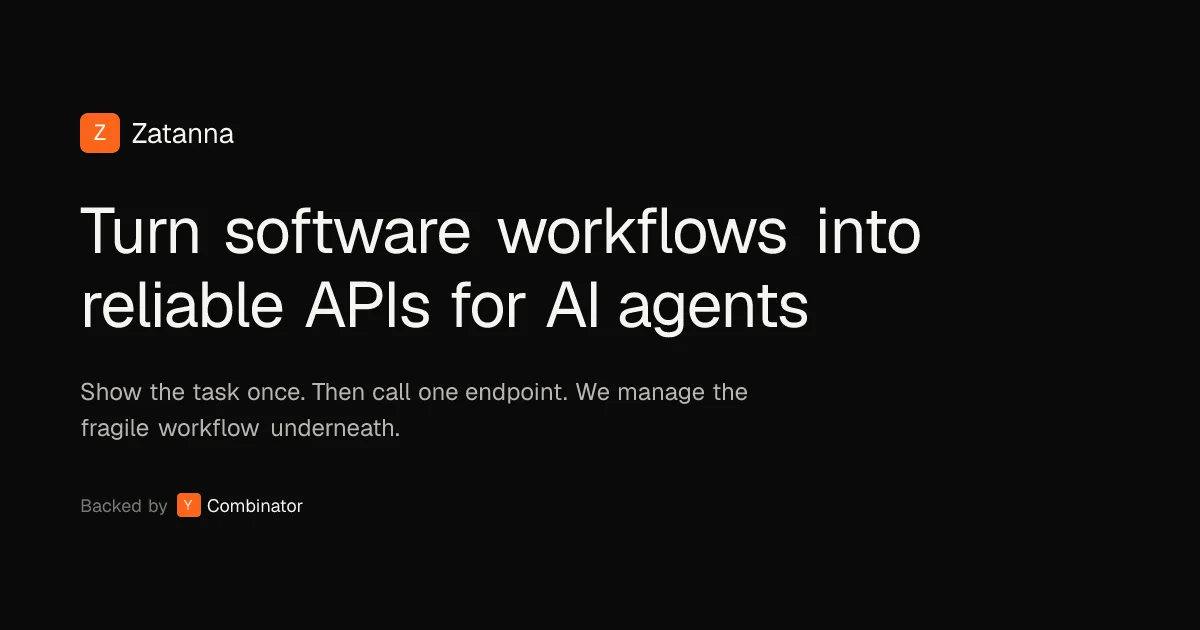
TL;DR: Kampala by Zatanna watches real network traffic as you use a web portal, then reconstructs that workflow as a clean, parameterized API your AI agents can call directly — no browser automation needed.
Source and Accuracy Notes
- Project page: zatanna.ai — verified June 29, 2026
- HN launch thread: news.ycombinator.com/item?id=47794514 — 100 points, June 2026
- License: proprietary SaaS (no open-source repo) — verified via site
- No public GitHub repository — Zatanna is a hosted service
What Is Kampala?
Kampala is a product from Zatanna — a YC W26 startup that takes a different approach to browser automation. Instead of spinning up a headless browser to click through UIs, Kampala intercepts the actual network traffic (login flows, API calls, session tokens) while a human completes a workflow once, then exposes that workflow as a clean, parameterized REST endpoint.
The pitch: if a human can reach it through a browser login, your agents can reach it through one API call. This applies to ERP portals, freight carrier sites, insurance platforms, internal tools with no public API, and any other gated web interface that blocks programmatic access.
The key differentiator is the maintenance layer. Session tokens expire, portals update, auth flows change. Kampala monitors when tools break and repairs the underlying request flow automatically, so the API stays alive even when the upstream portal changes.
How It Works
Step 1: Record the Workflow
A human logs into the target portal and completes the desired task — for example, looking up a shipment status by tracking number. Kampala observes all network requests in the background: login sequences, session tokens, parameterized calls, and the sequencing between them.
Step 2: Reconstruct the Optimal Request Flow
Zatanna models the real calls, auth behavior, retry logic, and edge cases from the captured traffic. It produces a clean, stable API definition with the parameters surfaced as explicit inputs.
Step 3: Call One Stable Endpoint
Your agent sends a single REST call with the required parameters. Kampala handles auth, retries, anti-bot detection, and session management beneath the surface.
Self-Maintenance
When a portal updates its login flow or changes an API endpoint, Kampala detects the failure and repairs the underlying request model automatically. This is the part that differentiates it from brittle browser-automation approaches.
Comparison to Browser Automation
Browser automation tools render full pages and simulate clicks through the UI. This breaks whenever anything changes, is slow (seconds per action), and requires managing headless Chrome at scale.
Kampala operates at the network layer. The request model is derived from the actual API calls the portal makes — not from DOM selectors or button positions. This makes it:
- Faster — direct API calls instead of rendering and clicking
- More stable — no DOM selectors to break on UI updates
- Easier to maintain — Kampala self-repairs when the portal changes
Use cases where this matters: ERP systems, freight carrier portals, insurance platforms, internal tools with no public API, permit applications, record lookups, document submissions, and structured data entry at scale.
Pricing
Kampala is a hosted service. Specific pricing tiers are not publicly listed — interested users must contact Zatanna directly for a demo and quote.
Practical Evaluation Checklist
- Captures login flows, API calls, session tokens, and sequencing from real browser usage
- Exposes workflows as parameterized REST endpoints
- Self-maintaining: detects breakage and repairs the underlying request model
- No browser automation dependency — direct API calls to the portal
- Works with any portal that has a login (ERP, freight, insurance, internal tools)
- Agent-focused: designed for AI agents that need to act in third-party software, not just read it
FAQ
Q: Does Kampala work with portals that have CAPTCHAs or bot detection? A: Zatanna handles anti-bot detection as part of its managed infrastructure. The specific detection mechanisms are not publicly documented.
Q: Is there an open-source version? A: No. Zatanna and Kampala are proprietary SaaS. There is no public GitHub repository.
Q: How does it compare to tools like Skyvern or Browser Use? A: Skyvern and Browser Use both use browser automation (headless Chrome clicking through UIs). Kampala takes the opposite approach — it avoids the browser entirely by capturing and replaying the underlying API calls. This is faster and more stable but requires that the target portal makes the actual network requests you need.
Q: What happens when a portal updates? A: Kampala monitors endpoint health and auto-repairs the request model when breakage is detected, without requiring human re-recording.
Conclusion
Kampala solves the AI agent “last mile” problem: portals and internal tools that have no public API but are reachable by a human through a browser. By capturing real network traffic and exposing it as stable endpoints, it lets agents act programmatically without the fragility of DOM-based browser automation. Worth evaluating if your agents need to work in ERP systems, logistics portals, or any gated web interface that blocks direct API access.
Related Posts
ai-setup
Recall – Persistent Memory for Claude Code via MCP Hooks
Recall gives Claude Code a permanent memory store that survives session restarts and context compaction. Four hooks capture and restore context automatically — with cloud SaaS or self-hosted options.
2/28/2026
ai-setup
Sentrial – Catch AI Agent Failures Before Your Users Do
YC W26-backed AI agent observability platform. Trace sessions, detect silent regressions, and A/B test prompts in production before failures reach users.
5/28/2026
ai-setup
IonRouter – Fast Low-Cost AI Inference API
IonRouter is a YC W26 inference API routing open-source and fine-tuned models via an OpenAI-compatible endpoint, built on a C++ runtime optimized for GH200.
5/28/2026