VoiceStudio: A Fully Local ElevenLabs Alternative
VoiceStudio is an open-source, fully local ElevenLabs alternative covering voice cloning, voice design, dubbing and transcription.
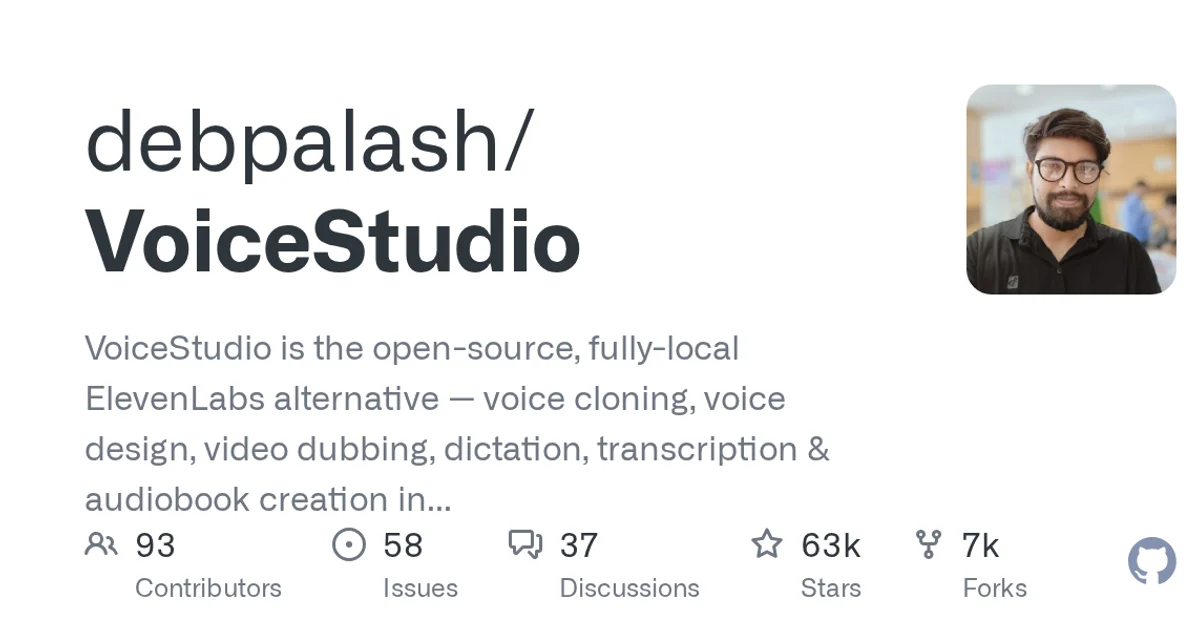
TL;DR: VoiceStudio is a Python project that runs voice cloning, voice design, video dubbing, dictation, transcription and audiobook generation entirely on your own machine, covering 646 languages. It is licensed AGPL-3.0, has passed 63,000 stars, and its topics call out both CUDA and Hugging Face.
What it is
The pitch is simple and unusually specific: a fully local ElevenLabs alternative. Nothing about it requires a hosted account or a per-character billing meter, which is the part that matters if you are generating hours of audio rather than a few test clips.
Feature coverage as the repository describes it spans a wide surface:
- Voice cloning from existing audio
- Voice design, building a synthetic voice rather than copying one
- Video dubbing
- Dictation and transcription
- Audiobook creation
- 646 languages
That list is broad enough that the 154 open issues against 63,000 stars reads as a healthy ratio rather than a warning sign.
How to try it
The demo and downloads live at voicestudio.sh. Before you go further, the dependency picture is worth checking, because the topics hint that this is not a lightweight install:
$ curl -s https://api.github.com/repos/debpalash/VoiceStudio \
  | jq '{stars: .stargazers_count, language, license: .license.spdx_id, topics}'
{
  "stars": 63476,
  "language": "Python",
  "license": "AGPL-3.0",
  "topics": ["ai","audiobook","cuda","dubbing","elevenlabs-alternative","huggingface"]
}
cuda and huggingface in that topic list tell you two things before you install anything. You are looking at local model inference rather than API calls, and GPU acceleration is an expected part of the setup rather than an optional extra. Plan your hardware accordingly.
The repository itself is straightforward to clone:
git clone https://github.com/debpalash/VoiceStudio.git
cd VoiceStudio
What it does well
Running locally is the whole argument, and it is a genuinely good one for the use cases this project targets. A voice cloning tool that runs offline means your reference audio never leaves the machine. For audiobook work spanning hundreds of hours, the per-character economics of a hosted service stop making sense quickly, and a local pipeline flattens that cost.
The language count is the other headline. 646 languages is far beyond what most commercial voice services cover well, and for localisation work that gap matters more than any quality delta between two good English voices.
Python as the primary language also means the model side is conventional. If you have Hugging Face models on disk already, this fits into an existing stack rather than demanding a new one.
When to use it
It makes sense when the audio is sensitive enough that sending it to a third party is not acceptable, when you are generating at volume and per-character billing would hurt, or when you need languages the commercial services handle poorly.
For narration, audiobook and dubbing pipelines that run repeatedly, the local deployment tends to win on both privacy and cost.
When NOT to use it
AGPL-3.0 is the constraint to think about first. If you plan to wrap VoiceStudio in a service or ship it inside a product, the copyleft terms are a real obligation, not a formality. Read the license before building around it.
Second, this is GPU-leaning Python software, not a native app you double-click. The cuda topic means you should expect to provision an accelerator and a Python environment before anything works. If you are not comfortable with that, the hosted path at voicestudio.sh is the lower-friction route.
Third, local does not mean automatically high quality. Voice quality on any cloning system depends heavily on the reference audio you feed it, and the repository does not make that guarantee for you.
Source and Accuracy Notes
- Project page: https://voicestudio.sh
- Source repository: debpalash/VoiceStudio (verified via GitHub API
html_url) - License: AGPL-3.0 (verified via GitHub API
license.spdx_id) - Stars at time of writing: 63476
Related Posts
ai-setup
Recall – Persistent Memory for Claude Code via MCP Hooks
Recall gives Claude Code a permanent memory store that survives session restarts and context compaction. Four hooks capture and restore context automatically — with cloud SaaS or self-hosted options.
2/28/2026
dev-tools
Automotive Skills Suite for AI Engineering
Evaluate Automotive Skills Suite for APQP, ASPICE, HARA, safety-plan, and DIA workflows with setup notes, governance risks, and SME review guidance.
5/28/2026
dev-tools
awesome-agentic-ai-zh Roadmap Guide
Explore awesome-agentic-ai-zh as a Chinese agentic AI learning roadmap, with setup notes, track selection, study workflow, and evaluation guidance.
5/28/2026