VoiceStudio: Open-Source Local ElevenLabs Alternative
VoiceStudio is a fully-local, open-source alternative to ElevenLabs: voice cloning, voice design, video dubbing, dictation, transcription, and audiobook creation across 646 languages. AGPL-3.0.
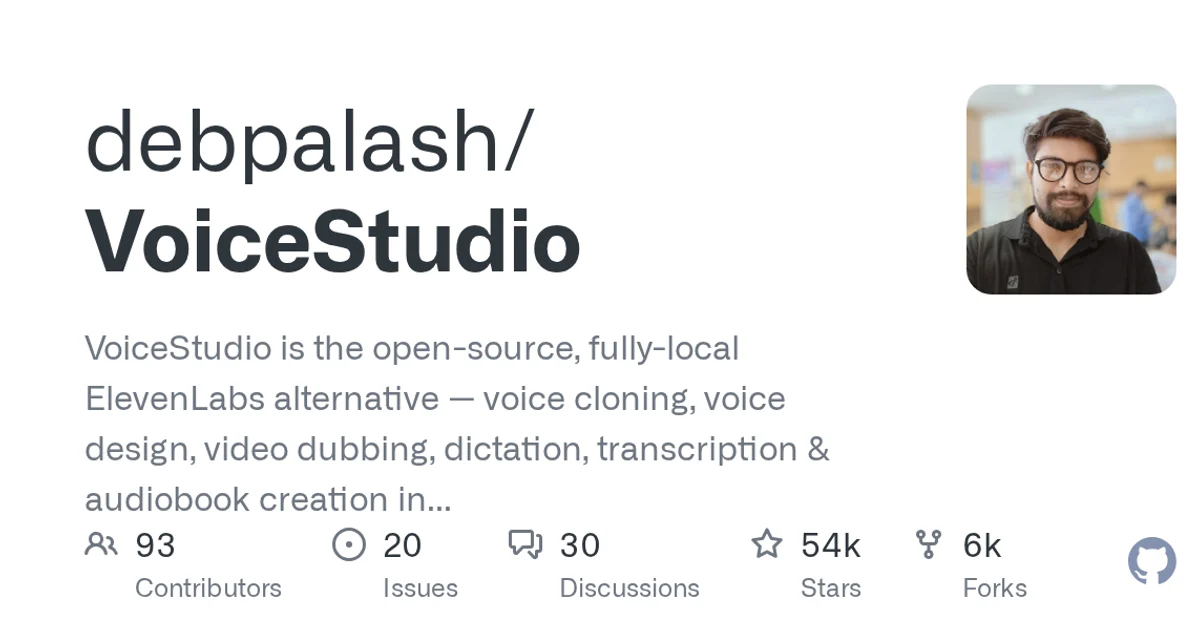
TL;DR: VoiceStudio is an open-source, fully-local voice-AI suite that aims to cover the same ground as ElevenLabs: voice cloning, voice design, video dubbing, dictation, transcription, and audiobook generation, across hundreds of languages. Everything runs on your own hardware, with no per-character cloud fees.
Source and Accuracy Notes
- Repository: debpalash/VoiceStudio
- License: AGPL-3.0
- Stars: 29,288 (as of September 2026)
- Language: Python
- Topics: ai, audiobook, cuda, dubbing, elevenlabs-alternative
- Homepage: voicestudio.sh
What It Is
VoiceStudio is a comprehensive voice-AI application written in Python. It bundles a wide range of voice capabilities behind a single UI and CLI:
- Voice cloning. Replicate a voice from a few seconds of reference audio.
- Voice design. Generate novel voices by adjusting attributes like age, tone, and gender.
- Video dubbing. Replace or layer new audio tracks onto video files.
- Dictation. Live transcription and voice-to-text workflows.
- Transcription. Audio-to-text for archival, accessibility, and content workflows.
- Audiobook generation. Long-form narrated audio from text input.
The marketing claim is “646 languages,” which reflects the underlying open models’ multilingual coverage rather than a single tuned model per language. The whole stack is local-first: models run on your hardware, your audio stays on your disk, and there are no per-character or per-hour cloud fees.
Why It Matters
ElevenLabs set the bar for consumer and prosumer voice AI: high-quality cloning, natural prosody, generous tooling. The trade-offs are real for many users: subscription pricing scales poorly with heavy usage, certain voice-cloning workflows have consent and provenance concerns, and audio traverses a third-party cloud.
VoiceStudio is interesting for users who want the same capability surface without those trade-offs:
- Local-first. Everything runs on the user’s hardware. Audio never leaves the machine unless the user explicitly exports it.
- No per-character fees. Once you’ve paid the hardware cost, generation is free. For audiobook-length or dubbing-length workflows this is a meaningful savings.
- Open ecosystem. The application composes open-weight models rather than depending on a single vendor’s API. Models can be swapped, fine-tuned, or replaced.
- Multilingual by default. Hundreds of languages are supported out of the box, making it attractive for content teams serving global audiences.
- Single application, multiple workflows. Having cloning, design, dubbing, dictation, transcription, and audiobook generation in one tool reduces integration overhead.
For podcasters, audiobook producers, video creators, accessibility services, and small studios, the value proposition is strong: comparable capabilities to a paid SaaS, with a one-time hardware investment and zero recurring API spend.
Practical Trade-Offs
A few honest caveats:
- AGPL-3.0. Strong copyleft. Internal use is fine; if you build a hosted product on top of VoiceStudio, the AGPL terms apply. For most individual creators this is irrelevant.
- GPU strongly recommended. Voice cloning, dubbing, and audiobook generation all benefit enormously from a CUDA-capable GPU. CPU-only inference works for short clips but is slow for long-form content.
- Quality varies by language. Like all multilingual voice stacks, English and a handful of major languages are strongest. Coverage for the long tail of 646 languages is real but may need quality acceptance work.
- Model orchestration overhead. Because the application composes multiple open models, the user has to manage model downloads, version compatibility, and storage. The application smooths this but does not eliminate it.
- Consent and provenance are your responsibility. Local tooling means there’s no upstream policy layer to enforce voice rights. The user must keep their own consent records and disclosure workflow.
These are the trade-offs of any local-first, multi-model stack — not flaws in the implementation. For the right user they’re worth it.
Who Should Care
VoiceStudio is a strong fit for:
- Podcasters and audiobook creators producing long-form content where per-character fees would be prohibitive.
- Independent video creators and localization teams that want dubbing without monthly subscriptions.
- Accessibility services building dictation or audio-output workflows that need to keep audio on-device for privacy.
- Educators and language learners producing practice material in many languages.
- Anyone uncomfortable sending voice samples or audio through a third-party cloud.
If you only need occasional short clips and don’t mind a subscription, ElevenLabs itself remains a great product. VoiceStudio is the right answer when usage volume, privacy, or cost predictability push you off SaaS.
Summary
VoiceStudio is a serious open-source attempt to recreate the full ElevenLabs capability surface — cloning, design, dubbing, dictation, transcription, audiobook generation — as a local-first, AGPL-licensed Python application. It’s not a perfect drop-in replacement for every workflow, but for users with the hardware and the privacy concerns, it’s a meaningful alternative.
Related Posts
ai-setup
Recall – Persistent Memory for Claude Code via MCP Hooks
Recall gives Claude Code a permanent memory store that survives session restarts and context compaction. Four hooks capture and restore context automatically — with cloud SaaS or self-hosted options.
2/28/2026
dev-tools
Automotive Skills Suite for AI Engineering
Evaluate Automotive Skills Suite for APQP, ASPICE, HARA, safety-plan, and DIA workflows with setup notes, governance risks, and SME review guidance.
5/28/2026
dev-tools
awesome-agentic-ai-zh Roadmap Guide
Explore awesome-agentic-ai-zh as a Chinese agentic AI learning roadmap, with setup notes, track selection, study workflow, and evaluation guidance.
5/28/2026