Hugging Face Transformers: State-of-the-Art ML Framework
The de-facto model-definition framework for text, vision, audio, and multimodal models. Apache 2.0, 165k+ stars, powers production inference and training across the industry.
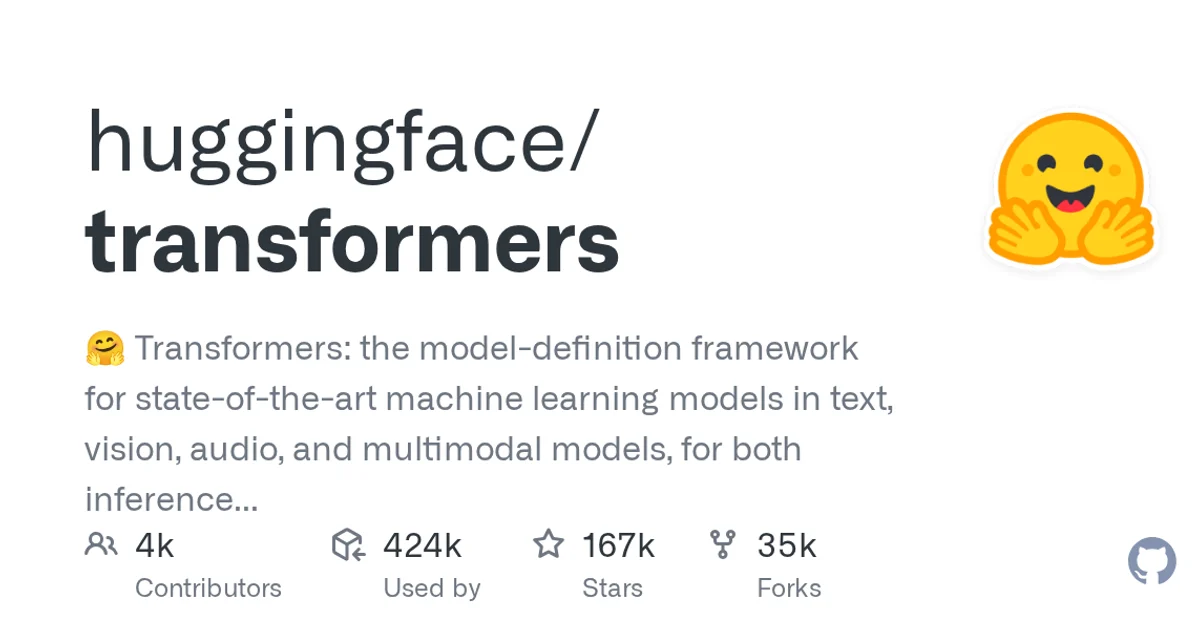
TL;DR: Hugging Face Transformers is the model-definition framework that became the lingua franca of modern machine learning. It unifies text, vision, audio, and multimodal modeling under a single Python API, supports both inference and training, and ships reference implementations for essentially every state-of-the-art open-weight model.
Source and Accuracy Notes
- Repository: huggingface/transformers
- License: Apache-2.0
- Stars: 165,985 (as of September 2026)
- Language: Python
- Topics: audio, deep-learning, deepseek, gemma, glm
- Homepage: huggingface.co/transformers
What It Is
Transformers is a Python library that provides model definitions, pre-trained weights, and training/inference tooling for transformer architectures. The library was first released in 2018 alongside the BERT paper and has since grown into the canonical interface for working with foundation models. Today it ships reference implementations of essentially every major open-weight model family — including Llama, Mistral, Qwen, DeepSeek, Gemma, GLM, Whisper, CLIP, and Stable Diffusion variants.
A single pipeline() call can load a model and run inference against text, images, audio, or video. Underneath, the same model class is reused for training and fine-tuning via the Trainer API or PyTorch-native loops. This unification is the library’s main trick: you can prototype with a pre-trained checkpoint, swap in your own data, fine-tune on a single GPU, and serve the result through the same code path.
Why It Matters
The library has become the default substrate for open ML work. Research papers that release weights almost always include a Transformers-compatible checkpoint; tutorials assume the from_pretrained() pattern; production stacks from small startups to large enterprises route through it. If you’ve touched an open-weight model in the last few years, you’ve probably touched Transformers.
A few reasons it has stuck around:
- Model coverage. New architectures land in Transformers within days of their paper release. The library tracks the field rather than chasing it.
- Ecosystem fit. It plugs into PyTorch, TensorFlow, JAX, ONNX, and the Optimum inference stack. The same model can be exported to TensorRT, TFLite, or ONNX Runtime without rewriting code.
- Hub integration. Loading a model is
from_pretrained("org/model-id")— the Hub resolves weights, config, tokenizer, and any custom code in one call. - Multi-modal. Beyond text, it covers vision (ViT, DINOv2, SAM), audio (Whisper, Wav2Vec2), and multi-modal models (LLaVA, Idefics, Qwen-VL) under the same API.
Practical Trade-Offs
The breadth that makes Transformers useful also makes it heavy. The library ships every model’s configuration, tokenizer, and weights loader in one tree, which can feel bloated when you only need one architecture. For production serving at scale, many teams use Transformers for prototyping and then export to a purpose-built runtime like vLLM, TensorRT-LLM, or llama.cpp for hot-path inference. The library’s own pipeline() is fine for batch jobs and demos but isn’t the fastest path for high-QPS serving.
The Apache-2.0 license is permissive and business-friendly. There’s no gating, no telemetry on by default, and no proprietary model formats — you can fork, modify, and ship without restrictions.
Who Should Care
If you build with open-weight models, you already know this library. If you’re evaluating it for the first time: start with pipeline("text-generation") or pipeline("image-classification") to feel the API, then move into the Trainer for fine-tuning. The Hugging Face Transformers documentation covers the basics well, and the Transformers course is a free guided path through the major concepts.
For teams shipping to production, the pragmatic stack is Transformers for training and experimentation, plus a dedicated inference runtime (vLLM, SGLang, TensorRT-LLM) for serving. Transformers itself includes Optimum and ONNX export paths to make that handoff less painful.
Summary
Hugging Face Transformers is the closest thing the open ML ecosystem has to a standard library. It is not the fastest runtime, nor the smallest, nor the most opinionated — but it is the one almost everyone agrees on. For model definition, fine-tuning, and multi-modal prototyping, it remains the default starting point.
Related Posts
ai-setup
Recall – Persistent Memory for Claude Code via MCP Hooks
Recall gives Claude Code a permanent memory store that survives session restarts and context compaction. Four hooks capture and restore context automatically — with cloud SaaS or self-hosted options.
2/28/2026
dev-tools
Automotive Skills Suite for AI Engineering
Evaluate Automotive Skills Suite for APQP, ASPICE, HARA, safety-plan, and DIA workflows with setup notes, governance risks, and SME review guidance.
5/28/2026
dev-tools
awesome-agentic-ai-zh Roadmap Guide
Explore awesome-agentic-ai-zh as a Chinese agentic AI learning roadmap, with setup notes, track selection, study workflow, and evaluation guidance.
5/28/2026