SuperLocalMemory – Zero-Cloud AI Memory That Stays Local
Local-first AI memory tool with 74.8% zero-LLM benchmark on LoCoMo. No API keys, no cloud, AGPL-3.0 — runs fully offline.
TL;DR
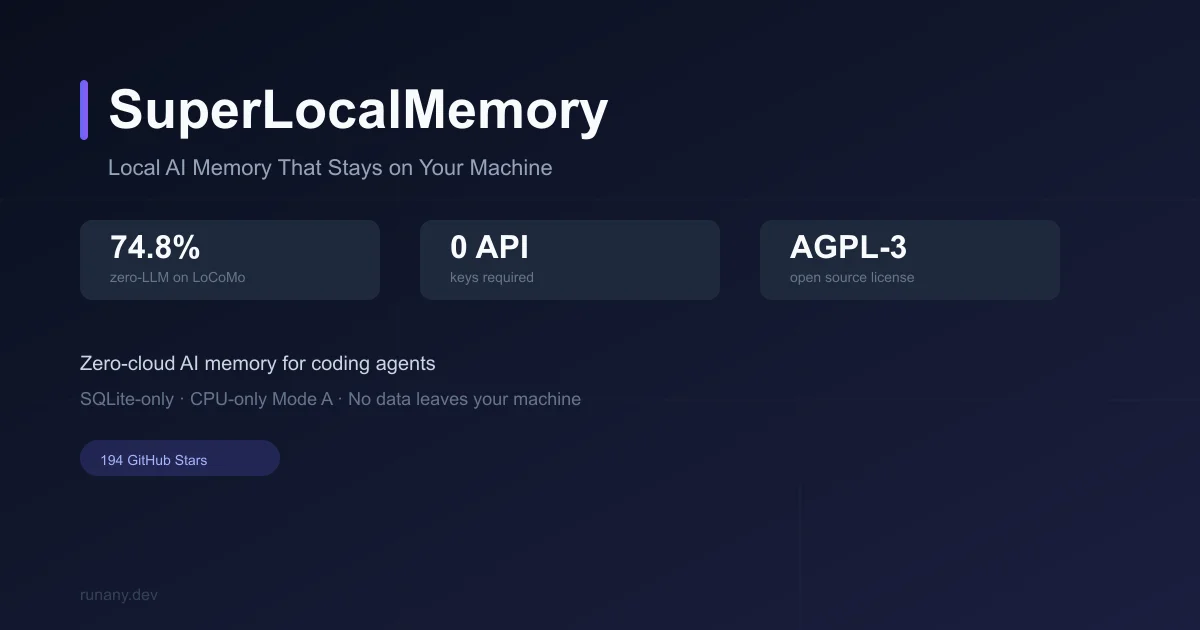
TL;DR: SuperLocalMemory is an open-source (AGPL-3.0) AI memory tool that runs entirely on your machine — no API keys, no cloud, no data leaving your environment. Mode A hits 74.8% on the LoCoMo benchmark without any LLM calls.
Source and Accuracy Notes
- Project page: superlocalmemory.com ← verified July 2026
- Source repository: github.com/varun369/SuperLocalMemoryV2 ← README read end-to-end
- License: AGPL-3.0 ← verified via README badge
- PyPI package: pypi.org/project/superlocalmemory
- npm package: npmjs.com/package/superlocalmemory
- arXiv paper: arXiv:2603.14588
What Is SuperLocalMemory?
Every hosted AI memory platform — Mem0 Cloud, Zep Cloud, Letta Cloud, EverMemOS Cloud — sends your data to cloud LLMs by default. Self-hosted alternatives exist but typically require Docker, a separate graph database, or Ollama configuration, and most default to OpenAI until you flip environment variables.
SuperLocalMemory V3 takes a different approach: mathematics instead of cloud compute. Its retrieval layer uses differential geometry, algebraic topology, and stochastic analysis to replace the LLM-dependent work other systems need. The result is a fully local memory store with no API key requirement and no data leaving your machine.
The project publishes three arXiv preprints and supports three surface areas:
- Proxy:
slm wrap claude— wraps your existing Claude invocation - MCP tools: add
slm_compressto your MCP configuration - Skill: zero-config skill-based interface
Benchmark claim (verified from README): On the LoCoMo long-conversation memory benchmark, Mode A scores 74.8% in a CPU-only, zero-LLM configuration — 10.6 percentage points above Mem0’s equivalent zero-LLM setup (64.2%). Mode C, which uses a local Ollama LLM, reaches 87.7%.
Setup Workflow
Prerequisites
- Node.js 18+ (for npm install) or Python 3.10+ (for pip install)
- No API keys required for Mode A
- No Docker required
Option 1: npm (recommended)
npm install -g superlocalmemory
slm setup       # Choose mode: A (zero-LLM), B (hybrid), or C (local LLM)
slm doctor      # Verify installation
```bash

### Option 2: pip

```bash
pip install superlocalmemory
slm setup
slm doctor
```bash

### Basic usage

```bash
# Add a memory
slm remember "Alice works at Google as a Staff Engineer"

# Recall it
slm recall "What does Alice do?"

# Check status
slm status
```bash

### Wrap your agent

```bash
# Starts proxy + sets environment + launches your agent
slm wrap claude

# First repeat prompt → cache hit → $0.00 in API costs
slm optimize savings --since 1
Deeper Analysis
Architecture
Mode A (the zero-LLM configuration) uses SQLite for storage and applies mathematical retrieval without any LLM call. This makes it suitable for air-gapped environments, regulated industries, or anyone who wants zero data exfiltration.
Mode C adds an optional Ollama integration for cases where a local LLM improves retrieval quality while still keeping everything self-hosted.
EU AI Act considerations
The README flags that after August 2, 2026, cloud-dependent AI memory platforms become a compliance question under the EU AI Act. SuperLocalMemory’s fully local architecture sidesteps this entirely — no data leaves the user’s environment at any point.
Three-surface design
The proxy surface (slm wrap) is the quickest integration for users who already have a CLI agent set up. The MCP surface targets agent frameworks that expose MCP tools. The skill surface is zero-config for straightforward use cases.
Practical Evaluation Checklist
- Install via npm or pip and run
slm doctor - Try Mode A:
slm setup→ choose A →slm remember+slm recall - Verify no outbound network calls during retrieval (Mode A)
- Test
slm wrap claudeif Claude CLI is installed - Check
slm statusfor storage statistics
Security Notes
- Mode A: Zero network calls during operation. All data stays in local SQLite.
- Mode C: Optional Ollama integration — configure which local model to use.
- AGPL-3.0 license requires source code availability if you distribute modifications.
FAQ
Q: What is LoCoMo? A: LoCoMo (Long-term Conversation Memory benchmark) evaluates how well AI systems remember facts from extended conversations. SuperLocalMemory’s Mode A scored 74.8% on this benchmark without any LLM calls, compared to Mem0’s zero-LLM baseline of 64.2%.
Q: Does Mode A require an internet connection? A: No. Mode A is fully offline — no API calls, no cloud dependency, no data exfiltration.
Q: What is Mode C? A: Mode C uses a local Ollama LLM for retrieval assist, reaching 87.7% on LoCoMo while still keeping all data self-hosted. It is optional and separate from Mode A.
Q: How does this compare to Mem0? A: On the zero-LLM LoCoMo configuration, SuperLocalMemory Mode A (74.8%) outperforms Mem0’s zero-retrieval-LLM baseline (64.2%) by 10.6 percentage points. Mem0’s cloud configurations score higher but require API keys and cloud compute.
Q: What license is it published under? A: AGPL-3.0. The source is on GitHub with 194 stars as of June 2026.
Conclusion
SuperLocalMemory is a compelling option for developers who want persistent, on-device memory for AI coding agents without handing data to a third-party cloud. The zero-LLM Mode A design is architecturally distinct from every other AI memory tool in the space — it replaces LLM-based retrieval with mathematical methods, which also addresses EU AI Act compliance concerns for cloud-averse deployments.
Install it with npm install -g superlocalmemory or pip install superlocalmemory and run slm setup to choose your mode.
Related Posts
ai-setup
Recall – Persistent Memory for Claude Code via MCP Hooks
Recall gives Claude Code a permanent memory store that survives session restarts and context compaction. Four hooks capture and restore context automatically — with cloud SaaS or self-hosted options.
2/28/2026
dev-tools
Automotive Skills Suite for AI Engineering
Evaluate Automotive Skills Suite for APQP, ASPICE, HARA, safety-plan, and DIA workflows with setup notes, governance risks, and SME review guidance.
5/28/2026
dev-tools
awesome-agentic-ai-zh Roadmap Guide
Explore awesome-agentic-ai-zh as a Chinese agentic AI learning roadmap, with setup notes, track selection, study workflow, and evaluation guidance.
5/28/2026