vercel-labs/skills: The Open Agent Skills CLI
vercel-labs/skills is an open agent skills tool distributed as an npm CLI, letting teams install and reuse reusable agent capability packs.
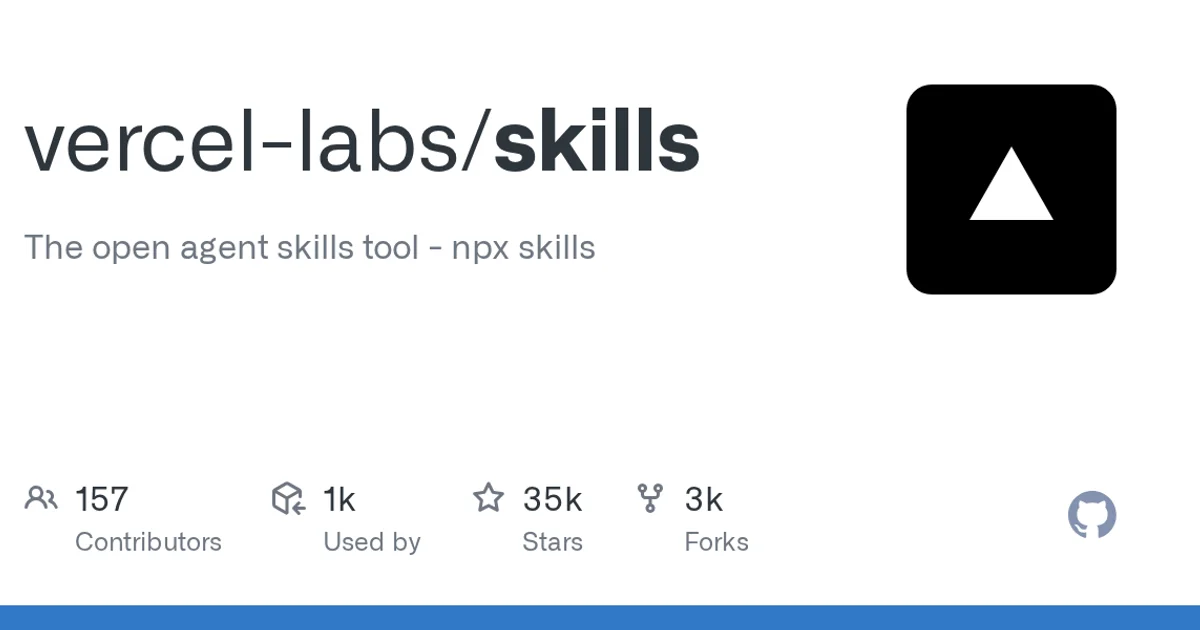
TL;DR: vercel-labs/skills is a TypeScript CLI published as
npx skillsthat installs reusable agent skill packs into a project. It is MIT licensed, has 34,000 stars, and carries an unusually large 1,115 open issues for a tool of its size.
What it is
The repository description is one line: the open agent skills tool, distributed through npx. That economy tells you what kind of project this is. It is infrastructure, not a framework. Something you run once to pull capability packs into a repository so an agent can use them.
The hosted front door is skills.sh, which is the directory rather than the tool itself.
Written in TypeScript, created 2026-01-14, last pushed 2026-10-09.
$ curl -s https://api.github.com/repos/vercel-labs/skills \
  | jq '{stars: .stargazers_count, forks: .forks_count, open_issues: .open_issues_count, language, license: .license.spdx_id}'
{
  "stars": 34550,
  "forks": 2953,
  "open_issues": 1115,
  "language": "TypeScript",
  "license": "MIT"
}
Why a Vercel Labs tool keeps trending
Vercel Labs is a known incubator for experimental developer tooling, and the star count reflects that distribution as much as it reflects adoption. Seeing a Labs project at the top of trending usually means the underlying idea is being picked up faster than the tooling can stabilise.
The MIT license is worth noting alongside that. Compared to AGPL-3.0 projects in the same trend cycle, this one carries no copyleft obligation, so it is straightforward to adopt into commercial work.
The open issue problem
1,115 open issues is the number that deserves a second look. Against 2,953 forks, that is a ratio you do not see in a mature, well-staffed tool. It points to genuine, sustained demand colliding with a project that is still finding its shape.
Practically, that means two things:
- You are unlikely to get fast answers on issues, so budget for reading source rather than asking.
- The interface may still be shifting, which is a consideration if you script against it.
That is the honest tradeoff. You get a fast-moving tool with broad adoption and a permissive license, at the cost of some interface churn.
How to try it
Because it ships through npm, there is no build step to understand before you have a feel for it:
npx skillsCloning for a closer look is equally direct:
git clone https://github.com/vercel-labs/skills.git
cd skills
When to use it
It makes sense if you are standardising how agent capabilities are distributed across a team or across several repositories. A single CLI that installs skill packs into a project removes the per-project hand-configuration that otherwise fragments quickly.
The permissive license makes it low-risk to adopt early. MIT means you can wrap it, extend it, and ship it commercially without negotiating terms.
When not to use it
If you need a stable, documented API surface with predictable behaviour, this is early for that. The issue volume is a fair proxy for how much the surface is still moving.
It is also worth being clear-eyed that a Labs project is a statement about experimentation, not long-term support guarantees. If you are building a production pipeline on it, pin versions and read the source before upgrades.
Source and Accuracy Notes
- Project page: https://skills.sh
- Source repository: vercel-labs/skills (verified via GitHub API
html_url) - License: MIT (verified via GitHub API
license.spdx_id) - Stars at time of writing: 34550
Related Posts
ai-setup
Recall – Persistent Memory for Claude Code via MCP Hooks
Recall gives Claude Code a permanent memory store that survives session restarts and context compaction. Four hooks capture and restore context automatically — with cloud SaaS or self-hosted options.
2/28/2026
dev-tools
Automotive Skills Suite for AI Engineering
Evaluate Automotive Skills Suite for APQP, ASPICE, HARA, safety-plan, and DIA workflows with setup notes, governance risks, and SME review guidance.
5/28/2026
dev-tools
awesome-agentic-ai-zh Roadmap Guide
Explore awesome-agentic-ai-zh as a Chinese agentic AI learning roadmap, with setup notes, track selection, study workflow, and evaluation guidance.
5/28/2026