Sipp – Browser WebGPU GGUF Inference at 3x Speed
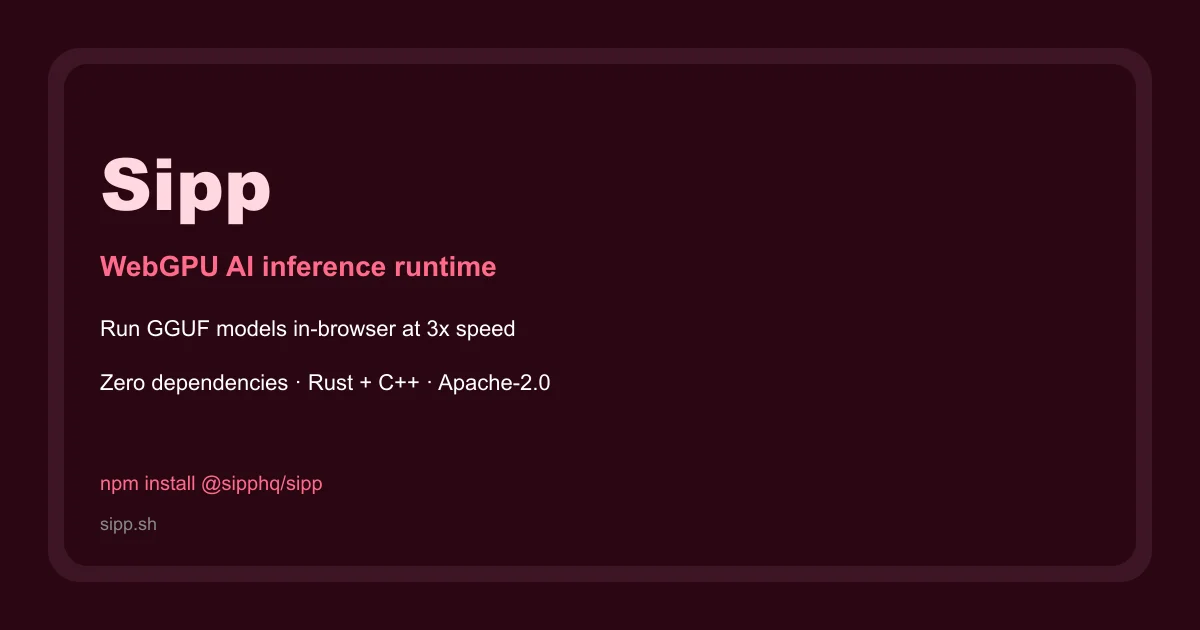
Sipp is an open-source WebGPU runtime for running GGUF AI models directly in the browser with no server calls. Built with Rust and C++, it delivers 3x faster inference than comparable approaches with
TL;DR
TL;DR: Sipp is an open-source, zero-dependency WebGPU runtime that runs GGUF AI models directly in the browser, delivering local inference 3x faster than comparable approaches.
Source and Accuracy Notes
- Project page: sipp.sh
- GitHub: github.com/noumena-labs/Sipp — 56 stars, Apache-2.0 license
- HN launch: news.ycombinator.com/item?id=48660884
What Is Sipp?
Sipp is a browser-native AI inference runtime built with Rust and C++. It loads GGUF-format model weights directly into the browser via WebGPU and executes inference locally — no server round-trips, no API keys, no data leaving the device.
The project comes from Noumena Labs and targets developers building AI-augmented web apps, games, and creative tools that need fast, private inference without a backend.
The headline claim is 3x faster inference compared to approaches that route through a server-side endpoint. The mechanism is straightforward: keeping model weights and token generation on-device eliminates network latency, and the Rust/GGML core minimizes copies across the WASM boundary.
Supported Platforms
Sipp ships SDKs across five platforms:
| Platform | Install command | Use case |
|---|---|---|
| Browser | npm install @sipphq/sipp | In-browser GGUF inference, gateway clients |
| Node.js | npm install @sipphq/sipp-server | Server-side local inference, route handlers |
| Python | pip install sipppy | Scripts, notebooks, gateway clients |
| Python CUDA | GitHub release wheel | Local inference with CUDA GPU acceleration |
| Rust | cargo add sipp-rs | Native apps, runtime internals, gateway builds |
Quick Start (Browser)
npm install @sipphq/sipp
```bash

```javascript
import { Sipp } from '@sipphq/sipp';

const model = await Sipp.fromURL('https://example.com/model.gguf');
const result = await model.complete({ prompt: 'Write a haiku about lemons' });
console.log(result.text);
The browser SDK communicates with a gateway server or loads models from a URL. For self-hosted scenarios, a gateway server binary can be deployed as a Docker container or built from source.
The Gateway Server
When inference needs extend beyond a single device, Sipp’s gateway server exposes a local HTTP endpoint that routes to local GPU targets, trusted providers, or both. It is open source and can be self-hosted from the source checkout using the provided Dockerfile.
The gateway is useful when:
- You want to serve local GPU inference to multiple clients
- You need to balance between local and cloud provider endpoints
- You want a single consistent API surface regardless of where inference actually runs
Architecture Notes
Sipp’s core is written in Rust with a C++ layer for the GGML tensor operations. The browser target uses WASM compiled from this core, bridged to WebGPU for GPU acceleration. This avoids the JavaScript tensor library overhead that slows down typical in-browser inference approaches.
Model format is GGUF — the same format used by llama.cpp, Ollama, and most local inference tools. This means a large ecosystem of pre-quantized models is directly compatible without conversion.
Practical Evaluation Checklist
- Open source (Apache-2.0)
- No server required for browser use
- Standard GGUF model format
- WebGPU-accelerated in browser
- SDKs for browser, Node.js, Python, Rust
- Self-hostable gateway server
- Zero external dependencies at runtime
Limitations
- Browser WebGPU support varies by Chromium version and OS. Safari/WebKit WebGPU support is limited as of mid-2026.
- Model size is constrained by browser memory limits. Large models (over ~4B parameters) may crash on memory-constrained devices.
- CUDA wheels require a GPU with CUDA compute capability. The Python package on PyPI targets CPU; CUDA wheels are separate GitHub release artifacts.
- Server is not yet a published public artifact — self-hosting requires building from source or using the Dockerfile.
FAQ
Q: How does this compare to using a cloud API? A: Sipp keeps all inference on-device. There is no data sent to a server, which makes it suitable for privacy-sensitive applications. The tradeoff is that large models may be slower than a dedicated GPU cloud endpoint, and device capability determines maximum model size.
Q: What models work with Sipp? A: Any GGUF-format model. This includes most quantized Llama, Mistral, Phi, and Qwen variants available on Hugging Face and other model repositories.
Q: Does it work on mobile? A: Mobile browser support depends on WebGPU availability, which is restricted on iOS Safari. Android Chrome with WebGPU support can run Sipp, though memory constraints limit practical model sizes.
Conclusion
Sipp addresses a real gap in the browser AI toolkit: genuinely local inference without a server call. The Rust/GGML core delivering WebGPU performance 3x faster than server round-trips is the key differentiator. For developers building AI features into web apps where latency and privacy matter, it is worth evaluating against the overhead of cloud API calls.
The main thing to watch is WebGPU adoption trajectory — as browser support matures, in-browser local inference becomes more viable as a production approach.
Related Posts
ai-setup
Recall – Persistent Memory for Claude Code via MCP Hooks
Recall gives Claude Code a permanent memory store that survives session restarts and context compaction. Four hooks capture and restore context automatically — with cloud SaaS or self-hosted options.
2/28/2026
dev-tools
Automotive Skills Suite for AI Engineering
Evaluate Automotive Skills Suite for APQP, ASPICE, HARA, safety-plan, and DIA workflows with setup notes, governance risks, and SME review guidance.
5/28/2026
dev-tools
awesome-agentic-ai-zh Roadmap Guide
Explore awesome-agentic-ai-zh as a Chinese agentic AI learning roadmap, with setup notes, track selection, study workflow, and evaluation guidance.
5/28/2026