ShellTalk - Deterministic Text-to-Bash Without LLMs
ShellTalk converts natural English into Bash commands using semantic template matching—no LLM required. Runs on macOS, Linux, and WebAssembly.
TL;DR
TL;DR: ShellTalk is an Apache 2.0 CLI that converts plain English to Bash commands using semantic template matching—zero LLMs, fully deterministic, runs on macOS, Linux, and in-browser via WebAssembly.
Source and Accuracy Notes
- Project page: barrasso.me/posts/2026-04-22-text-to-bash-with-shell-talk
- Source repository: github.com/LastByteLLC/ShellTalk
- License: Apache 2.0 (verified via post text and GitHub repo)
- HN launch thread: news.ycombinator.com/item?id=47865778
What Is ShellTalk?
ShellTalk is a CLI tool and Swift library that maps natural language English descriptions to Bash commands through Semantic Template Matching (STM)—a deterministic rule-based approach that uses no large language models at all.
The author built it after exploring on-device AI text-to-bash tools and hypothesizing that the constrained, single-command bash space could be solved without LLMs. The result is a tool that produces reproducible, auditable command outputs that are easy to debug and improve.
The key claim is determinism: because ShellTalk does not use probabilistic generation, its failure modes are reproducible and can be fixed programmatically by AI agents.
Supported Platforms
- macOS (Universal binary)
- Linux (x86_64)
- WebAssembly (browser, via GitHub Pages)
How It Works
ShellTalk uses Semantic Template Matching (STM) to map English intent to Bash commands. The author credits inspiration from the Meta-Harness paper and Apple’s on-device Junco project, which demonstrated a small 3B Apple Foundation Model could handle this task—but ShellTalk eliminates the model dependency entirely.
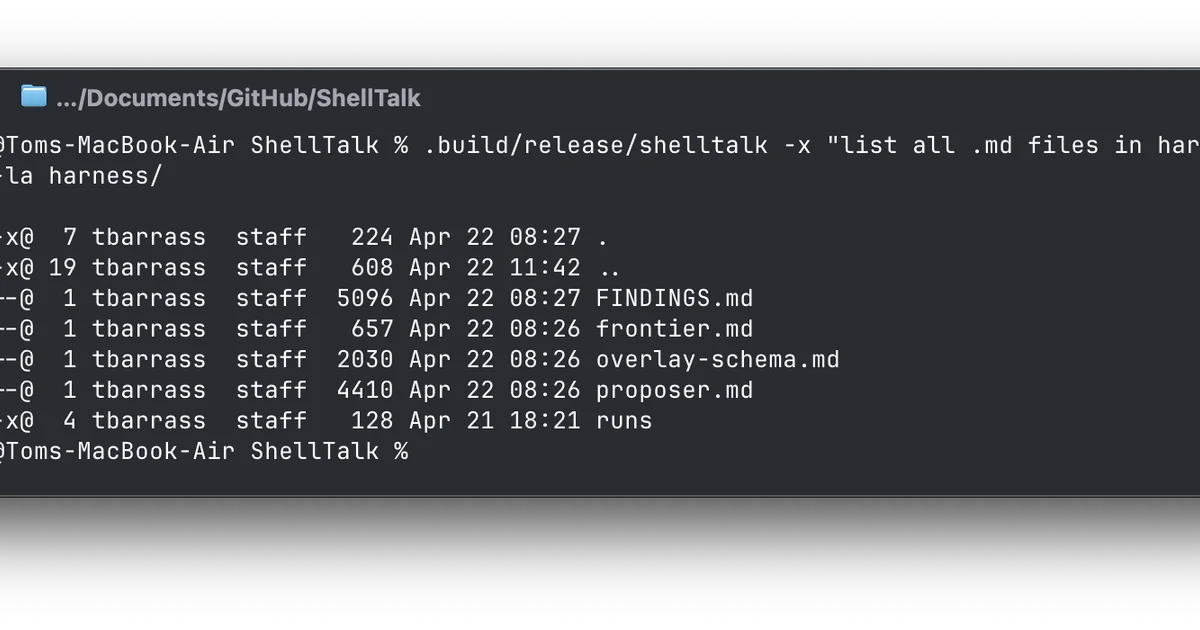
shelltalk "find all images in this folder"
```bash

Output includes the Bash command plus safety and confidence scores. The tool detects installed commands and their versions to avoid generating commands that do not exist on the target system.

### Screenshots

The author published a [full post on barrasso.me](https://barrasso.me/posts/2026-04-22-text-to-bash-with-shell-talk/) with screenshots of ShellTalk running in Ghostty terminal and in the browser via WebAssembly. The WebAssembly build is approximately 45 MB and works fully offline, though it lacks command healing (matching to available versions) and typo correction since `NSSpellChecker` is macOS-only.

## Setup Workflow

### Prerequisites

- macOS, Linux, or a modern browser (for WebAssembly)
- Optional: Apple Foundation Model on macOS 26 Tahoe for the AFM-backed variant

### Install via Homebrew (macOS/Linux)

```bash
brew install lastbytellc/tap/shelltalk
```bash

### Download Pre-built Binaries

Pre-built binaries for macOS Universal and Linux x86_64 are available on the [GitHub Releases page](https://github.com/LastByteLLC/ShellTalk/releases/tag/v1.0.0).

### Build from Source

ShellTalk is written in Swift. Clone and build:

```bash
git clone https://github.com/LastByteLLC/ShellTalk.git
cd ShellTalk
swift build -c release
Try in Browser (WebAssembly)
Visit lastbytellc.github.io/ShellTalk to try it without installing anything. The page loads a pre-compiled WebAssembly build of the Swift library.
Deeper Analysis
Why No LLMs?
The author’s core argument is that the bash-command space is constrained enough for template matching to work reliably. LLM-based approaches are probabilistic—asking the same question twice can yield different commands. This is fine for creative tasks but problematic for automation where reproducibility matters.
STM produces identical output for identical input every time. When it fails, the failure is reproducible, which makes it tractable to fix by updating the template corpus rather than retraining a model.
Agentic Harness Potential
One interesting use case the author highlights: ShellTalk could be embedded inside an AI agent harness to spare tokens. Because the output is deterministic and compact, an agent could call ShellTalk for bash generation without paying LLM inference costs for simple, well-defined commands.
Known Limitations
The author explicitly calls out these failure modes:
- Works best on pre-trained commands in the bundled corpus
- Struggles with ambiguous intent or complex pattern matching for filenames, paths, and URLs
- WebAssembly build lacks command healing and typo correction (no
NSSpellChecker) - Not all Bash commands are covered—constrained domain means constrained coverage
Practical Evaluation Checklist
- Does the STM approach cover your most common Bash tasks?
- Is the output reproducible across runs for the same input?
- Does the pre-trained corpus include the commands you use most?
- How does it handle commands not in the corpus?
- Is the WebAssembly offline mode practical for your workflow?
- Does the lack of typo correction matter for your use case?
Security Notes
ShellTalk generates Bash commands that are executed by the user. Key security considerations:
- Always review generated commands before running them, especially as
sudo - Generated commands have access to the full filesystem and user permissions
- The deterministic output makes it easier to audit what the tool will produce for a given input
- No network access is required for the core STM matching (offline-capable)
FAQ
Q: How does ShellTalk differ from LLM-based text-to-bash tools? A: ShellTalk uses semantic template matching, not probabilistic generation. The same English input always produces the same Bash output. LLM-based tools may produce different commands on each run for the same input.
Q: Can it generate complex multi-step pipelines? A: The current corpus covers single commands best. Complex pipelines with pipes, conditionals, and loops may exceed the template corpus coverage. The author acknowledges this as a known limitation.
Q: Does it require an internet connection? A: No. The WebAssembly build loads fully offline after the initial 45 MB download. CLI binaries are also fully offline.
Q: Is this production-ready? A: ShellTalk is a v1.0.0 release. The author describes it as functional but with known limitations around coverage and complex intent. Evaluate it against your specific command needs before depending on it in critical workflows.
Conclusion
ShellTalk is an interesting proof-of-concept that deterministic STM can replace probabilistic LLM generation for a constrained domain like single-command Bash. The Apache 2.0 license and cross-platform support (macOS, Linux, Wasm) make it easy to try. If you find yourself reaching for an LLM to explain a Bash command you already know how to write, ShellTalk might already handle it—without the inference cost.
The tool is worth watching if the STM corpus expands, and its agentic harness use case (sparing tokens in bigger AI systems) is potentially significant. Try the WebAssembly demo or grab a binary from the GitHub releases.
Related Posts
ai-setup
Recall – Persistent Memory for Claude Code via MCP Hooks
Recall gives Claude Code a permanent memory store that survives session restarts and context compaction. Four hooks capture and restore context automatically — with cloud SaaS or self-hosted options.
2/28/2026
dev-tools
Automotive Skills Suite for AI Engineering
Evaluate Automotive Skills Suite for APQP, ASPICE, HARA, safety-plan, and DIA workflows with setup notes, governance risks, and SME review guidance.
5/28/2026
dev-tools
awesome-agentic-ai-zh Roadmap Guide
Explore awesome-agentic-ai-zh as a Chinese agentic AI learning roadmap, with setup notes, track selection, study workflow, and evaluation guidance.
5/28/2026