rust: Reliable and Efficient Software
The Rust compiler repository at 120,066 stars and 16 years old. What the metadata shows about the language's home repository and its issue count.
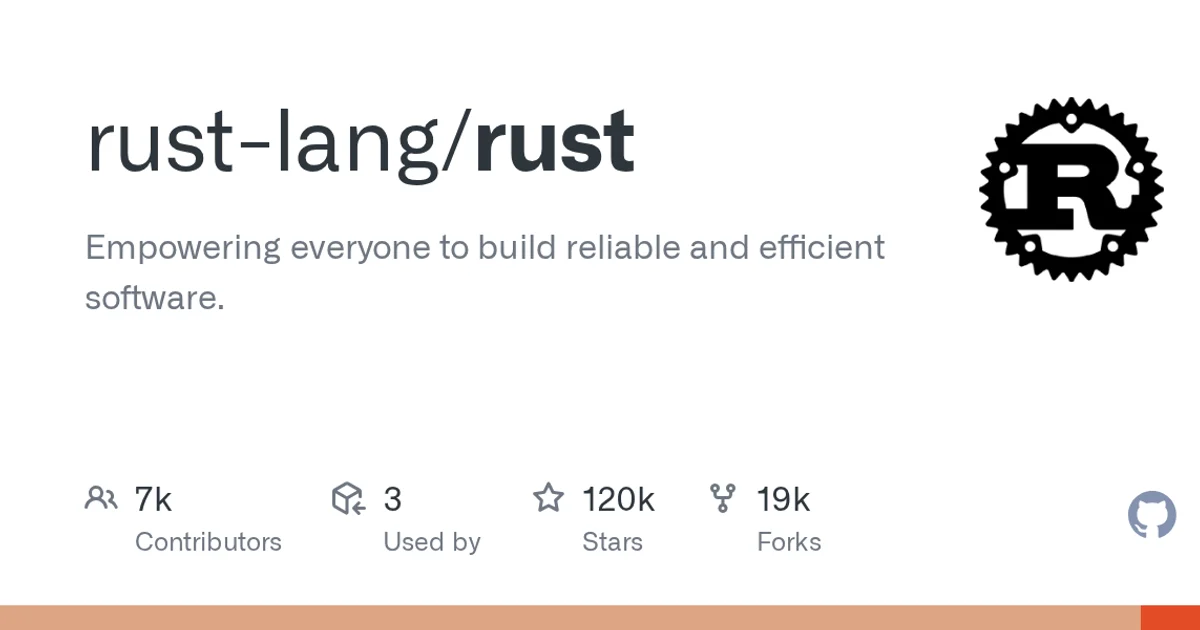
TL;DR: rust-lang/rust is the compiler and standard library for Rust, at 120,066 stars, 18,701 forks and 12,556 open issues. It is Apache-2.0 licensed, created in June 2010, and pushed to as recently as 2026-10-14.
What it is
This is the repository that holds the language itself, not a wrapper or a tool around it. The description is a mission statement rather than a feature list: empowering everyone to build reliable and efficient software. The topics are compiler, language and rust, which is about as compressed a signal as you can get.
Worth being precise about scope early: this is the compiler and standard library. The rest of the tooling most people touch daily lives in other repositories under the same organisation. When you feel a delay installing a toolchain, you are probably not running code from here.
$ curl -s https://api.github.com/repos/rust-lang/rust \
  | jq '{stars: .stargazers_count, language, license: .license.spdx_id, topics, created_at}'
{
  "stars": 120066,
  "language": "Rust",
  "license": "Apache-2.0",
  "topics": ["compiler","language","rust"],
  "created_at": "2010-06-16T20:39:03Z"
}
Rust is the repository’s primary language, which is a rare and slightly circular signal: a language written in itself. It works because bootstrapping compilers is one of the few problems that tolerates a slow, self-hosted build.
The issue count needs context
12,556 open issues is by far the highest number in this batch of trending repositories, and it is tempting to read that as instability. For a compiler project it mostly is not. Language evolution runs through issues: proposals, tracking issues for stabilised features, and reports that get closed by triage policy rather than by resolution. A repository that carries the design of a language for sixteen years accumulates paperwork, not just bugs.
The number to hold onto instead is the push date. Code went in on 2026-10-14, the day before this post.
| Metric | Value |
|---|---|
| Stars | 120,066 |
| Forks | 18,701 |
| Open issues | 12,556 |
| Primary language | Rust |
| Created | 2010-06-16 |
| Last push | 2026-10-14 |
| License | Apache-2.0 |
Apache-2.0 rather than MIT is the more protective of the two licences, and for a language the entire ecosystem depends on, the patent grant is the part that does quiet work over decades.
How to try it
git clone https://github.com/rust-lang/rust.git
cd rust

# the ordinary workflow uses cargo, which ships with the toolchain
cargo new hello
cd hello
cargo run
Cloning this repository and building it is not the same task as running Rust. The language and its compiler are most people meet through cargo and rustup, and those are separate pieces of tooling. Clone the source when you want to read how a language is implemented, not when you want to start a project.
When to use it
The metadata cannot tell you whether to adopt Rust, and nothing here should pretend otherwise. What sixteen years of continuous development does tell you is that the language’s core is stable, actively maintained and not going to be abandoned.
The fork count is the more interesting number. Roughly 18,700 people have their own copy of the compiler, which for a language implementation means a large number of people are reading, patching and experimenting with the source rather than treating it as a black box.
When not to use it
Do not read star counts as a recommendation. 120,000 stars says the language is popular and durable, not that it fits your problem.
The repository is also not a good source for learning the language. It is the compiler, and reading a compiler to learn syntax is a slow path. The language reference and the standard library documentation are the places to start; this is the place to go once you want to understand what the tooling under you is doing.
Source and Accuracy Notes
- Project page: https://www.rust-lang.org
- Source repository: rust-lang/rust (verified via GitHub API
html_url) - License: Apache-2.0 (verified via GitHub API
license.spdx_id) - Stars at time of writing: 120066
Related Posts
ai-setup
Recall – Persistent Memory for Claude Code via MCP Hooks
Recall gives Claude Code a permanent memory store that survives session restarts and context compaction. Four hooks capture and restore context automatically — with cloud SaaS or self-hosted options.
2/28/2026
dev-tools
Automotive Skills Suite for AI Engineering
Evaluate Automotive Skills Suite for APQP, ASPICE, HARA, safety-plan, and DIA workflows with setup notes, governance risks, and SME review guidance.
5/28/2026
dev-tools
awesome-agentic-ai-zh Roadmap Guide
Explore awesome-agentic-ai-zh as a Chinese agentic AI learning roadmap, with setup notes, track selection, study workflow, and evaluation guidance.
5/28/2026