Ruflo: A TypeScript Harness for Agent Swarms
Ruflo is a TypeScript agent harness for multi-player agent swarms, with adaptive memory, federation, and vector RAG. MIT licensed, 75,155 stars.
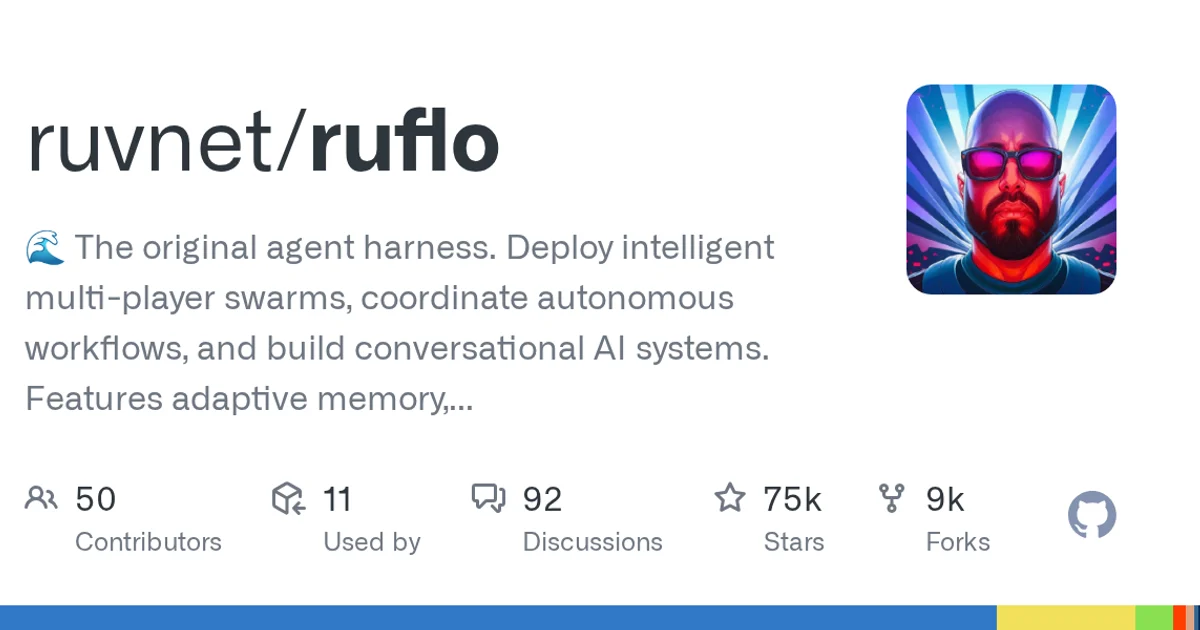
TL;DR: Ruflo is a TypeScript harness for running groups of AI agents that coordinate with one another, holding 75,155 stars and 8,930 forks under an MIT license. Everything about adaptive memory, self-learning and federation comes from the repository’s own description, not from independent testing.
What it is
The description leads with “the original agent harness”, which is a positioning claim rather than a technical one. A harness is the layer that sits between a model provider and your agents: it decides which agent runs, keeps state across steps, and routes work between them. That layer is where orchestration bugs live, so a harness that has been in development for about sixteen months is worth a look if you have been hand-rolling this part yourself.
The repository was created on 2025-06-02 and last pushed on 2026-10-15, so it is actively maintained. The public homepage sits at Cognitum.One.
What the description claims
The feature list is long for a project at this stage. Taken apart:
- Multi-player agent swarms that run as a group rather than a single agent
- Coordination of autonomous workflows
- Conversational AI systems
- Adaptive memory, plus something the description calls self-learning intelligence
- Federation between agents
- Vector RAG integration
- Native integration with Claude Code, Codex, Hermes and others
Two phrases in that list deserve a raised eyebrow. “Self-learning intelligence” is not a specification, and “federation” carries several different meanings in distributed systems. Neither tells you what actually runs at runtime, and the GitHub metadata does not settle it either.
The numbers tell a story
| Metric | Value |
|---|---|
| Stars | 75,155 |
| Forks | 8,930 |
| Open issues | 1,054 |
| Primary language | TypeScript |
| Repository size | about 640 MB |
| Created | 2025-06-02 |
| Last push | 2026-10-15 |
| License | MIT |
$ curl -s https://api.github.com/repos/ruvnet/ruflo \
  | jq '{stars: .stargazers_count, language, license: .license.spdx_id, topics, created_at}'
{
  "stars": 75155,
  "language": "TypeScript",
  "license": "MIT",
  "topics": ["agentic-ai","agentic-framework","agentic-workflow","agents","ai-agents"],
  "created_at": "2025-06-02T21:24:20Z"
}
The issue count is the number worth pausing on. 1,054 open issues against 75,155 stars is roughly 1.4 percent, and the repository is around 640 MB on disk. A project at that size with that many open issues tells you something about its support model before you install anything.
How to look at it
git clone https://github.com/ruvnet/ruflo.git
cd ruflo
gh api repos/ruvnet/ruflo/contents --jq '.[].name'
The point of the second command is to see the layout before you commit to anything. A harness is only as good as its extension points, and a top-level directory listing tells you quickly whether you are looking at a library, a CLI, or a full application.
When to use it
It fits when you are already running several agents and the coordination between them is the part that hurts. Multi-step workflows where one agent’s output is another agent’s input, long-running autonomous jobs, and any setup where you have outgrown a single system prompt all land here.
The language choice matters more than anything else. If your agent code is already in Node, the integration cost is low. If it is in Python or Rust, weigh that before anything else in this post.
When not to use it
Skip it if you are running a single agent against a single task. The harness abstraction is overhead in that case, not leverage.
Be careful with the star count on its own. 75,155 stars is not an adoption signal you can verify from metadata. Check who is actually committing before you plan a dependency on it.
Source and Accuracy Notes
- Project page: https://Cognitum.One
- Source repository: ruvnet/ruflo (verified via GitHub API
html_url) - License: MIT (verified via GitHub API
license.spdx_id) - Stars at time of writing: 75155
- The feature list, including “self-learning intelligence” and “federation”, is the repository’s own claim from its description and was not independently tested
Related Posts
dev-tools
Automotive Skills Suite for AI Engineering
Evaluate Automotive Skills Suite for APQP, ASPICE, HARA, safety-plan, and DIA workflows with setup notes, governance risks, and SME review guidance.
5/28/2026
dev-tools
awesome-agentic-ai-zh Roadmap Guide
Explore awesome-agentic-ai-zh as a Chinese agentic AI learning roadmap, with setup notes, track selection, study workflow, and evaluation guidance.
5/28/2026
dev-tools
Baguette iOS Simulator Automation Guide
Set up Baguette for iOS Simulator automation, web dashboards, device farms, gesture input, streaming, and camera testing with Xcode caveats.
5/28/2026