Polymorph – AI Personalization for Consumer Apps
Polymorph runs thousands of AI-generated experiments per customer, automating push, email, and user segmentation to maximize conversion.
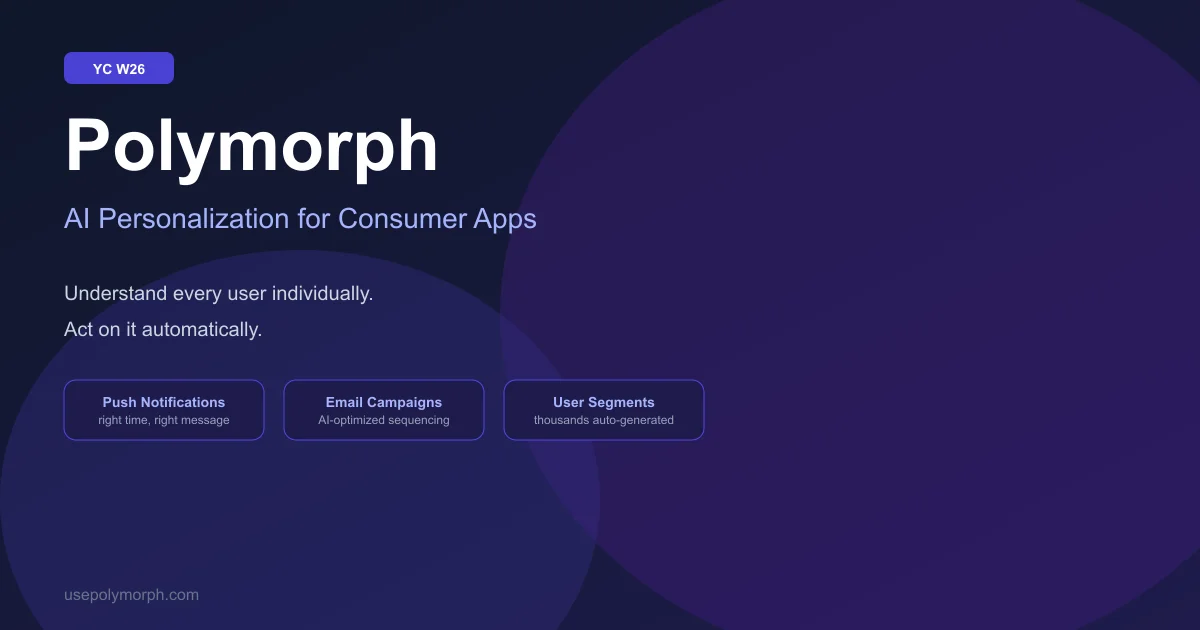
TL;DR
TL;DR: Polymorph is a YC W26-backed AI platform that automates user segmentation and multi-channel messaging (push, email) for consumer apps — replacing manual query-building with continuously-running experiments.
What Is Polymorph?
Polymorph is a product experimentation and lifecycle engagement platform built for consumer and self-serve SaaS apps. According to the founders’ HN launch thread, the team — three engineers who previously built Meta’s self-serve ads platform and Scale AI’s ML inference infra — noticed that consumer apps needing to send push notifications or emails had to write manual queries and build user segments themselves.
Polymorph handles this automatically. It mixes qualitative and quantitative user signals, then runs thousands of experiments continuously, each carrying the craft of the product’s direction and brand.
The product’s own landing page describes the vision:
“our vision is to make the consumer internet polymorphic: one that adapts to each user and optimizes for delightful experiences.”
How It Works
Polymorph acts as a permanent, automated growth team for each customer. The core loop:
- Signal ingestion — Polymorph pulls in behavioral and demographic data from your user base.
- AI segment generation — Instead of manual SQL queries to build segments, the system generates thousands of user segments automatically.
- Experiment orchestration — Experiments run continuously across multiple channels (push notifications, email, in-app) simultaneously.
- Optimization — The system learns which messages, timing, and channels drive the best conversion for each user cohort.
The platform positions itself as a replacement for the manual work of writing queries, building audience segments, drafting campaign copy, and scheduling — all of which are traditionally bottlenecked by headcount and design capacity.
Key Features
Based on the product description and launch thread:
- Automated user segmentation — AI generates audience segments on an ongoing basis, no manual query writing required.
- Multi-channel orchestration — Supports push notifications and email out of the box, with lifecycle engagement across the full user journey.
- Continuous experimentation — Runs thousands of simultaneous experiments, each reflecting the product’s brand and direction.
- Conversion optimization — Mixes qualitative (behavioral) and quantitative (events, metrics) signals to target the right message at the right time.
- Self-serve integration — Built for consumer and self-serve apps without requiring a dedicated data team.
Practical Evaluation Checklist
- Setup complexity — No self-hosted option mentioned; appears to be a cloud-hosted SaaS product requiring integration via API.
- Data requirements — Needs access to user behavioral and event data to power segmentation.
- Experiment scale — Claims thousands of concurrent experiments per customer — meaningful for high-traffic consumer apps.
- Multi-channel — Push + email confirmed; additional channels may be available.
- YC backing — YC W26 batch, confirmed via site badge and HN launch thread.
- Pricing — Not publicly listed on the landing page; likely on a sales or early-access model given YC W26 timing.
Security Notes
- User behavioral data is processed in Polymorph’s infrastructure — evaluate data processing agreements if handling PII.
- No self-hosted deployment option is documented, which means data leaves your environment.
- As a YC-backed startup in the early stage, evaluate vendor lock-in risk before committing high-volume data.
FAQ
Q: Does Polymorph require a data team to operate? A: No — the platform is designed to replace manual query-building and segment creation, which are typically the bottleneck in growth teams without dedicated data engineers.
Q: What channels does it support? A: Push notifications and email at launch, with lifecycle engagement across the user journey. Additional channels may be added.
Q: Is there a self-hosted option? A: Not currently documented. Polymorph appears to be exclusively cloud-hosted at this stage.
Q: How is it different from a traditional ESP or CDP? A: Traditional email service providers and customer data platforms require manual segment building and campaign orchestration. Polymorph automates both continuously, treating experimentation as the default operating mode rather than periodic campaigns.
Conclusion
Polymorph targets a real pain point in consumer app growth: the manual overhead of building segments, writing copy, and orchestrating multi-channel campaigns. By automating experimentation at scale, it lets small teams operate like a large, dedicated growth department.
If you are building a consumer or self-serve app and want to offload the query-writing and segmentation work to an AI system, Polymorph is worth an early conversation — especially given the YC W26 backing that validates the team’s infrastructure pedigree (Meta Ads + Scale AI).
The platform is in early stages. If you need transparency on pricing or self-hosted deployment, reach out to the team directly via the site.
Source and Accuracy Notes
- Project page: usepolymorph.com
- HN launch thread: news.ycombinator.com/item?id=47330789
- YC backing: Confirmed via site badge (“backed by Y Combinator”) and ycombinator.com/companies/polymorph (W26 batch)
Related Posts
ai-setup
Recall – Persistent Memory for Claude Code via MCP Hooks
Recall gives Claude Code a permanent memory store that survives session restarts and context compaction. Four hooks capture and restore context automatically — with cloud SaaS or self-hosted options.
2/28/2026
dev-tools
Automotive Skills Suite for AI Engineering
Evaluate Automotive Skills Suite for APQP, ASPICE, HARA, safety-plan, and DIA workflows with setup notes, governance risks, and SME review guidance.
5/28/2026
dev-tools
awesome-agentic-ai-zh Roadmap Guide
Explore awesome-agentic-ai-zh as a Chinese agentic AI learning roadmap, with setup notes, track selection, study workflow, and evaluation guidance.
5/28/2026