opencode: the open source coding agent, by the numbers
opencode is a TypeScript coding agent with 215,000 stars and an MIT license. Its GitHub description is one sentence, which says something about the project.
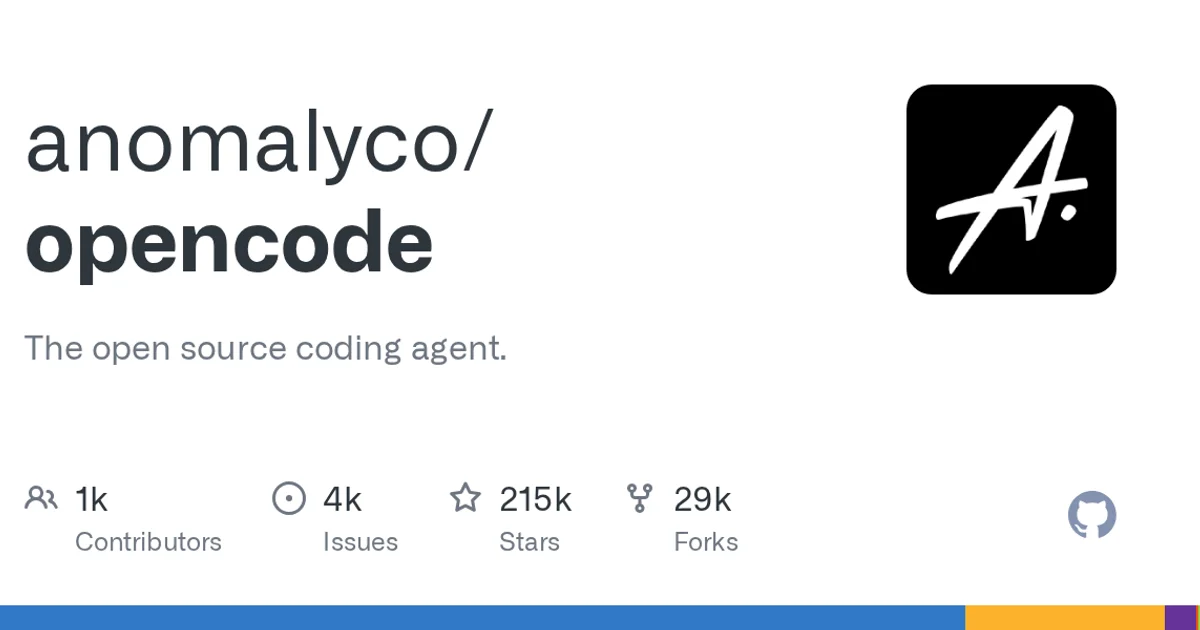
TL;DR: opencode is a TypeScript coding agent whose entire GitHub description is one sentence, “The open source coding agent.” The numbers make the argument instead: 215,401 stars, 28,865 forks, and an MIT license at the time of writing, with a project homepage at opencode.ai.
The full GitHub description for anomalyco/opencode is this: The open source coding agent.
That is the entire thing. No feature list, no architecture summary, no positioning sentence. Meanwhile the repository carries 215,401 stars and 28,865 forks, an MIT license, and a homepage at opencode.ai, and it was pushed to within hours of this post being written.
So let us do something slightly different here and read the metadata as the story, because the metadata is genuinely interesting.
What 215,000 stars means
A star count that size puts opencode among the most starred repositories on GitHub. That is not a comparison to a specific project, it is a placement. Whatever category you file coding agents under, opencode is one of the handful of names that come up, not a candidate you evaluate.
The number also tells you something about how the ecosystem treats it. Star counts at this level are usually accumulated over years across many adjacent audiences, which means opencode is probably not only being used as a daily driver. It is likely being forked, wrapped, embedded, or referenced in other projects’ stacks.
The fork ratio is the interesting number
Twenty-eight thousand eight hundred and sixty-five forks against 215,401 stars is a ratio of about 13.4 percent. That is high, and it is worth comparing against the other repositories trending today:
| Repository | Stars | Forks | Fork ratio | License | Owner type |
|---|---|---|---|---|---|
| anomalyco/opencode | 215,401 | 28,865 | 13.4% | MIT | organization |
| stablyai/orca | 95,458 | 6,114 | 6.4% | MIT | organization |
| akitaonrails/ai-memory | 9,940 | 720 | 7.2% | MIT | personal account |
A fork is usually a signal that someone wants to change something and keep the change. At 13 percent, a meaningful share of opencode’s audience is not just using it, it is departing with it. For a tool whose entire category is contested right now, that is healthy rather than alarming. It means the project tolerates forks instead of treating them as a threat.
MIT plus an organization
Those last two columns matter more than they look. Both large projects here are MIT licensed, which removes the licensing question entirely for commercial and self-hosted use. The difference is governance: orca sits under an organization, opencode sits under one too, and ai-memory sits under a personal account.
For an agent that people are evidently modifying, organization ownership usually means someone is accountable for releases, security response, and continuity when an individual moves on. Combined with pushes landing the same day, it reads like an actively maintained project rather than a popular one on autopilot.
Why the one-line description works
Most repositories this size publish a README that opens with a positioning statement and a feature grid. opencode publishes seven words and points at opencode.ai.
There is a reason a description that short can hold up: by the time a repository has 215,000 stars, the description is no longer the recruiting tool. It is a label. The audience arriving at the page already knows what it is, and the job of the description is only to confirm the category in one glance.
The trade is real, though. If you have never heard of it, that page gives you nothing to evaluate. You end up on the homepage instead, which is where the actual pitch lives.
Checking it yourself
Every number above is one command away:
gh repo view anomalyco/opencode
gh api repos/anomalyco/opencode --jq '.stargazers_count, .forks_count, .license.spdx_id, .topics'
Worth noting that the topics field comes back empty. At this scale that is unusual. Most repositories with a large audience tag themselves so they surface under topic listings, and opencode publishes none. Discovery here is presumably happening through the homepage and word of mouth rather than GitHub search.
When it fits
When you want an MIT licensed coding agent that an organization maintains, that large numbers of people have already forked and adapted, and that will still be receiving pushes a year from now. That is a low risk starting point for anything you care about.
When it does not
When you need to evaluate features from the repository page alone, you will not manage it. The description is a label, not documentation, and the README was not consulted for this post, so no feature claim is made here. Go to opencode.ai or read the repository before deciding.
Source and Accuracy Notes
- Project page: https://github.com/anomalyco/opencode
- Project site: https://opencode.ai (from GitHub API
homepage) - Source repository: anomalyco/opencode (verified via GitHub API
html_url) - License: MIT (verified via GitHub API
license.spdx_id) - Stars at time of writing: 215,401
- All counts come from the GitHub repository API on 2026-10-18 and will drift. The README was not fetched, so this post deliberately makes no claims about features, supported models, providers or installation. Fork ratios are computed from the same API fields and are not a GitHub-reported metric.
Related Posts
ai-setup
Recall – Persistent Memory for Claude Code via MCP Hooks
Recall gives Claude Code a permanent memory store that survives session restarts and context compaction. Four hooks capture and restore context automatically — with cloud SaaS or self-hosted options.
2/28/2026
dev-tools
Automotive Skills Suite for AI Engineering
Evaluate Automotive Skills Suite for APQP, ASPICE, HARA, safety-plan, and DIA workflows with setup notes, governance risks, and SME review guidance.
5/28/2026
dev-tools
awesome-agentic-ai-zh Roadmap Guide
Explore awesome-agentic-ai-zh as a Chinese agentic AI learning roadmap, with setup notes, track selection, study workflow, and evaluation guidance.
5/28/2026