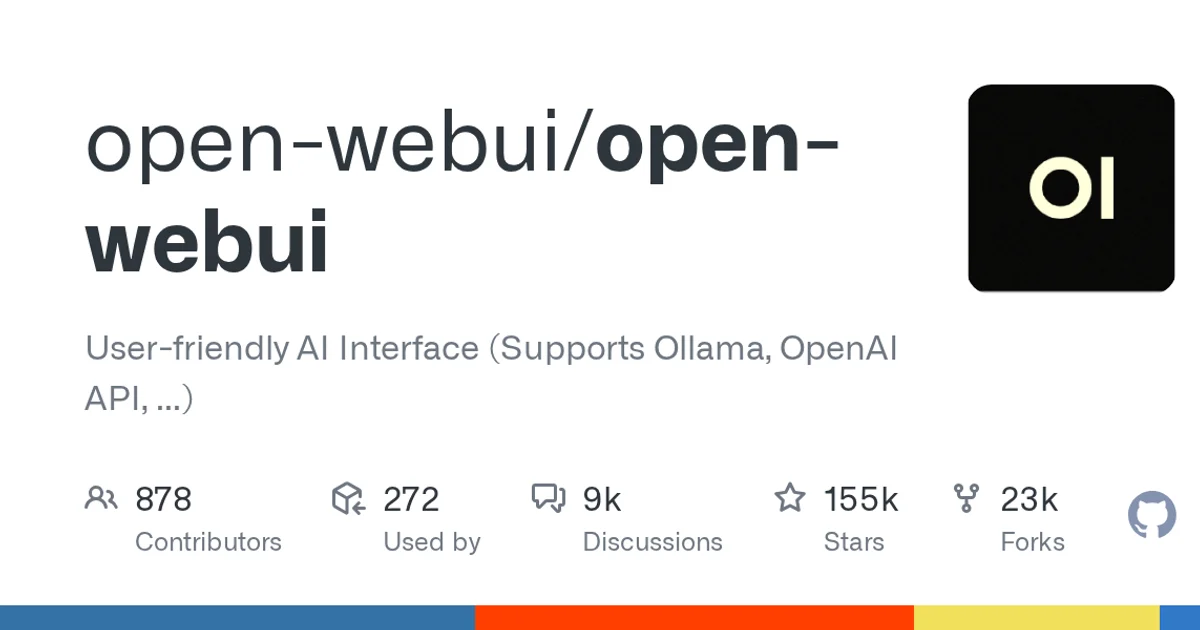
Open WebUI is the kind of project that turns a local model into something that feels like a product rather than a terminal experiment. The repository describes itself without much fuss: “User-friendly AI Interface (Supports Ollama, OpenAI API, …)”.
TL;DR: Open WebUI is a Python web app that puts a chat interface in front of Ollama and OpenAI-compatible APIs. It has 155,068 stars and 22,646 forks, and the project tags itself for MCP and LLM UI work.
What it is
At the time of writing, the repository sits at 155,068 stars with 22,646 forks and 185 open issues. The primary language is Python, the default branch is main, and the project was created on October 6, 2023. A commercial site is published separately at https://openwebui.com.
The declared topics are the more interesting part, because they describe the scope the maintainers have chosen rather than what you might guess at from the name:
| Topic | What it signals |
|---|---|
ai, llms | General positioning rather than a narrow niche |
llm-ui, llm-webui | This is a front end, not a model |
mcp | Model Context Protocol is part of the current focus |
That third row is the one to keep an eye on. MCP in the topic list means the protocol is on the project’s radar, not necessarily that every documented integration is finished.
What the numbers say
The gap between stars and forks is worth a second look. About 14 percent of stargazers have forked it. For a repository that is an application layer rather than a library, that ratio is unusually high, and it usually points at people running their own instance with modifications rather than simply watching from the sidelines.
The project was last pushed on October 12, 2026, so this is not a popular repo that quietly stopped moving.
How to try it
The deployment path is Docker, and if you already have Ollama running on the host, the shape of a compose file looks roughly like this:
services:
  open-webui:
    image: ghcr.io/open-webui/open-webui:main
    ports:
      - "3000:8080"
    volumes:
      - open-webui-data:/app/backend/data
    environment:
      - OLLAMA_BASE_URL=http://host.docker.internal:11434

volumes:
  open-webui-data:
Two details matter more than they look. The named volume is where conversation history lives, so dropping it drops your chats. And OLLAMA_BASE_URL has to reach the host, because host.docker.internal from inside the container points at your machine rather than at another service on the same network. Confirm the image reference against the current docs before you pin any of this to a real deployment.
When to use it
It makes the most sense when you want one front end across several backends. Stated support for both Ollama and the OpenAI API means the interface does not have to change when you change where inference happens.
It also fits a privacy posture. Running the chat surface on your own hardware keeps your conversations off a hosted chat service, which matters when you are working with material you would rather not hand to a third party.
When NOT to use it
If you need a hardened, access-controlled, multi-user deployment, read the deployment documentation before you commit. This is a fast-moving application with a large contributor base, and 185 open issues is a healthy amount of churn for something you intend to put in front of other people.
Check the licensing yourself too. GitHub’s license detector returns NOASSERTION for this repository, which means it did not match a standard SPDX identifier. If the license matters to your situation, read the files in the repository rather than trusting a badge.
Source and Accuracy Notes
- Project page: https://github.com/open-webui/open-webui
- Source repository: open-webui/open-webui (verified via GitHub API
html_url) - License: NOASSERTION, GitHub did not match a standard SPDX identifier (verified via GitHub API
license.spdx_id) - Stars at time of writing: 155068
- Declared topics at time of writing: ai, llm, llm-ui, llm-webui, llms, mcp
- Created 2023-10-06, last push 2026-10-12
- Star, fork, and issue counts were read from the GitHub API on 2026-10-13 and will drift.
Related Posts
ai-setup
Recall – Persistent Memory for Claude Code via MCP Hooks
Recall gives Claude Code a permanent memory store that survives session restarts and context compaction. Four hooks capture and restore context automatically — with cloud SaaS or self-hosted options.
2/28/2026
dev-tools
Automotive Skills Suite for AI Engineering
Evaluate Automotive Skills Suite for APQP, ASPICE, HARA, safety-plan, and DIA workflows with setup notes, governance risks, and SME review guidance.
5/28/2026
dev-tools
awesome-agentic-ai-zh Roadmap Guide
Explore awesome-agentic-ai-zh as a Chinese agentic AI learning roadmap, with setup notes, track selection, study workflow, and evaluation guidance.
5/28/2026