Moltis – Secure persistent AI agent server in Rust
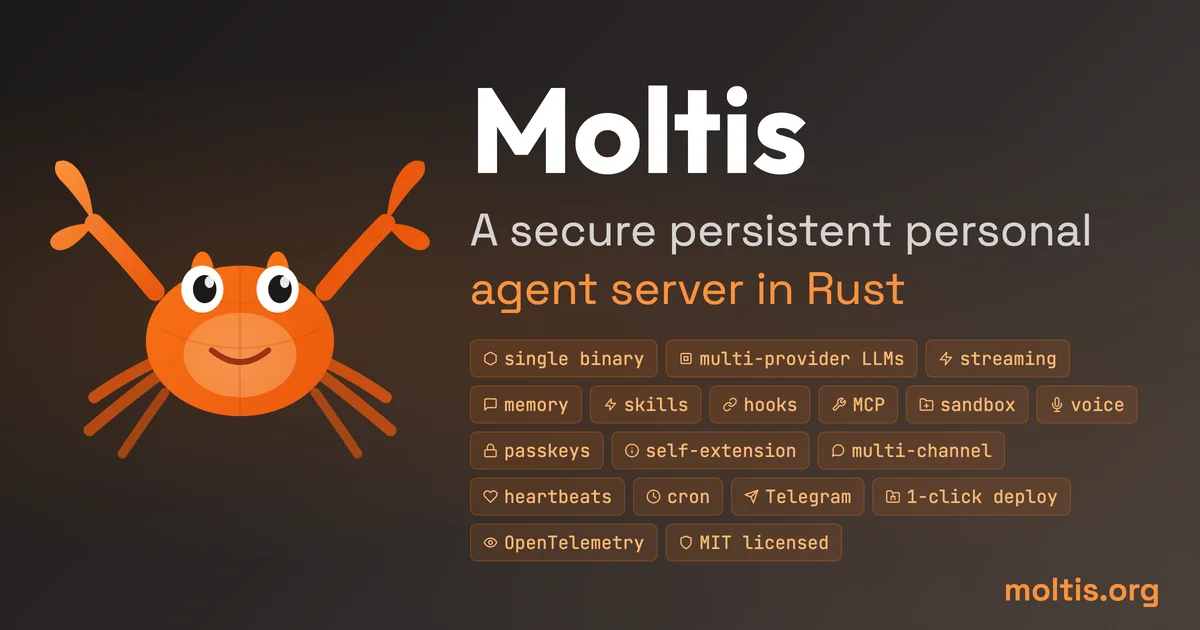
One Rust binary that runs a persistent personal AI agent on your own hardware. Sandboxed execution, voice, memory, 30+ integrations, no npm or Node.js required.
TL;DR
TL;DR: Moltis is a single Rust binary that runs a persistent personal AI agent on your own hardware — sandboxed execution, built-in voice and memory, 30+ integrations (Telegram, Discord, Slack, Matrix, and more), zero npm/Node.js dependency.
What Is Moltis?
Moltis is an open-source persistent personal agent server written in Rust. Unlike agent frameworks that run as ephemeral CLI sessions, Moltis stays running as a background server on a machine you own — a Mac Mini, Raspberry Pi, or any Linux server.
From the official project description:
A secure persistent personal agent server in Rust. One binary, sandboxed execution, multi-provider LLMs, voice, memory, Telegram, WhatsApp, Discord, Slack, Matrix, Nostr, Teams, and MCP tools. Secure by design, runs on your hardware.
The project was launched on Hacker News in February 2026 and hit the front page.
Key Features
Security-first architecture — Keys never leave your machine. Every command runs inside a sandboxed container (Docker/Podman on Linux, Apple Container on macOS, WASM sandbox), never directly on your host. The Rust workspace spans ~270K lines across 59 modular crates, each independently auditable.
Single binary, no runtime sprawl — One moltis binary, no Node.js, no npm, no Python dependency. Rust 1.81+ required.
Built-in capabilities:
- Voice I/O with STT and TTS providers
- SQLite + FTS + vector memory for cross-session recall
- Automatic edit checkpoints
- Scheduling and cron-like automation
- Browser automation
- MCP servers (stdio + HTTP/SSE)
- SSH and remote exec
- 30+ channel integrations: Telegram, Signal, Discord, Slack, Matrix, Nostr, Microsoft Teams, WhatsApp
Cursor-compatible project context — Sends project context to Cursor. Context-file threat scanning built in.
Supported LLM Providers
The moltis-providers crate (~19K lines) implements interfaces for multiple LLM providers. The README lists the architecture but does not enumerate every supported provider — check docs.moltis.org for the current provider list.
Installation
One-liner install script (macOS / Linux):
curl -fsSL https://www.moltis.org/install.sh | sh
```bash

Via Homebrew:

```bash
brew install moltis-org/tap/moltis
```bash

Via Docker (multi-arch: amd64/arm64):

```bash
docker pull ghcr.io/moltis-org/moltis:latest
```bash

Build from source:

```bash
cargo install moltis --git https://github.com/moltis-org/moltis
Architecture
Moltis is organized as a Rust workspace with 59 crates. Key modules:
| Crate | Role |
|---|---|
moltis-gateway | HTTP/WS server, RPC, auth |
moltis-tools | Tool execution and sandboxing |
moltis-providers | LLM provider implementations |
moltis-agents | Agent loop, streaming, prompt assembly |
moltis-chat | Chat engine, agent orchestration |
moltis-memory | SQLite + FTS + vector memory |
moltis-mcp | MCP server (stdio + HTTP/SSE) |
moltis-voice | STT and TTS providers |
moltis-browser | Browser automation |
The agent runner and model interface are ~7.5K lines; providers add ~19K more. Unsafe code is isolated to FFI and precompiled runtime boundaries, not the core agent loop.
Comparison with Similar Tools
| OpenClaw | Hermes Agent | Moltis | |
|---|---|---|---|
| Primary stack | TypeScript + Swift/Kotlin | Python + TypeScript TUI | Rust |
| Runtime | Node.js + npm | Python + uv | Single Rust binary |
| Local size | ~1.1M LoC | ~152K LoC | ~270K Rust LoC |
| Sandbox | App-level permissions | Local, Docker, SSH | Docker/Podman + Apple Container + WASM |
| Voice | Voice wake and talk | Voice memo transcription | Built-in STT + TTS |
| MCP | Plugin support | MCP integration | stdio + HTTP/SSE |
| Memory | Plugin-backed | Session search | SQLite + FTS + vector |
| Skills | Bundled/managed | Self-improving | Bundled + autonomous improvement |
Security Notes
- Agent runs in sandboxed containers, not directly on host
- Keys stored locally, never transmitted externally
- Password + Passkey + API keys + Vault for auth
- Context-file threat scanning on project files
- 470+ Rust test files across the workspace
FAQ
Q: Does Moltis require an API key for the LLM? A: Yes. Moltis acts as a local server and requires an API key for whichever LLM provider you configure (OpenAI, Anthropic, self-hosted, etc.). Keys stay on your machine.
Q: Can I self-host Moltis on a Raspberry Pi? A: Yes. The project targets “a Mac Mini, a Raspberry Pi, or any server you own.” The Docker image supports both amd64 and arm64 architectures.
Q: How does it compare to OpenWebUI or Ollama? A: Ollama is a local LLM inference runner. Moltis is a persistent agent server with memory, tools, multi-channel integrations (Discord, Telegram, etc.), and an agent loop. They serve different roles — Moltis could use Ollama as one of its LLM providers.
Q: Is there a plugin marketplace? A: No. The project explicitly avoids a plugin marketplace to prevent supply-chain attacks. All features are built into the monorepo and auditable together.
Source and Accuracy Notes
- Project page: moltis.org
- Source repository: github.com/moltis-org/moltis
- License: MIT (verified via GitHub)
- HN launch thread: news.ycombinator.com/item?id=46993587
- Documentation: docs.moltis.org
Related Posts
ai-setup
Recall – Persistent Memory for Claude Code via MCP Hooks
Recall gives Claude Code a permanent memory store that survives session restarts and context compaction. Four hooks capture and restore context automatically — with cloud SaaS or self-hosted options.
2/28/2026
dev-tools
Automotive Skills Suite for AI Engineering
Evaluate Automotive Skills Suite for APQP, ASPICE, HARA, safety-plan, and DIA workflows with setup notes, governance risks, and SME review guidance.
5/28/2026
dev-tools
awesome-agentic-ai-zh Roadmap Guide
Explore awesome-agentic-ai-zh as a Chinese agentic AI learning roadmap, with setup notes, track selection, study workflow, and evaluation guidance.
5/28/2026