Lucid — Read What an LLM Thinks Before It Answers
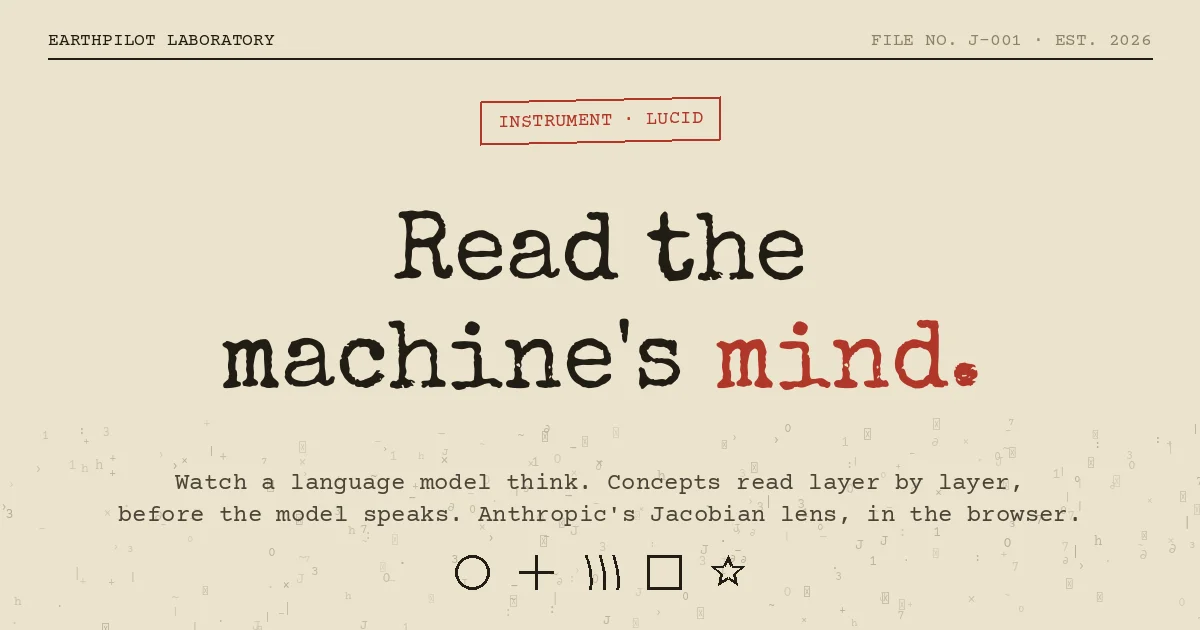
Lucid is a free web tool that lets you watch an AI model's internal concept activation layer by layer before it commits to an answer, based on Anthropic's Jacobian Lens research.
TL;DR
TL;DR: Lucid is a free, no-login web tool that visualizes what an LLM is thinking internally before it generates a response — letting you watch concept activations unfold layer by layer and even edit the model’s internal state mid-computation.
Source and Accuracy Notes
- Project page: lucid.earthpilot.ai
- Source repository: no public repo (EarthPilot is a private AI lab, no open-source release confirmed)
- License: not applicable — closed-source free web tool, no license file
- HN launch thread: news.ycombinator.com/item?id=48849618 (34 points, July 2026)
- Anthropic paper reference: transformer-circuits.pub/2026/workspace/index.html
What Is Lucid?
Lucid is a free web tool built by EarthPilot, a small AI research lab and playground. It implements a technique inspired by Anthropic’s Jacobian Lens — a method for visualizing the internal activations of a language model as it processes a prompt, layer by layer, before it commits to generating a token.
The core idea comes from Anthropic’s 2026 paper “Verbalizable Representations Form a Global Workspace in Language Models”. Rather than just reading the final output logits, Lucid watches which concepts activate inside the model’s middle layers while it’s still “thinking”.
For example, ask a model to describe a symbol of “three curving lines of water” and you can watch “ocean”, “sea”, and “surf” light up across several layers before the model eventually settles on “waves” as the final answer. The tool surfaces these intermediate concept activations in real time.
What You Can Do with It
- Watch concepts unfold — see which ideas the model holds about a topic before it speaks
- Edit internal state — inject a concept like “fire” into the middle layer of a prompt about the ocean and watch the answer shift accordingly
- Read the model’s inner workspace — let the model observe and report on its own intermediate activations
- Experiment with open models — works against开放的模型 without needing an API key
How to Use Lucid
Step 1: Open the Tool
Visit lucid.earthpilot.ai. No sign-up, no API key, no login required.
Step 2: Enter a Prompt
Type any text prompt into the input field. Lucid will begin processing and show the model’s internal concept activations across its layers.
Step 3: Explore the Layers
The interface displays activations as the model processes each token. You can see which semantic concepts are firing at each depth — a window into the model’s “mental” representation before it produces its final output.
Step 4: Edit and Intervene
Use the state editor to inject or modify activations mid-computation. For example, inserting “fire” into a layer processing an ocean prompt will visibly shift the model’s attention and subsequent output.
How It Works: Jacobian Lens
Traditional LLM interpretability tools like TransformerLens and logit lens have been used to peer inside models. The Jacobian Lens approach differs by computing the Jacobian matrix to correct for the shift in basis from initial to final layers — something plain logit lens does not account for.
According to the HN discussion, Jacobian lens “beats a plain logit lens on some architectures and does nothing on others, and it is not about model size.” This makes it an interesting research-grade tool that behaves differently depending on the model architecture.
The EarthPilot implementation appears to apply this technique to open-access models via a web interface, making it accessible without needing to run anything locally.
Deeper Analysis
Why It Matters
Most LLM interaction is purely input-output — you ask, it answers. Lucid makes the process visible. For researchers, it offers a way to develop intuition about how transformer-based models represent and retrieve semantic information across layers. For curious developers, it provides a rare peek under the hood.
Limitations
From the HN discussion, the approach does not uniformly improve interpretability across all model architectures. Some models show clear, stable concept activations; others show little useful signal through the Jacobian lens.
The site itself is minimal — generated content and sparse documentation suggest this is a research prototype rather than a polished product. EarthPilot explicitly describes it as a “lab and playground.”
Similar Tools
- TransformerLens — open-source Python library for mechanistic interpretability, the foundation much of this research builds on
- Arize Phoenix — LLM observability and evaluation platform with trace-level introspection
- GGUF + llama.cp — local inference with ability to extract logits and internal states
FAQ
Q: Is Lucid open source? A: No public source repository exists. EarthPilot describes it as a research tool from their AI lab. The underlying Anthropic paper is public, and TransformerLens (an open-source library) implements related techniques.
Q: Does it work with any LLM? A: It works with supported open models. The exact model coverage is not documented on the site. According to the author, it was tested successfully on open-access models.
Q: Is my prompt data private? A: EarthPilot’s privacy policy is not linked on the tool page. As a research prototype, assume no data privacy guarantees.
Q: How is this different from logit lens? A: Logit lens reads the untransformed residual stream at each layer. Jacobian lens corrects for basis rotation using the model’s Jacobian matrix, which can reveal cleaner concept representations in some architectures.
Conclusion
Lucid is a curiosity-driven research tool that makes the invisible — what a model is actually “thinking” internally — visible in a web interface. It is free, requires no login, and offers a genuinely novel window into LLM mechanics. Whether you are a researcher studying mechanistic interpretability or a developer curious about how transformers represent meaning, it is worth a few minutes of exploration.
If you want to go deeper, read Anthropic’s Jacobian Lens paper and explore TransformerLens to run similar experiments on your own hardware.
Related Posts
ai-setup
Recall – Persistent Memory for Claude Code via MCP Hooks
Recall gives Claude Code a permanent memory store that survives session restarts and context compaction. Four hooks capture and restore context automatically — with cloud SaaS or self-hosted options.
2/28/2026
dev-tools
Automotive Skills Suite for AI Engineering
Evaluate Automotive Skills Suite for APQP, ASPICE, HARA, safety-plan, and DIA workflows with setup notes, governance risks, and SME review guidance.
5/28/2026
dev-tools
awesome-agentic-ai-zh Roadmap Guide
Explore awesome-agentic-ai-zh as a Chinese agentic AI learning roadmap, with setup notes, track selection, study workflow, and evaluation guidance.
5/28/2026