Lucid – See What an LLM Thinks Before It Answers
A free browser tool showing which internal concepts a language model holds mid-computation, using Anthropic's Jacobian lens to let you observe reasoning layer by layer.
TL;DR
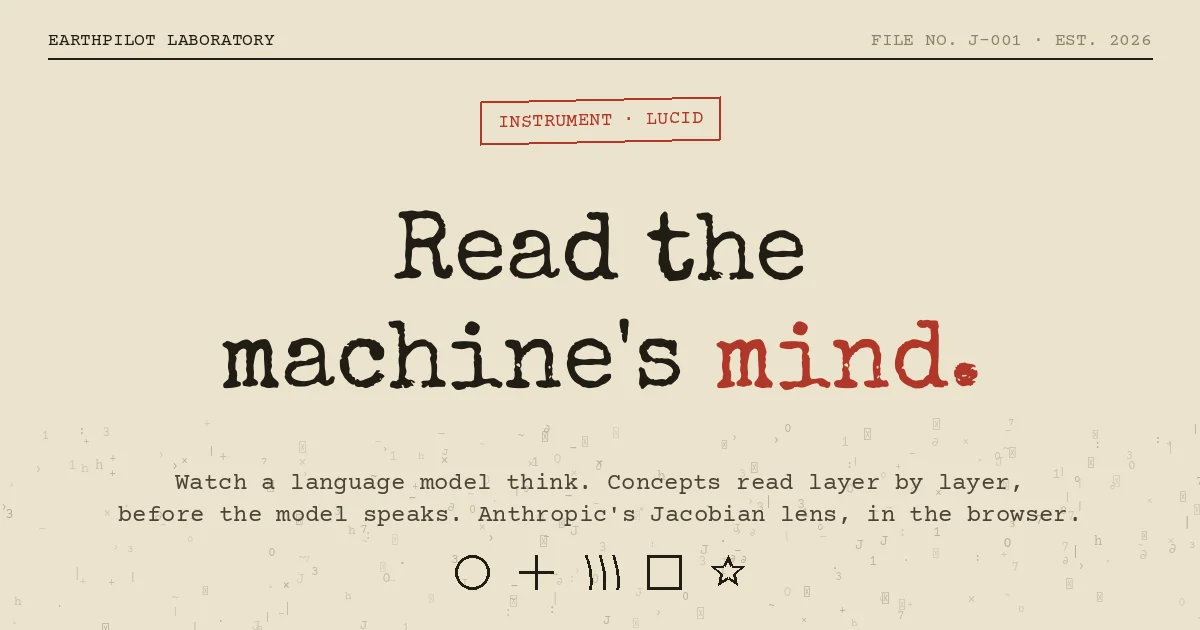
TL;DR: Lucid is a free browser tool that uses Anthropic’s Jacobian lens to show you which internal concepts a language model is holding before it produces an answer — letting you observe the reasoning process layer by layer in real time.
Source and Accuracy Notes
- Project page: lucid.earthpilot.ai
- Source repository: none (proprietary research tool)
- License: free web tool, no license stated
- HN launch thread: news.ycombinator.com/item?id=48849618
What Is Lucid?
Lucid is an open-access web instrument from EarthPilot Laboratory that applies Anthropic’s Jacobian lens to any language model prompt. Where a standard chatbot shows you the final answer, Lucid shows you the concepts the model is holding in its workspace — the privileged internal representations Anthropic calls J-space — at each computation layer, before the response is emitted.
The tool frames its UI around a psychological experiment analogy: Zener cards, the standardized test Carl Jung used to probe whether one mind could perceive another’s mental contents. In Lucid, you type a prompt and watch which concepts enter the workspace, at which layer, and which the model holds but never says.
The public instance runs on small open models — Qwen 0.5B to 3B and Pythia 1.4B — with more models available on request. A paid or larger-model version is not publicly documented; the open tier is the verified baseline.
Setup Workflow
No installation required. Lucid runs entirely in the browser.
Step 1: Open the tool
Navigate to lucid.earthpilot.ai. No account, no API key, no sign-up flow.
Step 2: Select a model
The UI defaults to one of the small open models (Qwen or Pythia). No configuration needed — the Jacobian lens is fit to the model at session start.
Step 3: Enter any prompt
Type a question or statement into the prompt field. The lens performs a single forward pass and renders the concept activations per layer.
Step 4: Inspect layer-by-layer reasoning
The output shows:
- Top concepts per layer — ranked by activation strength
- Position tracking — how concept rank shifts as layers progress
- Pinned token behavior — what the model holds but does not surface in the answer
Step 5: Share the session
Every session exports as a shareable slice page. This lets you point someone directly to a specific prompt-and-activation trace.
Deeper Analysis
How the Jacobian lens works
Anthropic introduced the Jacobian lens in their J-space research, published in 2025. Rather than treating a language model’s output as a single flat probability distribution, J-space isolates the subset of internal representations that are both reportable (the model can reference them) and redirectable (you can intervene on them without destabilizing the forward pass).
Lucid applies this by computing the Jacobian matrix between the model’s initial and final layers, identifying concepts that enter the privileged workspace before the response is generated. The result is a layer-by-layer trace of concept activation rather than a token-by-token logit trace.
What you can actually see
In practice, Lucid’s card-based interface shows concept activations ranked per layer. The key insight is that not all activated concepts make it into the final answer — some are held but discarded before emission. This gives a precise view of the suppression process, not just the generation process.
For AI safety and interpretability researchers, this means you can observe cases where a model “knows” something but does not say it — the Zener card framing is literal here. For developers, this is a first-pass diagnostic for whether a model is reasoning about your prompt in the way you expect.
Limitations of the public version
The public tier is intentionally limited to small open models. The behavior on larger frontier models (Claude, GPT-4o) is not available through the open instrument — Anthropic’s own implementation runs on those models internally. The Jacobian lens is also fit per model, so switching models requires a separate calibration pass.
Practical Evaluation Checklist
- Free, no install, no account — open lucid.earthpilot.ai and start
- Prompt any question; observe concept rank shift per layer
- Try a prompt where the model “should” know something and check whether the concept appears in layer traces before the answer
- Export a session and share the slice URL
- Compare concept activation between a simple factual query and a multi-step reasoning query
Security Notes
Lucid is a read-only instrument. It performs a single forward pass on your prompt with no persistent storage of model outputs. The session trace is stored server-side only for the shareable slice feature — you can avoid sharing by not using the export function.
No data is used for model training. The EarthPilot privacy policy covers this instrument; a dedicated policy page for Lucid specifically was not found at time of writing.
FAQ
Q: Is this related to Anthropic’s internal interpretability work? A: Yes. Lucid applies the Jacobian lens technique that Anthropic published openly. The EarthPilot Laboratory is an independent research group building on the published method, not an Anthropic product.
Q: Can I use this with Claude or GPT-4o? A: Not through the public instrument. The open tier runs Qwen 0.5B–3B and Pythia 1.4B. Larger or frontier models are not currently accessible through the free web UI.
Q: How is this different from logit lens? A: Logit lens traces residual stream activations assuming the basis stays constant across layers. Jacobian lens corrects for the shift in basis from initial to final layer — the math is architecture-aware rather than architecture-agnostic. On some models this makes no difference; on others it substantially changes which concepts are visible at each position.
Q: Does editing a concept actually change the model’s output? A: The current public instrument is observational. EarthPilot’s research lab has published related work on intervention; the free tool at lucid.earthpilot.ai is the observation mode, not the edit mode.
Conclusion
Lucid is the most accessible public implementation of Anthropic’s Jacobian lens interpretability technique. For AI engineers and researchers who want to see what a model is thinking before it answers — without spinning up a local inference stack or requesting API access to internal tools — this is the fastest path in. The Zener card framing is more than aesthetic: it is a precise description of what the tool actually does, which is to probe whether one mind can know the contents of another before the response is given.
Run the experiment yourself at lucid.earthpilot.ai.
Related Posts
ai-setup
Recall – Persistent Memory for Claude Code via MCP Hooks
Recall gives Claude Code a permanent memory store that survives session restarts and context compaction. Four hooks capture and restore context automatically — with cloud SaaS or self-hosted options.
2/28/2026
dev-tools
Automotive Skills Suite for AI Engineering
Evaluate Automotive Skills Suite for APQP, ASPICE, HARA, safety-plan, and DIA workflows with setup notes, governance risks, and SME review guidance.
5/28/2026
dev-tools
awesome-agentic-ai-zh Roadmap Guide
Explore awesome-agentic-ai-zh as a Chinese agentic AI learning roadmap, with setup notes, track selection, study workflow, and evaluation guidance.
5/28/2026