LLMKube – Kubernetes Operator for Local LLM Inference
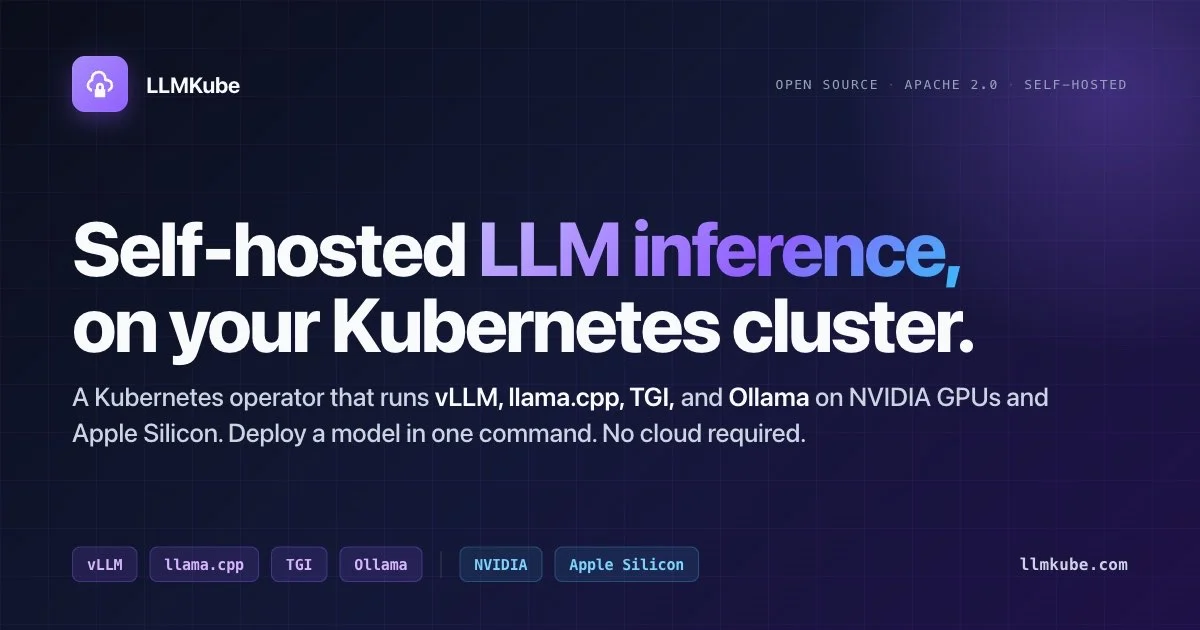
LLMKube is an open-source Kubernetes operator that manages local LLM inference across NVIDIA, Apple Silicon Metal, and AMD GPUs from a single YAML spec, with an OpenAI-compatible API.
TL;DR
TL;DR: LLMKube is an open-source Kubernetes operator that manages local LLM inference across NVIDIA, Apple Silicon Metal, and AMD GPUs from a single YAML spec. Deploy a model with one CLI command and query it via an OpenAI-compatible endpoint.
Source and Accuracy Notes
- Project page: llmkube.com
- Source repository: github.com/defilantech/LLMKube
- License: Apache 2.0 (verified via GitHub API
license.spdx_id) - Latest release: v0.9.13 (verified via GitHub API, published 2026-07-29)
- GitHub stars: 180 (as of 2026-07-30)
- HN launch thread: news.ycombinator.com/item?id=48247414
What Is LLMKube?
LLMKube is a Kubernetes operator that turns LLM deployment into a two-line YAML problem. Define a Model and an InferenceService, and the operator handles downloading, caching, GPU scheduling, health checks, scaling, and exposing an OpenAI-compatible API — all managed through standard Kubernetes tooling.
The key differentiator is heterogeneous hardware support. Where most inference tools are NVIDIA-only or CPU-only for Apple Silicon, LLMKube manages NVIDIA GPUs, Apple Silicon Metal GPUs, and AMD GPUs in the same cluster through a unified CRD interface. A Mac Studio running local Metal inference and a cloud node with NVIDIA cards both surface as InferenceService objects to kubectl.
LLMKube is written in Go and released under Apache 2.0. The current version is v0.9.13 (published July 29, 2026).
Core Architecture
LLMKube has two cooperating processes:
- In-cluster controller — owns Kubernetes-side desired state, watches
ModelandInferenceServicecustom resources, schedules runtime pods running llama.cpp, vLLM, or TGI - Metal Agent (optional, Apple Silicon only) — runs as a native macOS process that spawns
llama-serverwith full Metal GPU access, then registers endpoints back into the cluster
┌──────────────────────────────┐      ┌──────────────────────────────┐
│ Linux Server / Cloud         │      │ Mac (Apple Silicon)          │
│  Kubernetes                 │      │ Metal Agent                  │
│  LLMKube Controller         │◄────►│ Watches K8s API               │
│  InferenceService CRDs       │  LAN │ Spawns llama-server (Metal)  │
│  NVIDIA Nodes (CUDA)        │      │ Full GPU + unified memory    │
└──────────────────────────────┘      └──────────────────────────────┘
```bash

The Metal Agent is the distinctive piece. Apple Silicon Metal GPUs cannot be accessed from inside a container, so every container-native inference tool either ignores Macs or runs slow CPU-only inference. LLMKube inverts the model — the agent runs native on macOS and bridges back into Kubernetes.

## Setup Workflow

### Step 1: Install the CLI

```bash
brew install defilantech/tap/llmkube
```bash

### Step 2: Install the operator on any K8s cluster

```bash
helm repo add llmkube https://defilantech.github.io/LLMKube
helm install llmkube llmkube/llmkube --namespace llmkube-system --create-namespace
```bash

Supported cluster types include kind, minikube, GKE with GPUs, MicroK8s on DGX Spark, and air-gapped environments.

### Step 3: Deploy a model

```bash
llmkube deploy phi-4-mini
```bash

The operator downloads the model, creates the Deployment, sets up the Service, and exposes an OpenAI-compatible endpoint. The built-in model catalog contains tested defaults for common models.

To deploy with GPU acceleration:

```bash
llmkube deploy llama-3.1-8b --gpu --gpu-count 1
```bash

### Step 4: Query the endpoint

```bash
kubectl port-forward svc/phi-4-mini 8080:8080 &
curl http://localhost:8080/v1/chat/completions \
  -H "Content-Type: application/json" \
  -d '{"messages":[{"role":"user","content":"Hello!"}],"max_tokens":100}'
```bash

Works with the OpenAI Python/Node/Go SDKs, LangChain, and LlamaIndex out of the box.

### Deploy without the CLI (plain kubectl)

```yaml
apiVersion: inference.llmkube.dev/v1alpha1
kind: Model
metadata:
  name: tinyllama
spec:
  source: https://huggingface.co/TheBloke/TinyLlama-1.1B-Chat-v1.0-GGUF/resolve/main/tinyllama-1.1b-chat-v1.0.Q4_K_M.gguf
  format: gguf
---
apiVersion: inference.llmkube.dev/v1alpha1
kind: InferenceService
metadata:
  name: tinyllama
spec:
  modelRef: tinyllama
  replicas: 1
  resources:
    cpu: "500m"
    memory: "1Gi"
```bash

```bash
kubectl apply -f model.yaml
Deeper Analysis
ModelRouter: Hybrid Local + Cloud Routing
ModelRouter is a CRD that puts a policy-aware OpenAI-compatible endpoint in front of both local InferenceServices and external providers (Anthropic, OpenAI, LiteLLM). It enforces:
- Fail-closed for regulated data — PII or PHI data is statically rejected at the Kubernetes-enforcement layer and refused at runtime with HTTP 503 if the local pool cannot serve the request
- Per-rule and per-backend timeout budgets — strict policy tiers fast-fail; lenient tiers stay patient; context timeouts apply per attempt so a slow primary does not eat the fallback budget
- Policy-aware routing — an agent running on a local model can selectively hand off complex steps to Claude or GPT without the agent code knowing where the model lives
Foreman: Agentic Coding on Your Own Fleet
Foreman is an opt-in add-on that introduces CRDs for orchestrating coding agents across a heterogeneous LLM fleet. It ships its own Helm chart with four custom resources (Workload, AgenticTask, Agent, FleetNode). The v0.1 shape runs a three-node pipeline:
- Coder agent produces a branch
- Verifier agent runs
make fmt vet lint test - Reviewer agents score the diff against the issue body
Foreman has shipped real DCO-signed branches to the LLMKube repository: PR #508 and PR #588.
Foreman targets shops where on-prem hardware or sovereignty constraints make the cloud API model a poor fit — it is the control plane for fleets doing autonomous work, not a replacement for individual developer tools.
Comparison with Adjacent Tools
| LLMKube | vLLM / TGI | Ollama | KServe | |
|---|---|---|---|---|
| Kubernetes-native CRDs | Yes | No | No | Yes |
| Apple Silicon Metal GPU | Native (Metal Agent) | No | Local only | No |
| NVIDIA GPU | Yes | Yes | Limited | Yes |
| AMD GPU | Yes (Vulkan) | No | Limited | No |
| Heterogeneous clusters | Yes | No | No | No |
| Hybrid local + cloud routing | ModelRouter CRD | No | No | No |
| OpenAI-compatible API | Built-in | Yes | Yes | Requires config |
| Model catalog + deploy CLI | llmkube deploy | Manual | ollama pull | Manual |
| Prometheus + Grafana | Included | External | No | External |
Practical Evaluation Checklist
- Deploy to kind cluster in under 5 minutes using the Quick Start above
- Verify OpenAI SDK streaming works against the local endpoint
- Test Metal Agent on Apple Silicon if hardware is available
- Deploy a ModelRouter with a PII rule and verify fail-closed behavior
- Run the built-in throughput benchmark:
llmkube bench phi-4-mini - Test Foreman Workload against a fork of a real repository
Security Notes
- Metal Agent runs as a native macOS process, not a container — keep the macOS host secure as it has direct Metal GPU access
- ModelRouter fail-closed enforcement is at the Kubernetes layer, not application code — audited rules in
spec.rulesare enforced even if the application code is compromised - Foreman agents run against your repository with whatever permissions the agent credentials carry — use scoped tokens
- No built-in auth on the inference endpoint; wrap with your own authentication layer or network policies
FAQ
Q: Does LLMKube support GGUF models?
A: Yes. The Model CRD accepts any HuggingFace URL to a GGUF file via the spec.source field with spec.format: gguf.
Q: Can it route between local and cloud models based on data classification?
A: Yes. ModelRouter’s spec.rules[].match.dataClassification with spec.rules[].failClosed: true enforces this at the proxy layer, rejecting routing for classified data to cloud backends.
Q: What Kubernetes versions are supported? A: The operator targets Kubernetes 1.26 and later. Tested variants include kind, minikube, GKE, MicroK8s, and OpenShift.
Q: How does LLMKube compare to Ollama? A: Ollama is simpler for a single machine. LLMKube is for teams that need Kubernetes-managed inference across multiple nodes and hardware types (NVIDIA + Apple Silicon + AMD) with unified observability and policy controls.
Conclusion
LLMKube fills the gap between single-machine inference tools (Ollama) and enterprise NVIDIA-only serving stacks (vLLM on KServe). Its Kubernetes-native approach, heterogeneous hardware support, and built-in policy routing make it worth evaluating if you are running inference across mixed infrastructure. The Metal Agent alone justifies the project — no other Kubernetes LLM tool gives Apple Silicon its full GPU memory access.
The ModelRouter and Foreman add-ons push LLMKube beyond simple inference hosting into the territory of platform-level AI infrastructure for regulated or air-gapped environments.
Explore the project at llmkube.com or deploy with brew install defilantech/tap/llmkube followed by llmkube deploy to get started.
Related Posts
dev-tools
Raindrop Workshop Agent Debugging Guide
Set up Raindrop Workshop for local agent traces, tool-call debugging, replay workflows, SQLite storage, instrumentation, and eval repair loops.
5/28/2026
dev-tools
AgentMesh – Define AI Agent Teams in YAML
Define multi-agent AI workflows in YAML and run them locally with one command. AgentMesh brings Docker Compose patterns to AI agent orchestration.
5/28/2026
dev-tools
Cicada – FOSS CI/CD That Replaces YAML With a Real Language
Cicada replaces GitHub Actions and GitLab CI YAML configs with a custom functional DSL, letting you write pipelines using variables, functions, and shell.
5/29/2026