heretic: training-free refusal removal for open models
heretic is an AGPL-3.0 Python tool that modifies open-weight models to remove refusal behavior and cut sycophancy without retraining, with 38,125 GitHub stars.
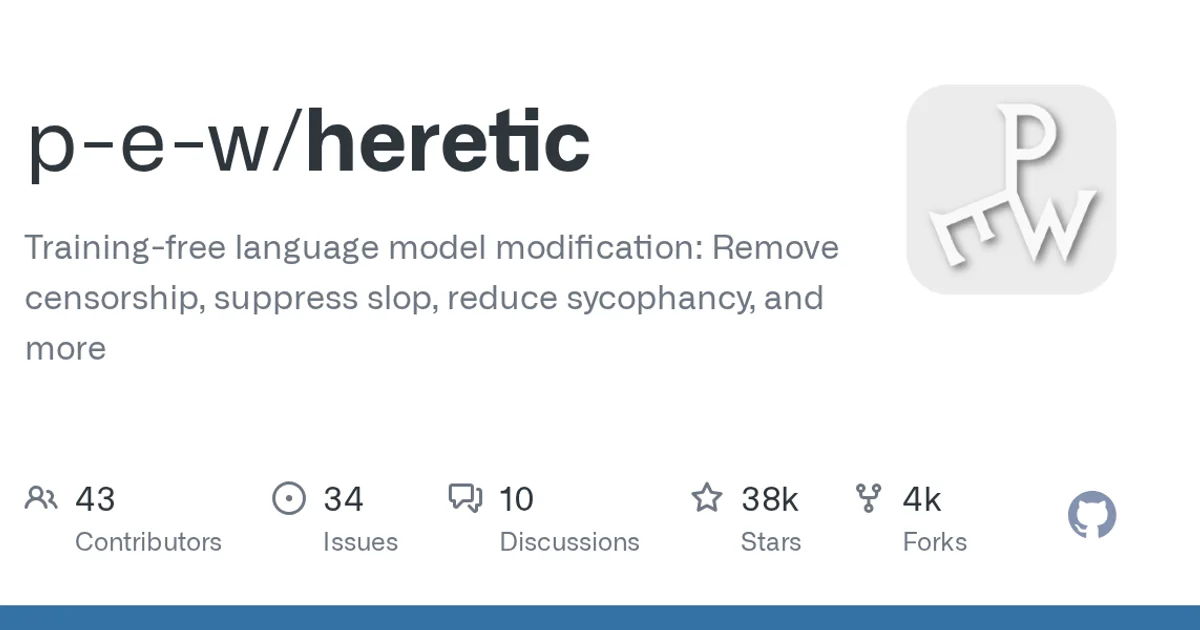
TL;DR: heretic modifies open-weight language models so they stop refusing and stop agreeing with you, and it does it without any training. It is a Python project under AGPL-3.0 with 38,125 stars and a homepage at heretic-project.org.
What it is
The repository description states the scope directly: “Training-free language model modification: Remove censorship, suppress slop, reduce sycophancy, and more.”
Three separate behaviors are bundled in one tool, and they are not the same thing. Refusal removal means the model stops declining requests it declined before. Sycophancy suppression means it stops mirroring your opinion back at you. The remaining items are variations on rewriting the model’s default personality, which the topic list names as abliteration alongside anti-censorship and censorship-resistance.
Why training-free is the interesting part
The word doing the most work in that description is “training-free”. The conventional way to change how a model behaves is to fine-tune it, which means collecting data, running a training job, and accepting the compute bill. That is slow, it changes other behavior as a side effect, and it requires a training pipeline you maintain.
Abliteration takes a different route. The approach traces behavior to a direction in the model’s internal activation space, then removes that direction from the weights themselves. No dataset, no gradient steps, no optimizer. You run the tool against a checkpoint on disk and write out a modified copy.
That property is what makes it usable. The cost is the size of the model file and some time to process it, the operation is reproducible, and you can compare the original and the modified model side by side to see what actually changed.
The practical caveat is that the same technique cuts both ways. Removing refusal behavior from a model also removes the behavior that keeps a model from doing things you would rather it did not do, which is worth weighing before you ship a modified checkpoint to anyone else.
What the metadata says
| Field | Value |
|---|---|
| Language | Python |
| License | AGPL-3.0 |
| Stars | 38,125 |
| Forks | 4,326 |
| Open issues | 74 |
| Topics | abliteration, anti-censorship, anticensorship, censorship, censorship-resistance, llm |
| Homepage | https://heretic-project.org |
| Created | 2025-09-21 |
| Last push | 2026-11-01 |
A 4,326 fork count against 38,125 stars is the same ratio you see in projects people genuinely run, and 74 open issues on a repository this size points to an active project rather than a dormant one. The last push on November 1, 2026 is recent enough that the tool is still being worked on.
AGPL-3.0 is the part to read carefully
This is the one detail worth slowing down on. AGPL-3.0 is the strongest copyleft in common use, and unlike GPL it extends to software you offer over a network. If you modify heretic and run your modified version as a service, you owe your users the corresponding source.
The license covers the tool, not the weights. The models you run it against carry their own licenses, and a tool that rewrites weights does not change what you are licensed to do with the result. Read both before you put a modified checkpoint into a product.
For a research tool you run locally on your own machine, AGPL is not an obstacle. For anything you intend to distribute or host, it is the first question to answer.
How to try it
git clone https://github.com/p-e-w/heretic.git
cd heretic
pip install -e .
The tool operates on a local model directory and writes out a modified copy, leaving the original in place:
# Produce a modified copy of a local model
python -m heretic ./models/my-model --output ./models/my-model-modified
Check the documentation for the exact command name and flags before you rely on that syntax, and confirm which model formats and architectures the current release supports. Expect a GPU with enough memory to hold the model you are modifying.
The homepage at heretic-project.org carries the project documentation and is the right place to check the current supported model list.
When to use it
heretic fits when you are running an open-weight model locally and want more direct answers, when you are studying refusal behavior as a research question, or when you need a reproducible way to compare a model’s behavior before and after a weight edit.
It does not fit when you need a model you are allowed to redistribute under the original license, and it does not fit if you are building a hosted service on top of a modified copy without reading what AGPL-3.0 obligates you to publish.
Source and Accuracy Notes
- Project page: https://github.com/p-e-w/heretic
- Source repository: p-e-w/heretic (verified via GitHub API
html_url) - License: AGPL-3.0 (verified via GitHub API
license.spdx_id) - Stars at time of writing: 38125
- Forks at time of writing: 4326
- Open issues at time of writing: 74
- Homepage listed in repository metadata: https://heretic-project.org
- Repository created: 2025-09-21
- Last push: 2026-11-01
Related Posts
dev-tools
Automotive Skills Suite for AI Engineering
Evaluate Automotive Skills Suite for APQP, ASPICE, HARA, safety-plan, and DIA workflows with setup notes, governance risks, and SME review guidance.
5/28/2026
dev-tools
awesome-agentic-ai-zh Roadmap Guide
Explore awesome-agentic-ai-zh as a Chinese agentic AI learning roadmap, with setup notes, track selection, study workflow, and evaluation guidance.
5/28/2026
dev-tools
Baguette iOS Simulator Automation Guide
Set up Baguette for iOS Simulator automation, web dashboards, device farms, gesture input, streaming, and camera testing with Xcode caveats.
5/28/2026