FizzBee – Formal Requirements Engineering for AI Coding
FizzBee is a free web app that uses formal verification to elicit requirements, uncover gaps, and generate precise specs for AI coding agents — fewer iterations, more correct code.
TL;DR
TL;DR: FizzBee is a free, no-signup web app that applies formal verification to the requirements phase — asking high-signal questions, converting specs to formal notation, and generating validation scenarios that AI coding agents can execute against.
Source and Accuracy Notes
- Project page: fizzbee.ai
- Source repository: github.com/fizzbee-io/fizzbee
- License: Apache-2.0 (verified via GitHub API
license.spdx_id) - HN launch thread: news.ycombinator.com/item?id=48835012
What Is FizzBee?
FizzBee is two things: an open-source formal methods engine (the underlying technology, available on GitHub) and a web app that applies that engine to requirements engineering for AI coding agents.
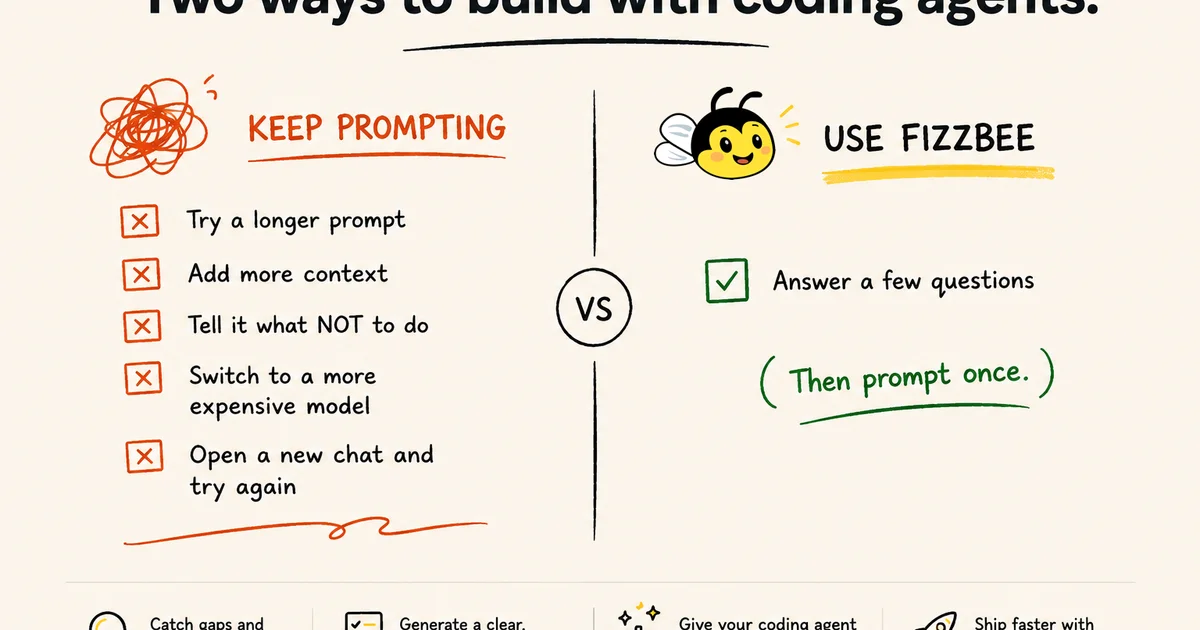
The problem it solves is familiar to anyone who has handed a spec to an AI coding agent: the agent silently fills in gaps with assumptions, produces code that does not match intent, and the iteration cycle begins. FizzBee intercepts this by making requirements explicit and formally verifiable before any code is written.
The founder described it as: “Every prompt leaves decisions unmade — and your agent will make them silently. FizzBee asks the questions your prompt did not.”
The engine is based on the TLA+ lineage — a formal specification language for describing concurrent and distributed systems. FizzBee brings this capability to a guided, interactive web UI that does not require knowledge of TLA+ syntax.
How It Works
FizzBee runs a three-phase workflow:
1. Elicitation
You describe your idea in plain language. FizzBee then asks targeted follow-up questions that expose scope ambiguities, missing preconditions, and unstated constraints. The founder notes that these questions have “high signal follow-up questions” that are the most time-consuming part of manual requirements work.
2. Formal Specification
Your requirements are converted to a formal specification. FizzBee checks this spec for contradictions, logical gaps, and completeness — the kind of hidden inconsistency that only surfaces as a production incident months later.
3. Validation Scenarios
FizzBee generates concrete scenarios that confirm the specification matches your expectations. These scenarios serve as a test oracle: any code the AI agent produces can be validated against them.
The output is a structured specification document that you share with your coding agent. The agent has a precise target rather than a vague prompt.
Why Formal Verification Matters for AI Agents
Traditional AI coding assistants generate plausible-looking code that may satisfy the letter of a prompt while violating its spirit. Formal verification does not predict — it proves properties about the spec. FizzBee applies this proof capability to catch:
- Contradictory requirements that no prompt engineering can reconcile
- Missing edge cases that only emerge under specific interleavings
- Assumptions that hold locally but break under concurrency
The result is fewer iteration cycles and more correct output from the downstream agent.
Practical Evaluation Checklist
- Problem addressed: Ambiguous requirements leading to incorrect AI-generated code
- Core mechanism: Formal specification + scenario generation
- Interface: Free web app, no signup required
- Underlying engine: Open-source Apache-2.0 (fizzbee-io/fizzbee on GitHub)
- Language lineage: TLA+-style formal methods
- HN reception: 27 points, 5 comments (positive signal on the elicitation approach)
- Key gap it fills: The requirements phase before agentic code generation
Security Notes
FizzBee processes requirements text through its web app. No persistent data or code is stored on FizzBee’s servers beyond the active session. For sensitive specifications, the open-source engine can be self-hosted — see the GitHub repository for self-hosting instructions.
FAQ
Q: Do I need to know TLA+ or formal methods to use FizzBee? A: No. The web app guides you through plain-language elicitation. The formal translation happens internally. You only write natural language requirements.
Q: Is FizzBee competing with AI coding agents like Cursor or Claude? A: No — it is upstream of them. FizzBee improves the requirements that you hand to an agent, rather than generating code itself. It pairs with any AI coding tool.
Q: Can I self-host FizzBee? A: The underlying engine is open source. Self-hosting options are documented in the fizzbee-io/fizzbee repository.
Q: What does the output look like? A: A structured specification document with formal constraints and validation scenarios. The founder shared a sample project that demonstrates the interface.
Q: Is there a free tier? A: The web app is free to use without an account. The underlying engine is open source under Apache-2.0.
Conclusion
FizzBee tackles a real problem in the AI coding workflow: the gap between a prompt and a correct specification. By applying formal verification to the requirements phase, it gives coding agents a precise target instead of an ambiguous one. The free web app makes this accessible without any formal methods background, while the Apache-2.0 engine on GitHub lets teams self-host or extend it. Worth trying before handing your next complex feature spec to an AI agent.
Related Posts
ai-setup
Recall – Persistent Memory for Claude Code via MCP Hooks
Recall gives Claude Code a permanent memory store that survives session restarts and context compaction. Four hooks capture and restore context automatically — with cloud SaaS or self-hosted options.
2/28/2026
dev-tools
Automotive Skills Suite for AI Engineering
Evaluate Automotive Skills Suite for APQP, ASPICE, HARA, safety-plan, and DIA workflows with setup notes, governance risks, and SME review guidance.
5/28/2026
dev-tools
awesome-agentic-ai-zh Roadmap Guide
Explore awesome-agentic-ai-zh as a Chinese agentic AI learning roadmap, with setup notes, track selection, study workflow, and evaluation guidance.
5/28/2026