Fireproof – Local-First Database with Encrypted Sync
Fireproof is an embedded JavaScript database with encrypted sync, Git-like versioning, and React hooks for building offline-capable apps.
TL;DR
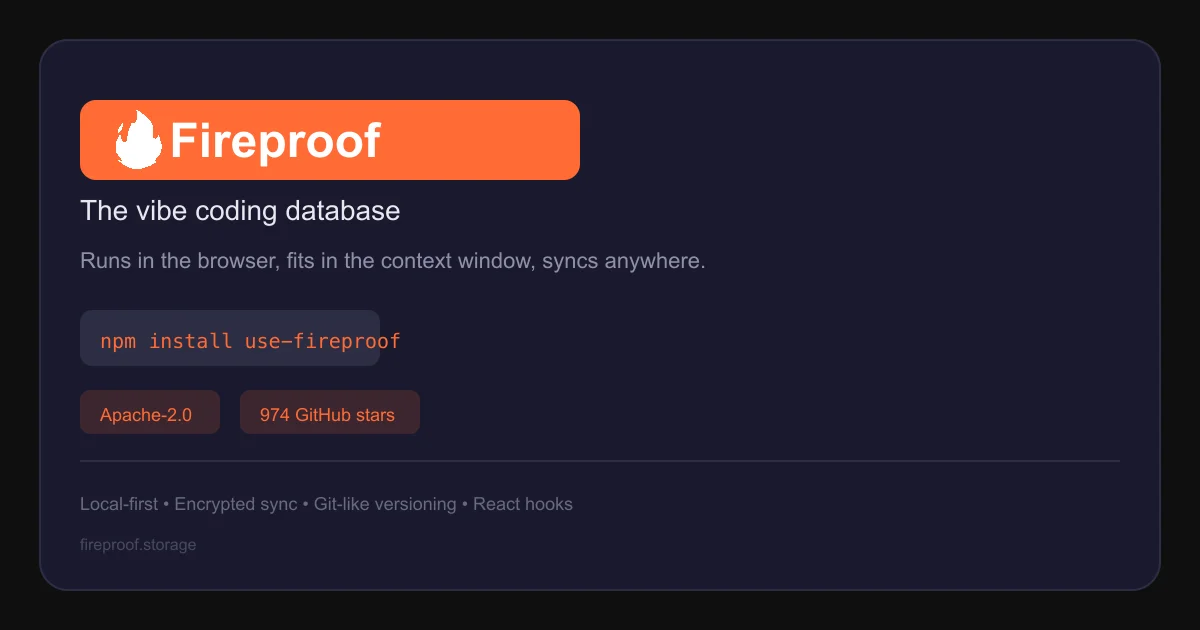
TL;DR: Fireproof is an open-source embedded JavaScript database that runs entirely in the browser with encrypted sync, Git-like versioning, and React hooks for building offline-capable apps.
Source and Accuracy Notes
- Project page: fireproof.storage ← verified July 2026
- Source repository: github.com/fireproof-storage/fireproof ← README read July 2026
- License: Apache-2.0 (verified via GitHub API)
- GitHub stars: 974 (verified July 2026)
- HN launch thread: news.ycombinator.com/item?id=42184362
What Is Fireproof?
Fireproof is a lightweight embedded document database with encrypted live sync. It is designed for browser-first applications and provides a unified API that works across Deno, Bun, Node.js, and the browser. The official tagline: “The vibe coding database runs in the browser, fits in the context window, and syncs anywhere.”
The core innovation is cryptographic causal consistency using hash history — each change is content-addressed and linked to prior state, providing git-like versioning with blockchain-style verification without requiring a blockchain.
Key Features
- Runs anywhere — bundles UI, data, and logic in one file
- Offline-first — no loading or error states; works without connectivity
- Unified API — TypeScript with Deno, Bun, Node.js, and browser support
- React hooks —
useLiveQueryanduseDocumentfor live collaboration - Encrypted sync — data replicated as content-addressed encrypted blobs
- Git-like versioning — hash history tracks every document change
- Compatible with LLM code generation — designed for vibe coding workflows with ChatGPT Canvas, bolt.new, and Claude Artifacts
Setup Workflow
Step 1: Install the Package
Install use-fireproof for the full React API:
npm install use-fireproof
```bash

Or install just the core ledger in any JavaScript environment:

```bash
npm install @fireproof/core
```bash

You can also load it via CDN:

```html
<script src="https://cdn.jsdelivr.net/npm/@fireproof/core/dist/browser/fireproof.global.js"></script>
```bash

Or use ESM.sh:

```js
import { useFireproof } from "https://esm.sh/use-fireproof";
```bash

### Step 2: Use in a React App

```js
import { useFireproof } from "use-fireproof";

function App() {
  const { database, useLiveQuery, useDocument } = useFireproof("my-ledger");

  // Create and edit a document
  const { doc, merge, submit } = useDocument({ text: "" });

  // Query documents by _id, most recent first
  const { docs } = useLiveQuery("_id", { descending: true, limit: 100 });

  return (
    <div>
      <form onSubmit={submit}>
        <input value={doc.text} onChange={(e) => merge({ text: e.target.value })} placeholder="New document" />
        <button type="submit">Submit</button>
      </form>
      <ul>
        {docs.map((doc) => (
          <li key={doc._id}>{doc.text}</li>
        ))}
      </ul>
    </div>
  );
}
```bash

### Step 3: Sync Data

Fireproof syncs via commodity object storage. Connect to any compatible backend:

```js
const db = new Fireproof("my-ledger");
await db.sync("https://your-storage-provider.com/bucket");
Architecture Deep Dive
Content-Addressing
Every document is stored with a content address derived from its hash. This means identical content always produces the same address, making deduplication automatic and enabling efficient Merkle tree comparisons during sync.
Hash Chain (Git-like Versioning)
Each document maintains a chain of hash pointers. When you update a document, the new version includes a pointer to the previous version’s hash. This creates an immutable audit trail — you can reconstruct the full history of any document at any point in time.
Encryption Model
Data is encrypted end-to-end. The sync layer only ever sees encrypted blobs, and the encryption keys never leave the client. This makes Fireproof safe to sync via untrusted infrastructure (e.g., a commodity S3 bucket or Cloudflare R2).
Conflict Resolution
Fireproof uses a last-writer-wins strategy for conflicting writes, with the hash chain providing full auditability. Because all changes are content-addressed and immutable, there’s no risk of data loss — every version is preserved.
Practical Evaluation Checklist
- Installs without native dependencies (pure JavaScript)
- Works offline with no loading states
- React hooks integrate cleanly with existing apps
- Sync works with standard object storage (S3, R2, GCS)
- Encryption is verified before data leaves the browser
- Hash chain correctly preserves full document history
- Concurrent edits from multiple clients resolve cleanly
- Works in Deno, Bun, and Node.js without adapters
Security Notes
- Encryption keys are client-side only and never transmitted
- Sync provider only sees encrypted blobs (no plaintext)
- Hash chain provides tamper-evident audit trail
- No external dependencies required for the core database
FAQ
Q: How does Fireproof compare to IndexedDB? A: IndexedDB is a raw storage API requiring significant boilerplate. Fireproof provides a document API with built-in versioning, encryption, and sync. IndexedDB has no native sync story; Fireproof makes sync a first-class concern.
Q: Can Fireproof sync with a self-hosted backend? A: Yes. Fireproof syncs via standard object storage APIs, so you can self-host MinIO, use a Cloudflare R2 bucket, or any S3-compatible endpoint.
Q: Does Fireproof work without React?
A: Yes. The @fireproof/core package provides a framework-agnostic API that works in any JavaScript environment, including vanilla HTML pages, Deno, Bun, and Node.js.
Q: Is the data encrypted at rest? A: Yes. Data is encrypted before leaving the browser. The sync layer receives and stores only encrypted blobs. Decryption happens client-side on read.
Conclusion
Fireproof fills a specific niche: browser-first applications that need real offline capability and encrypted sync without the operational complexity of running a traditional database server. The hash chain approach gives it a credible claim to data integrity that simpler localStorage or IndexedDB wrappers lack.
If you are building a vibe-coded app and want persistence plus sync without a backend, Fireproof is worth a look. The Apache-2.0 license means you can use it freely in commercial projects.
Source: github.com/fireproof-storage/fireproof | fireproof.storage
Related Posts
ai-setup
Recall – Persistent Memory for Claude Code via MCP Hooks
Recall gives Claude Code a permanent memory store that survives session restarts and context compaction. Four hooks capture and restore context automatically — with cloud SaaS or self-hosted options.
2/28/2026
ai-setup
Sentrial – Catch AI Agent Failures Before Your Users Do
YC W26-backed AI agent observability platform. Trace sessions, detect silent regressions, and A/B test prompts in production before failures reach users.
5/28/2026
ai-setup
IonRouter – Fast Low-Cost AI Inference API
IonRouter is a YC W26 inference API routing open-source and fine-tuned models via an OpenAI-compatible endpoint, built on a C++ runtime optimized for GH200.
5/28/2026