DataFuel – Turn Websites into LLM-Ready Data
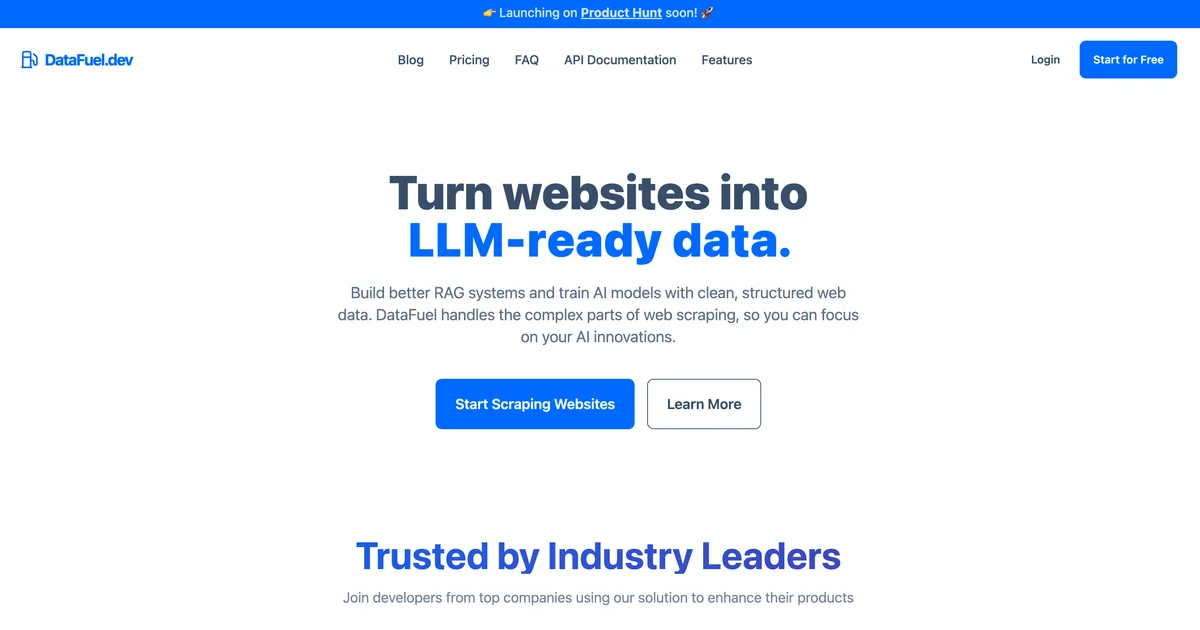
DataFuel API transforms websites into clean markdown for RAG pipelines and LLM training. One endpoint, no scraping code.
TL;DR
TL;DR: DataFuel is a web scraping API that converts any URL into clean, markdown-structured data optimized for RAG systems and LLM training pipelines — no writing scraping logic yourself.
Source and Accuracy Notes
- Project page: datafuel.dev ← visited and verified
- Source repository: none (API-first product, no public repo)
- License: proprietary SaaS — no open-source license verified
- HN launch thread: news.ycombinator.com/item?id=42405758 (43 points, Show HN May 2026)
What Is DataFuel?
DataFuel is a web scraping API designed specifically for AI workloads. Instead of writing selectors, handling pagination, and cleaning HTML, you send a URL and get back clean, markdown-structured data ready for vector storage or model fine-tuning.
The product targets developers building RAG (Retrieval-Augmented Generation) systems, researchers collecting training data, and teams that need to ingest web content at scale without maintaining scrapers.
Key capabilities as described on the product page:
- RAG-Ready Data — transforms websites into structured datasets for retrieval-augmented generation
- Training Data Pipeline — automates collection of diverse, high-quality datasets for fine-tuning
- Knowledge Base Building — creates comprehensive knowledge bases from multiple web sources
- Documentation Scraping — extracts and structures technical documentation for AI training
- Single API endpoint — no complex scraping code required
API Workflow
Step 1: Get an API Key
Sign up at datafuel.dev to receive an API key. The free tier offers a limited number of requests.
Step 2: Send a URL
The core API is a single POST request. Here is the JavaScript fetch pattern:
const response = await fetch('https://api.datafuel.dev/v1/scrape', {
  method: 'POST',
  headers: {
    'Authorization': 'Bearer YOUR_API_KEY',
    'Content-Type': 'application/json'
  },
  body: JSON.stringify({
    url: 'https://example.com',
    format: 'markdown'  // or 'html', 'json'
  })
});

const data = await response.json();
// data.markdown contains the scraped content in markdown format
```bash

Python with the standard library:

```python
import urllib.request
import json

payload = json.dumps({
    "url": "https://example.com",
    "format": "markdown"
}).encode('utf-8')

req = urllib.request.Request(
    'https://api.datafuel.dev/v1/scrape',
    data=payload,
    headers={
        'Authorization': 'Bearer YOUR_API_KEY',
        'Content-Type': 'application/json'
    },
    method='POST'
)

with urllib.request.urlopen(req) as resp:
    result = json.loads(resp.read())
    print(result['markdown'][:500])
```bash

### Step 3: Ingest into Your RAG Pipeline

The markdown output is designed to be chunked and embedded directly:

```bash
# Example: chunk and embed with OpenAI
curl -X POST https://api.openai.com/v1/embeddings \
  -H "Authorization: Bearer $OPENAI_API_KEY" \
  -d '{"input": "Your markdown content here", "model": "text-embedding-3-small"}'
Deeper Analysis
Why DataFuel instead of custom scraping?
Writing a robust web scraper involves handling JavaScript rendering, rate limiting, bot detection, and content extraction — all of which is glue code, not core product work. DataFuel abstracts this away.
The markdown-first output is the key differentiator. Raw HTML requires significant post-processing before it is useful in a vector database. DataFuel claims to handle the extraction and structure for you.
Use cases
- RAG systems — feed clean, structured web content into vector databases like Pinecone, Qdrant, or Weaviate
- Training data collection — batch-scrape documentation, blog posts, or research papers for fine-tuning
- Competitive analysis pipelines — monitor changes in competitor product pages or pricing
Limitations
- No JavaScript rendering guarantee — if a site requires client-side rendering, the output may be incomplete
- Rate limits — the free tier caps requests; production use requires a paid plan
- No public pricing — cost structure is behind a login wall
Practical Evaluation Checklist
- Does the API return clean markdown without HTML artifacts? Test with
format: "markdown" - Is the content chunked correctly for your vector database? Run a small batch first
- Does the free tier support enough requests to evaluate quality? Yes — 2 live demos per visitor on the site
- Are there rate limits that would break batch ingestion? Check the API docs after signup
Security Notes
- Store your API key in environment variables, not in source code
- The API key grants access to your account’s scraped data and quota — treat it like a password
- DataFuel’s privacy policy and terms of use should be reviewed before scraping user-generated content or personal websites
FAQ
Q: Does DataFuel render JavaScript before scraping? A: The product page does not explicitly confirm full JavaScript rendering. Sites that rely heavily on client-side rendering may return incomplete content. Test with a small sample before building a large pipeline.
Q: What output formats are available?
A: The API supports markdown, html, and json output formats, selected via the format field in the request body.
Q: Is there a free tier? A: Yes. The site offers 2 live demo requests per visitor without an API key, and a free tier with API access after signup. Specific limits are behind a login wall.
Q: Can I batch-scrape multiple URLs? A: The API accepts one URL per request. For batch use cases, loop over your URL list with rate limiting on the client side.
Conclusion
DataFuel solves the web scraping problem for AI pipelines by handling extraction and structure so you do not have to. The markdown-first output is immediately useful for RAG systems, and the single-endpoint API keeps your code simple.
If you are building anything that needs to ingest web content at scale — a RAG system, a training data pipeline, a knowledge base — it is worth a few API calls to evaluate whether the output quality meets your needs. Start with the live demo on the site before committing to the API.
Source and Accuracy Notes
- Project page: datafuel.dev
- HN launch: news.ycombinator.com/item?id=42405758
Related Posts
ai-setup
Recall – Persistent Memory for Claude Code via MCP Hooks
Recall gives Claude Code a permanent memory store that survives session restarts and context compaction. Four hooks capture and restore context automatically — with cloud SaaS or self-hosted options.
2/28/2026
dev-tools
Automotive Skills Suite for AI Engineering
Evaluate Automotive Skills Suite for APQP, ASPICE, HARA, safety-plan, and DIA workflows with setup notes, governance risks, and SME review guidance.
5/28/2026
dev-tools
awesome-agentic-ai-zh Roadmap Guide
Explore awesome-agentic-ai-zh as a Chinese agentic AI learning roadmap, with setup notes, track selection, study workflow, and evaluation guidance.
5/28/2026