Bike4Mind - AI Workbench with Notebooks, Agents, RAG
Bike4Mind is an open-core AI workspace combining notebooks, autonomous agents, and a RAG knowledge engine across any model—OpenAI, Anthropic, Google, xAI, or local Ollama/vLLM.
TL;DR
TL;DR: Bike4Mind is an open-core AI workbench that wires notebooks, autonomous agents, and a RAG knowledge engine into one workspace, running across any model from OpenAI to local Ollama.
Source and Accuracy Notes
- Project page: bike4mind.com ← verified
- Source repository: github.com/Bike4Mind/bike4mind ← README read in full
- License: BSL 1.1 (Business Source License), auto-converts to Apache-2.0 after two years — verified via LICENSE file
- HN launch thread: news.ycombinator.com/item?id=42285421 (2026-07-07)
- GitHub stars: 83 (verified via GitHub REST API, 2026-07-31)
What Is Bike4Mind?
Bike4Mind is an open-core AI knowledge platform that positions itself as “a bicycle for the mind in the age of AI.” It brings together several AI tooling layers into a single workspace:
- Notebooks — the core workspace for chat, documents, and context, swappable between any supported model
- Multi-LLM support — OpenAI, Anthropic, Google Gemini, xAI, Ollama (local), and vLLM; plus image models including FLUX, DALL·E 3, and Stable Diffusion
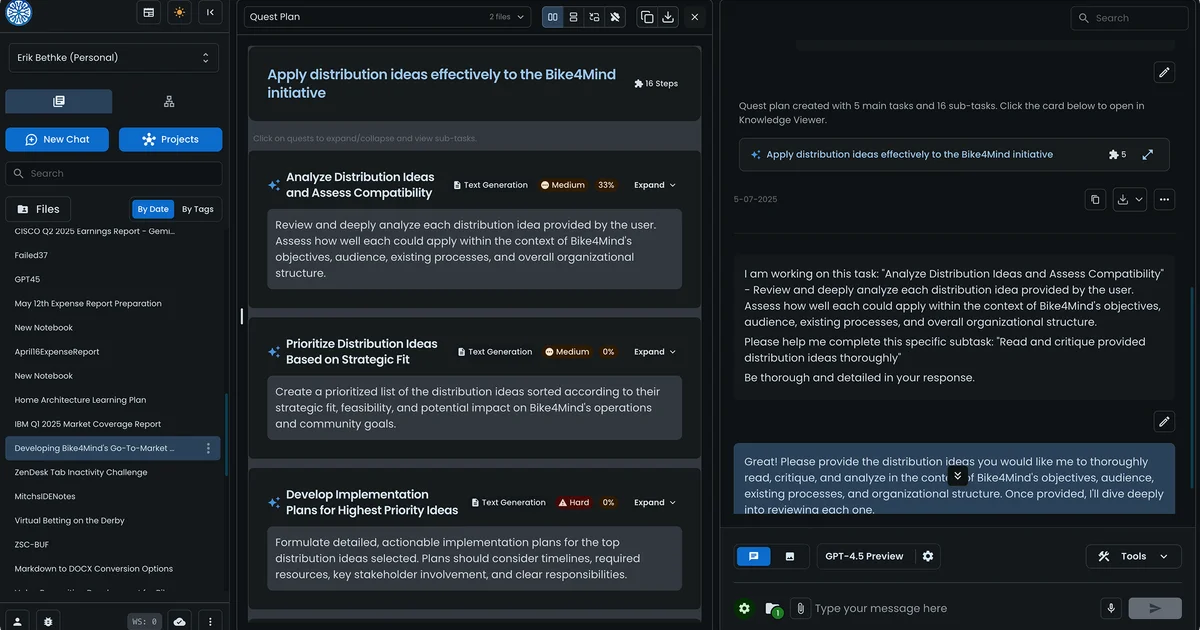
- Quest Master — autonomous multi-step task planner: text and image generation, vision review, web search, math, code, and human-in-the-loop steps run in parallel
- AI Agents — autonomous ReAct-style agents that carry out complex tasks against your own tools and knowledge base
- Knowledge Engine — RAG over your documents with smart chunking, vector search, collections, and tagging
- Artifacts — reusable snippets, documents, and visualizations produced by agents, with a built-in publish-and-share layer
The project is open core. The engine is published under BSL 1.1, which converts to Apache-2.0 automatically after two years. A hosted version is available at app.bike4mind.com, or you can self-host the open core.
Setup Workflow
Prerequisites
- Node.js 20+ (for the self-hosted version)
- Docker (recommended for containerized deployment)
- At least one LLM API key (OpenAI, Anthropic, Google, xAI) or a local Ollama/vLLM instance
Step 1: Clone the Repository
git clone https://github.com/Bike4Mind/bike4mind.git
cd bike4mind
```bash

### Step 2: Configure Environment Variables

```bash
cp .env.example .env
```bash

Edit `.env` to add your API keys. The README specifies keys for OpenAI, Anthropic, Google Gemini, and xAI. For local models, set the Ollama endpoint:

```bash
OLLAMA_BASE_URL=http://localhost:11434
```bash

### Step 3: Run with Docker

```bash
docker compose up -d
```bash

The app will be available at `http://localhost:3000`. On first launch, open the admin panel to configure your model providers and any self-hosted backends.

### Step 4: Connect a Local Model (Optional)

If running Ollama locally, ensure it is running:

```bash
ollama serve
ollama pull llama3.2
Then in Bike4Mind’s settings, add the Ollama provider with http://localhost:11434 as the base URL.
Step 5: Set Up the Knowledge Engine (RAG)
Upload documents through the Knowledge Engine tab. Bike4Mind handles chunking and embedding automatically. Once indexed, agents can query your knowledge base in natural language.
Deeper Analysis
Architecture
Bike4Mind’s frontend is a Next.js application. The backend exposes an API that routes requests to the configured model providers. The Knowledge Engine uses vector storage for semantic search. Agents are built on a ReAct loop—observe, reason, act—allowing multi-step task execution with tool access.
The multi-model routing is notable: instead of committing to a single provider, the workspace maintains active sessions with multiple models simultaneously, letting you swap between them within the same notebook context.
Quest Master vs. Generic Agent Frameworks
Quest Master is Bike4Mind’s bespoke autonomous planner. Unlike generic agent frameworks that execute a single tool chain, Quest Master can branch—running text generation, image generation, vision review, and web search in parallel, then synthesizing the results. This parallel execution is the distinguishing feature for power users.
License Considerations
The BSL 1.1 license is worth noting: you can run and modify the software freely, but Bike4Mind Inc. retains the right to prevent use of the open core in a competing commercial hosted service for two years. After the two-year window, the full Apache-2.0 license applies. For internal use or self-hosted commercial deployments, this is not a practical restriction.
Practical Evaluation Checklist
- Multi-model notebook switching (OpenAI to Ollama in the same session)
- Quest Master parallel task execution
- RAG knowledge engine with document upload
- Self-hosted Docker deployment
- Agent tool access configuration
Security Notes
- API keys are stored server-side in environment variables — never commit
.envto version control - If self-hosting with external model providers, ensure your network policy restricts access to the deployment
- The RAG knowledge engine processes uploaded documents; for sensitive data, use the self-hosted version with a local embedding model rather than a cloud provider
FAQ
Q: Does Bike4Mind require a GPU? A: Not for cloud API models. If running entirely on local Ollama or vLLM with large models, a GPU will significantly improve performance, especially for image generation.
Q: Can I use Bike4Mind without any external API keys? A: Yes — if you have Ollama running locally with models pulled, Bike4Mind can operate fully offline with no external dependencies.
Q: What is the difference between the hosted and self-hosted versions? A: The hosted version at app.bike4mind.com is a managed service. The self-hosted version runs the same open-core engine on your own infrastructure, giving you full control over data and model configuration.
Q: How does the BSL license affect commercial use? A: For most commercial use cases—internal tools, self-hosted deployments—the BSL imposes no practical constraint. It only restricts using the open core to build a competing hosted AI service during the two-year conversion window.
Conclusion
Bike4Mind occupies an interesting space between the notebook-as-chatbot (ChatGPT, Claude) and full agent frameworks (LangChain, AutoGPT). The multi-model notebook, parallel Quest Master executor, and built-in RAG make it a credible all-in-one AI workspace for developers who want to mix and match models without stitching together separate tools.
The two-year BSL-to-Apache clock is already running — the full open-source future arrives mid-2028. Worth evaluating now if you want the flexibility of multi-model routing with agents and RAG in a single deployment.
Related Posts
ai-setup
Recall – Persistent Memory for Claude Code via MCP Hooks
Recall gives Claude Code a permanent memory store that survives session restarts and context compaction. Four hooks capture and restore context automatically — with cloud SaaS or self-hosted options.
2/28/2026
dev-tools
Automotive Skills Suite for AI Engineering
Evaluate Automotive Skills Suite for APQP, ASPICE, HARA, safety-plan, and DIA workflows with setup notes, governance risks, and SME review guidance.
5/28/2026
dev-tools
awesome-agentic-ai-zh Roadmap Guide
Explore awesome-agentic-ai-zh as a Chinese agentic AI learning roadmap, with setup notes, track selection, study workflow, and evaluation guidance.
5/28/2026