ai-memory: long-term memory for agent coding CLIs
ai-memory is a Rust tool for long-term memory in agent coding CLIs, built so work can hand off cleanly between different AI agent vendors.
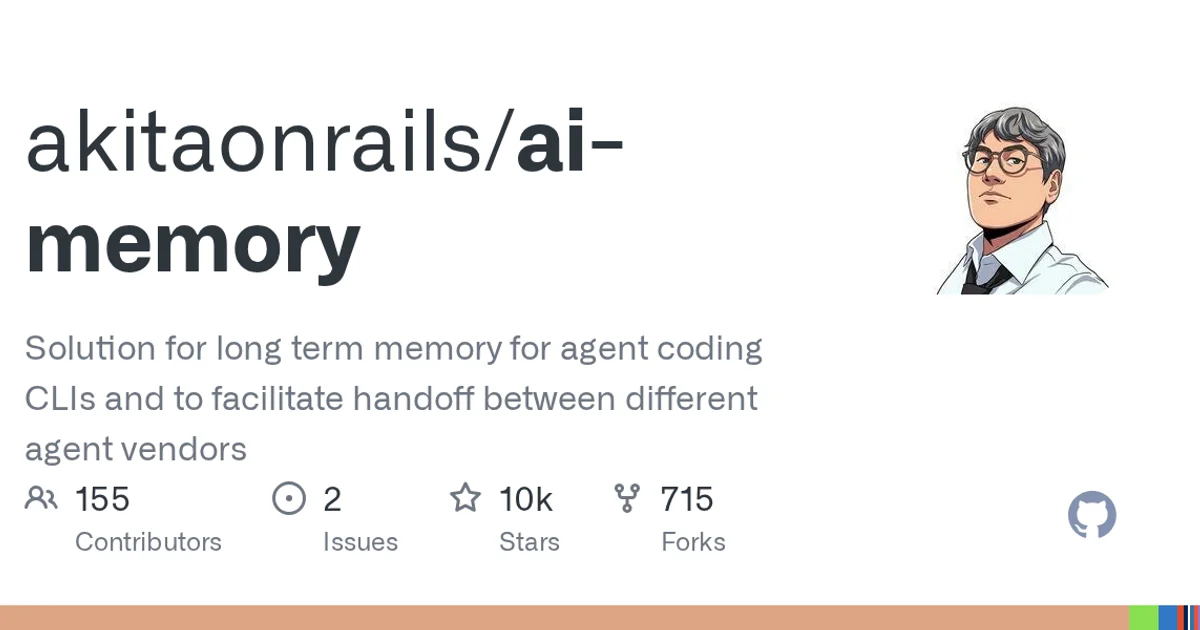
TL;DR: ai-memory is a Rust project that adds long-term memory to agent coding CLIs, so decisions made in one session survive a switch to a different vendor’s tool. It competes on continuity rather than model quality, and it was MIT licensed with 9,940 stars at the time of writing.
Agent coding CLIs are good at the work in front of them and bad at remembering. You start a task in one tool, and whatever context made that task tractable dies with the session. Switch to a different vendor’s CLI and you are back to explaining the codebase from zero. ai-memory is a Rust project pointed straight at that gap. Its own description calls it a solution for long term memory for agent coding CLIs, and for facilitating handoff between different agent vendors.
That is a narrow promise, and the narrowness is the interesting part. Most agent tooling competes on model quality or on how clever the loop is. This one competes on continuity.
The problem it is aimed at
The default mental model for a coding agent is a session: start it, prompt it, close it. That model breaks down in two places. First, any long-running project needs decisions you made on day one still to hold on day thirty, and a fresh CLI process has no reason to know them. Second, tool choice tends to drift. You try one vendor on a ticket, switch to another because of a rate limit or a subscription you happen to have, and now the accumulated understanding is split across two places.
Neither problem is dramatic on its own. Both get expensive quietly, as re-explaining, re-discovering, and re-deciding work that was already settled.
What the repository looks like today
Here is the shape of the project as GitHub reports it, without guessing at internals:
| Signal | Value |
|---|---|
| Primary language | Rust |
| License | MIT |
| Stars | 9,940 |
| Forks | 720 |
| Published topics | none |
| Homepage | none |
| Last push | 2026-10-17 |
| Owner type | personal account |
Two of those rows are worth pausing on. There is no homepage and no topic tags, so this is not positioned as a hosted service you sign up for. It is a repository. And the owner is a personal account rather than an organization, which usually means one person is carrying the roadmap.
The fork count is close to 7 percent of stars. For a developer tool that is a healthy signal: forks in this category tend to come from people who want the memory layer wired into their own setup rather than people merely bookmarking it.
Rust is an unusual default for agent tooling, which is otherwise dominated by TypeScript and Python. It buys predictable startup and a single binary, which matters for something meant to sit underneath every coding session rather than inside one of them.
How to try it
The MIT license means you can read it, run it, and change it without asking anyone. Start by looking at what it actually persists and where:
git clone https://github.com/akitaonrails/ai-memory
cd ai-memory
ls
With no topics and no docs site published, the repository layout is the documentation. Before wiring anything into your own workflow, worth confirming directly:
- What is written to disk, and in what format
- Whether that store is per project or global
- How a handoff is triggered, and whether you can inspect it before switching tools
Treat the third one as the real test. Memory you cannot read is a liability, not a feature.
When it fits
If you rotate between agent CLIs, or you routinely lose the thread of a project across sessions, the problem it names is one you have. The MIT license also makes it a reasonable thing to fork and adapt if the default storage location does not match your setup.
When it does not fit
If you want a managed product with a web UI and someone else’s uptime, this is the wrong shape. There is no hosted offering here to subscribe to. If your workflow lives entirely inside a single agent tool that already handles its own context, the cross-vendor handoff argument does not apply to you.
Source and Accuracy Notes
- Project page: https://github.com/akitaonrails/ai-memory
- Source repository: akitaonrails/ai-memory (verified via GitHub API
html_url) - License: MIT (verified via GitHub API
license.spdx_id) - Stars at time of writing: 9,940
- Everything above comes from the GitHub repository API. The README was not fetched for this post, so no claim about specific commands, file formats, or storage backends is made here. Verify those against the repository before relying on them.
Related Posts
ai-setup
Recall – Persistent Memory for Claude Code via MCP Hooks
Recall gives Claude Code a permanent memory store that survives session restarts and context compaction. Four hooks capture and restore context automatically — with cloud SaaS or self-hosted options.
2/28/2026
dev-tools
Automotive Skills Suite for AI Engineering
Evaluate Automotive Skills Suite for APQP, ASPICE, HARA, safety-plan, and DIA workflows with setup notes, governance risks, and SME review guidance.
5/28/2026
dev-tools
awesome-agentic-ai-zh Roadmap Guide
Explore awesome-agentic-ai-zh as a Chinese agentic AI learning roadmap, with setup notes, track selection, study workflow, and evaluation guidance.
5/28/2026