Agnost AI – Extract User Feedback from Agent Conversations
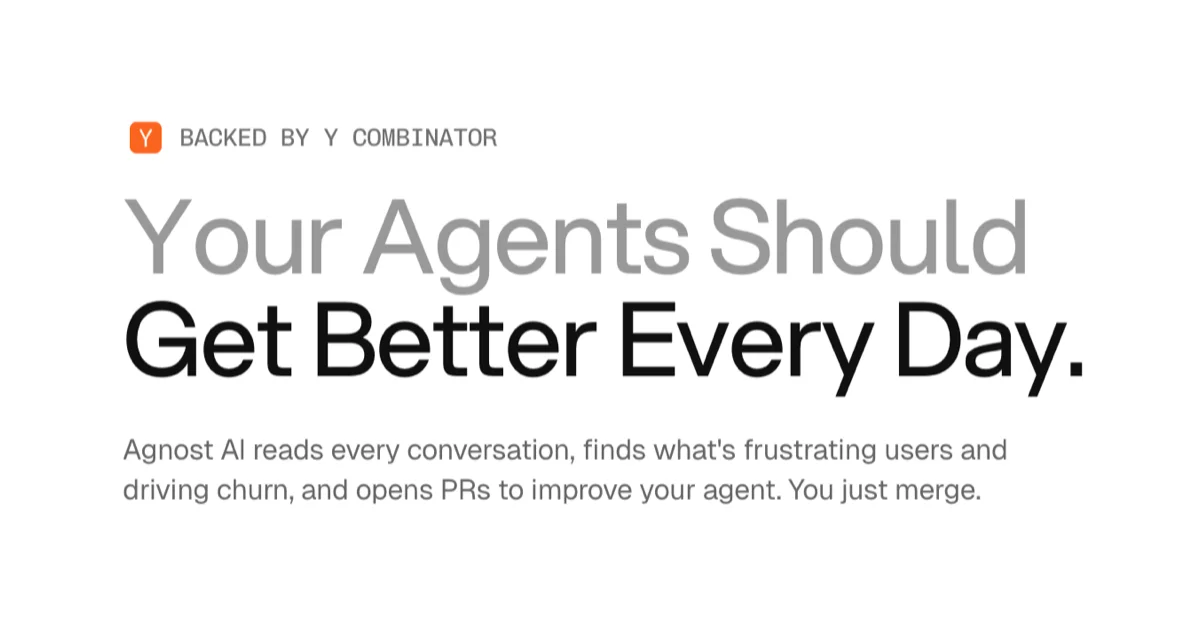
Agnost AI continuously analyzes production conversations, catches agent failures your evals miss, and turns the highest-impact patterns into reviewed fixes.
TL;DR
TL;DR: Agnost AI reads your live agent conversations, identifies where users get stuck or where the agent fails, and automatically opens reviewed PRs to fix the highest-impact issues.
Source and Accuracy Notes
- Project page: agnost.ai
- HN launch thread: news.ycombinator.com/item?id=48908950
- YC batch: Y Combinator S26
What Is Agnost AI?
Agnost AI is a Y Combinator S26-backed product that bridges the gap between how you test AI agents during development and what actually happens when they run in production.
The core problem it solves: your evals and test suites miss real failure modes. Agnost reads actual production chat and voice conversations, identifies where users get stuck or frustrated, and automatically generates reviewed fixes.
“It reads real production chat and voice conversations, surfaces where users get stuck or frustrated, and opens reviewed PRs to fix your agent.”
The platform integrates with your existing agent stack and continuously monitors conversations. When a failure pattern crosses a significance threshold, Agnost AI generates a fix and opens a pull request for your team to review before merging.
Trusted by Google and 25+ AI teams according to the product page.
Setup Workflow
Step 1: Connect Your Agent Stack
Agnost AI integrates with common agent frameworks. From the product page, you connect your production agent endpoint and grant access to conversation logs.
Step 2: Define Failure Signals
Configure which conversation patterns should trigger alerts. You can set thresholds for:
- User frustration signals (e.g., repeated re-phrasing, abandonment)
- Agent error rates
- Specific intent failure rates
Step 3: Review Automated Fixes
When Agnost identifies a high-impact failure pattern, it:
- Analyzes the root cause across conversation history
- Generates a targeted fix
- Opens a PR with the proposed change
- Your team reviews and merges
Step 4: Measure Impact
After fixes are merged, Agnost tracks whether the issue recurs in production, giving you a closed-loop feedback system for agent reliability.
Deeper Analysis
Why Evals Miss Production Failures
Traditional agent evaluation relies on curated test sets and synthetic inputs. Production conversations expose edge cases, unexpected user behaviors, and context that test suites cannot anticipate. Agnost AI is designed to close this gap by treating production as the source of truth.
Integration Model
The product appears to operate as a sidecar in your agent pipeline rather than requiring a full replacement of your existing agent infrastructure. This makes adoption lower-risk for teams with established agent deployments.
Pricing
No public pricing was found on the product page at time of writing. The product targets AI teams at scale, suggesting an enterprise tier.
Practical Evaluation Checklist
- Connects to production agent endpoints without code changes
- Identifies failure patterns across chat and voice conversations
- Automatically generates reviewed PRs for fixes
- Tracks whether fixes resolve issues in production
- Used by Google and 25+ AI teams (per product page)
Security Notes
As Agnost AI reads production conversation data, ensure your team reviews the data handling terms before connecting live customer conversations. Enterprise plans likely include appropriate data processing agreements.
FAQ
Q: Does Agnost AI require a specific agent framework? A: The product integrates with common agent frameworks. Check the official documentation for the current list of supported integrations.
Q: How does Agnost generate fixes? A: It analyzes conversation patterns to identify root causes, then generates code changes that are submitted as pull requests for human review before merging.
Q: Is this only for text-based agents? A: No — the product also handles voice conversations, not just chat.
Q: Can I control which conversations Agnost analyzes? A: Configuration options exist to define failure signals and thresholds. Review the documentation for privacy-sensitive configurations.
Conclusion
Agnost AI targets a real problem in AI agent development: production failures that never appear in your test suite. By reading live conversations, surfacing failure patterns, and automating the fix workflow, it closes the eval-to-production gap for agent teams.
If you are building and deploying AI agents and want a systematic way to catch what your tests miss, Agnost AI is worth evaluating.
Related Posts
ai-setup
Recall – Persistent Memory for Claude Code via MCP Hooks
Recall gives Claude Code a permanent memory store that survives session restarts and context compaction. Four hooks capture and restore context automatically — with cloud SaaS or self-hosted options.
2/28/2026
dev-tools
Automotive Skills Suite for AI Engineering
Evaluate Automotive Skills Suite for APQP, ASPICE, HARA, safety-plan, and DIA workflows with setup notes, governance risks, and SME review guidance.
5/28/2026
dev-tools
awesome-agentic-ai-zh Roadmap Guide
Explore awesome-agentic-ai-zh as a Chinese agentic AI learning roadmap, with setup notes, track selection, study workflow, and evaluation guidance.
5/28/2026