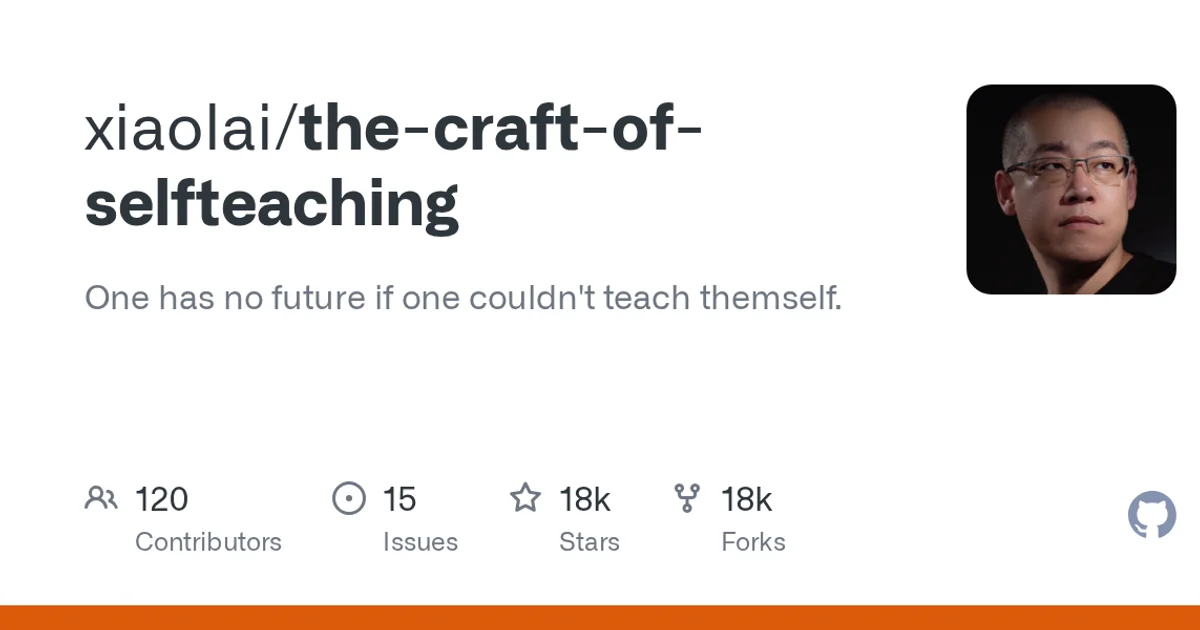
TL;DR: This is a book about teaching yourself to program, published as a directory of Jupyter notebooks with a numbered reading order. It has 18,544 stars and 17,890 forks, and no license file.
What it is
The description is a single line: “One has no future if one couldn’t teach themself.”
The content matches the claim in a way that is easy to verify. Every file in the root is an .ipynb notebook, and the file names are a curriculum:
00.cover.ipynb
01.preface.ipynb
02.proof-of-work.ipynb
Part.1.A.better.teachyourself.ipynb
Part.1.B.why.start.from.learning.coding.ipynb
Part.1.C.must.learn.sth.only.by.reading.ipynb
Part.1.D.preparation.for.reading.ipynb
Part.1.E.1.entrance.ipynb
Part.1.E.2.values-and-their.operators.ipynb
Part.1.E.3.controlflow.ipynb
Part.1.E.4.functions.ipynb
Part.1.E.5.strings.ipynb
Part.1.E.6.containers.ipynb
Part.1.E.7.files.ipynb
Part.1.F.deal-with-forward-references.ipynb
Part.1.G.The-Python-Tutorial-local.ipynb
Part.2.A.clumsy-and-patience.ipynb
Part.2.B.deliberate.practicing.ipynb
Part.2.C.why-start-from-writing-functions.ipynb
Part.2.D.1.args.ipynb
More than sixty notebooks, arranged so that the numbering is the reading order. Part.1.E.2 follows Part.1.E.1, and the sequence walks from programming fundamentals through strings and files into deliberate practice. You can work through the directory listing alone and know how to read it.
That 02.proof-of-work.ipynb filename is also the thesis. The project is named for a craft, and the method it teaches is persistence through difficulty rather than the fastest route to a syntax reference.
The fork count is the story
17,890 forks against 18,544 stars is a fork share of 96 percent. For comparison, most repositories in this category sit well below ten percent.
That ratio says something specific about how people use it. This is not a codebase that gets pulled in as a dependency. It is a book that gets copied, so that each person can work through the exercises in their own copy, translate it, adapt it to their own language, or annotate it. Forking a notebook repository is the equivalent of photocopying a textbook.
It also explains the pattern of the whole project. The original was created on 14 March 2019, and it is still being pushed to, most recently on 20 May 2026.
| Metric | Value |
|---|---|
| Stars | 18,544 |
| Forks | 17,890 |
| Open issues | 200 |
| Primary language | Jupyter Notebook |
| Repository size | 39 MB |
| License | none reported |
| Created | 2019-03-14 |
| Last push | 2026-05-20 |
The default branch is still named master
A small detail that dates the project precisely. The default branch is master, not main. The rename happened across GitHub in 2020, and most projects moved within a year or two. This one did not, which lines up with a repository that was created in 2019 and has been maintained at a slow, deliberate pace since.
No license means no grant
The GitHub API returns null for license.spdx_id, and there is no license file in the root listing. Without an explicit license, default copyright applies. You can read the notebooks, run them, and fork them for your own use. You do not have permission to redistribute them, publish a derivative, or ship them as part of something else.
For a book that has been forked nearly as many times as it has been starred, that gap between how people use it and how they are licensed to use it is worth keeping in mind.
How to try it
git clone https://github.com/xiaolai/the-craft-of-selfteaching.git
cd the-craft-of-selfteaching
ls *.ipynb | head -20
Read it in order from 00.cover.ipynb. There is nothing to install. Jupyter is the runtime, and the notebooks are the book.
When to use it
If you learn programming by reading and working through code rather than by being handed a specification, the structure suits that. The subtitles tell you the method is explicit about this: learning only by reading, preparing for reading, and dealing with forward references.
It is also a good model of how to publish a long-form technical curriculum. Numbered notebooks, no build step, a reading order encoded in filenames, and a fork-based culture around the exercises.
When not to use it
There is no license, so do not plan to redistribute it or build a course on top of the text.
Also check whether a Jupyter format is what you want. If your reading habit is a prose site rather than a notebook sequence, the same material in that format will suit you better, and the notes on the project page are worth a look before you clone.
Source and Accuracy Notes
- Project page: https://github.com/xiaolai/the-craft-of-selfteaching
- Source repository: xiaolai/the-craft-of-selfteaching (verified via GitHub API
html_url) - License: none reported (
license.spdx_idis null in the GitHub API) - Stars at time of writing: 18544
Related Posts
dev-tools
Automotive Skills Suite for AI Engineering
Evaluate Automotive Skills Suite for APQP, ASPICE, HARA, safety-plan, and DIA workflows with setup notes, governance risks, and SME review guidance.
5/28/2026
dev-tools
awesome-agentic-ai-zh Roadmap Guide
Explore awesome-agentic-ai-zh as a Chinese agentic AI learning roadmap, with setup notes, track selection, study workflow, and evaluation guidance.
5/28/2026
dev-tools
Baguette iOS Simulator Automation Guide
Set up Baguette for iOS Simulator automation, web dashboards, device farms, gesture input, streaming, and camera testing with Xcode caveats.
5/28/2026