Svelte: the compiler that turned a framework into a movement
Svelte compiles declarative components into lean JavaScript instead of shipping a runtime. Here is how the compiler works, what Svelte 5 changed, and where SvelteKit 3 fits.
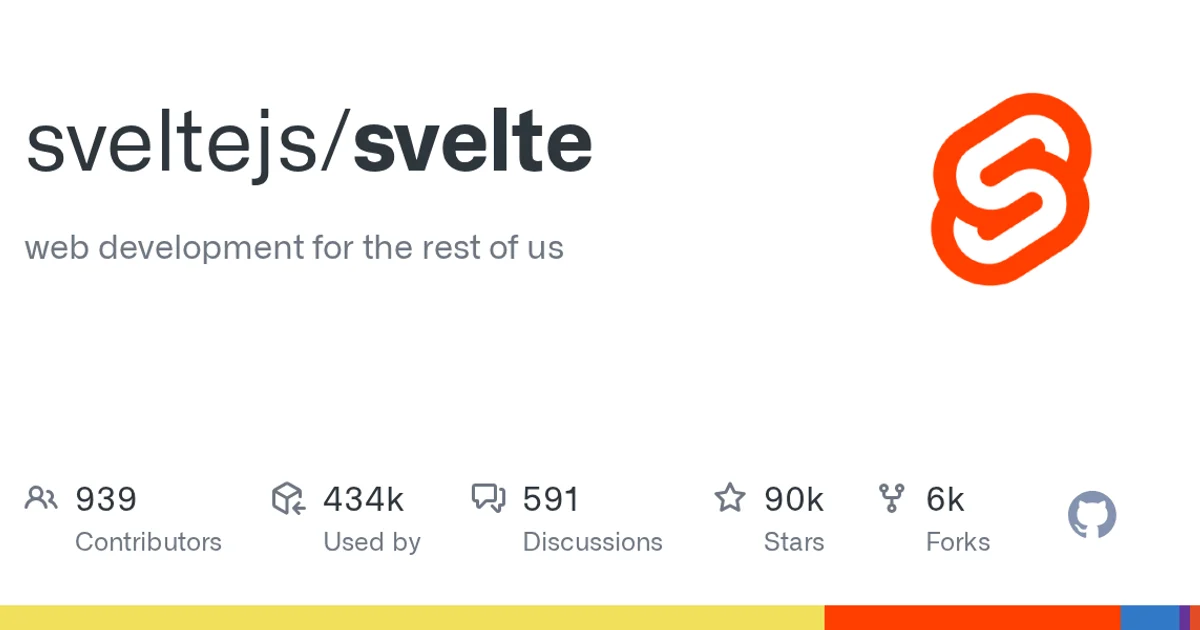
TL;DR: Svelte is a compiler that turns declarative components into JavaScript that surgically updates the DOM, instead of shipping a runtime that does that work in the browser. The current npm release is 5.58.0, pulling more than 10.1 million downloads a week, and the repository has 89,633 stars under an MIT license. Svelte 5 changed the reactivity model to runes, and SvelteKit 3 landed in October 2026 with configuration moved into
vite.config.tsand a new#libalias. The project has been continuously developed since November 2016.
What Svelte actually is
The README describes it as a new way to build web applications: a compiler that takes declarative components and converts them into efficient JavaScript. The homepage is blunter about the design intent, calling it a compiler that lets you write breathtakingly concise components that do minimal work in the browser, using languages you already know.
The whole idea sits in one sentence. Most frameworks ship a runtime that diffs your virtual DOM against the real one. Svelte moves that work to build time, where the compiler can see exactly which pieces of state each piece of markup depends on and generate direct DOM operations instead of a diff.
A component looks like this.
<script>
	function greet() {
		alert('Welcome to Svelte!');
	}
</script>

<button onclick={greet}>click me</button>

<style>
	button {
		font-size: 2em;
	}
</style>
One file holds markup, behavior and styles. The compiler scopes the CSS to that component, and in Svelte 5 the event handler is a plain onclick attribute rather than an on: directive.

The homepage shows this as a physical machine that packages your component code into a bundle. It is a fair metaphor, because the output is genuinely different from what a runtime framework would produce.
What the numbers say
Svelte is old enough that its history is visible in the release feed. The npm package was created on 2016-11-17 and the repository was created three days later on 2016-11-20. Version 1.0.0 shipped on 2016-11-29, twelve days after the first commit.
| Signal | Value |
|---|---|
| Current npm version | 5.58.0 |
| Weekly npm downloads | 10,153,587 |
| GitHub stars | 89,633 |
| GitHub forks | 6,208 |
| Open issues | 1,308 |
| License | MIT |
| First npm publish | 2016-11-17 |
| Repository created | 2016-11-20 |
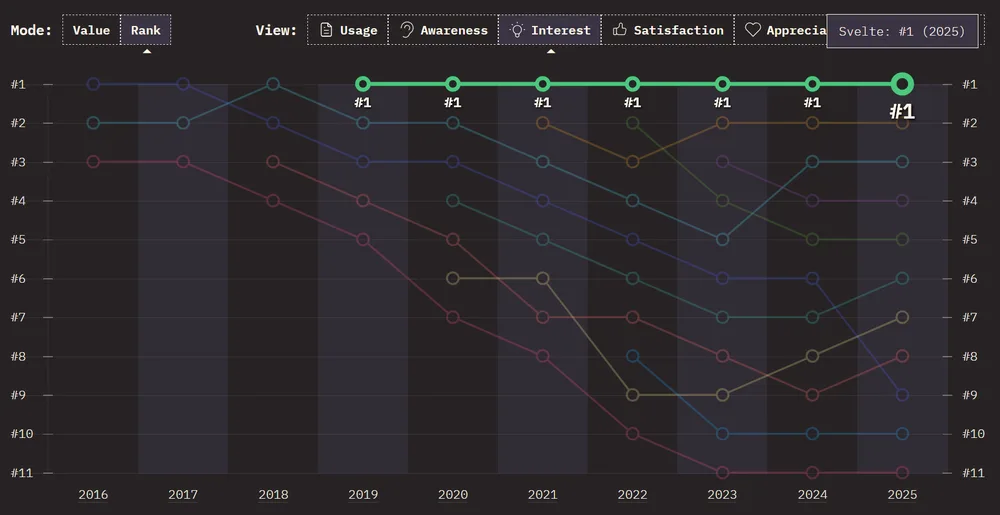
The homepage leans on developer sentiment surveys rather than its own metrics. It links a Stack Overflow 2024 Developer Survey result and a State of JavaScript 2025 chart showing Svelte at number one across usage, awareness, interest and satisfaction.
The site also lists companies that use Svelte in production, including Spotify, The New York Times, IKEA, Decathlon, 1Password, Mullvad, Yelp, Square and Apple. That is a heavier user list than the framework’s reputation as an indie-favorite usually implies.
How the compiler works
The npm dependency list is a fairly honest map of the compiler internals. acorn parses the JavaScript, magic-string handles surgical string manipulation, esrap generates the output code, zimmerframe walks the AST, locate-character resolves source positions, is-reference determines whether an identifier is a reference or a binding, and devalue serializes values for hydration payloads.
Two of those deserve more attention. esrap exists because generating readable, well-formatted JavaScript is harder than generating a correct blob. And is-reference is the piece that lets the compiler decide, per identifier, whether a value is reactive state, a prop, or a plain constant, which is the whole basis of Svelte 5’s reactivity.
Around that sits a set of libraries you would not expect from a UI framework: aria-query and axobject-query are accessibility metadata databases, which is how the compiler validates aria-* attributes against real ARIA rules at build time rather than at runtime.
The dev dependencies show the testing setup: Vitest for unit tests, Playwright for browser tests, Rollup and esbuild for bundling, and web-features for tracking baseline browser support.
Svelte 5 and the rune-based reactivity model
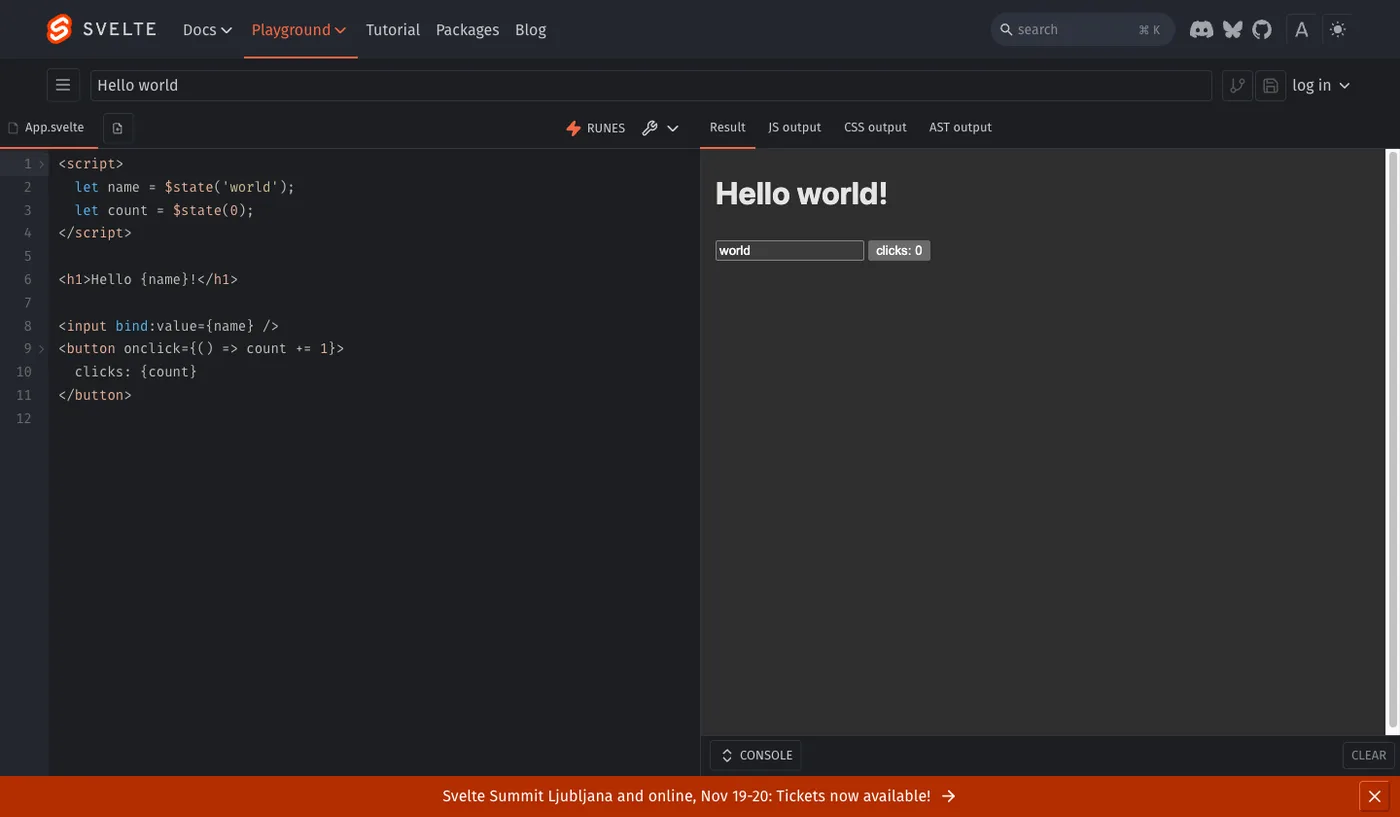
Svelte 5 is the current major version, and the biggest change is that reactivity is now explicit. State is declared with the $state rune, and derived values use $derived. The playground default shows the pattern.
<script>
	let name = $state('world');
	let count = $state(0);
</script>

<h1>Hello {name}!</h1>

<input bind:value={name} />
<button onclick={() => count += 1}>
	clicks: {count}
</button>
Older Svelte code relied on assigning to a variable and having the compiler detect that assignment. The rune model removes that inference, which means the compiler no longer has to guess which variables are state.
The migration path is documented, and older Svelte 3 and Svelte 4 documentation remains hosted at v4.svelte.dev for anyone still maintaining an older codebase.
SvelteKit 3 and the current state of the stack
Svelte itself is the component layer. SvelteKit is the application framework around it, and version 3.0 shipped on 2026-10-01.
The breaking changes are mostly about removing accumulated friction.
npx sv migrate sveltekit-3 --tasks all --confirmThat command migrates as much of a codebase as it can and leaves a TODO list for the rest. Creating a new app runs npx sv create my-new-app.
The specific changes: configuration moved from svelte.config.js into vite.config.ts, the $lib alias became #lib to use standard subpath imports, environment variables got more capable, service workers require less boilerplate, and error handling improved across the board.
Not everything shipped. Remote functions, which are the SvelteKit take on type-safe client-server communication, still require Async Svelte, which in turn needs an experimental flag. The team describes remote functions as their top priority and asks for patience on it.
The monthly changelog gives a clear picture of where the toolchain is going. Recent months have covered the SvelteKit 3 preview with new $app modules and zero-config error props, createContext in programmatic Svelte, better forms and long-lived remote query APIs, TypeScript 6 support in the language tools, MCP support in OpenCode, and hydration working with Content Security Policies.
There was also a post on CVEs affecting the Svelte ecosystem in January 2026, which is worth reading if you maintain a SvelteKit application.
Where to start and when to reach for something else
If you want to try Svelte without installing anything, the playground runs in the browser and can share apps by URL. The interactive tutorial teaches the basics in the same place.
For a real project, the recommended path is npx sv create to scaffold a SvelteKit app, which gets you server rendering, routing and deployment adapters rather than just the component layer.
Svelte is worth considering when you want a small runtime and tight, explicit reactivity. It is a less obvious fit if you need a large ecosystem of prebuilt component libraries, if your team is standardized on a virtual-DOM framework, or if you want to avoid the build-step complexity of a compiler-based toolchain entirely.
The project also has a plain-English docs mode aimed at language models at svelte.dev/docs/llms, and the development team posts a monthly roundup of what changed. The core repository is sveltejs/svelte, with the compiler living in the packages/svelte directory, and contributions are coordinated through the Contributing Guide.
Source and Accuracy Notes
- Source repository: sveltejs/svelte (verified via GitHub API
html_url) - README: https://github.com/sveltejs/svelte — the compiler description, contribution pointers, roadmap and license
- npm package page: https://www.npmjs.com/package/svelte — version 5.58.0, weekly download count, dependents count, full runtime and dev dependency lists, publish history
- Documentation overview: https://svelte.dev/docs/svelte — the component example and the compiler framing
- Documentation index: https://svelte.dev/docs — tutorial, migration guide, playground and the version 4 docs host
- Blog index: https://svelte.dev/blog — monthly changelog entries from December 2025 through October 2026, plus the ecosystem CVE post
- SvelteKit 3 announcement: https://svelte.dev/blog/sveltekit-3-is-here — release date, migration command, breaking changes and the remote functions status
- Homepage: https://svelte.dev/ — the compiler illustration, survey chart, user company list and the description quoted above
- Images: the Svelte playground captured from svelte.dev, and the compiler illustration asset
svelte-machine-mobile.DtvNEgov.pngserved from svelte.dev - License: MIT (verified via GitHub API
license.spdx_id) - Stars at time of writing: 89633, with 6208 forks and 1308 open issues
Related Posts
dev-tools
Automotive Skills Suite for AI Engineering
Evaluate Automotive Skills Suite for APQP, ASPICE, HARA, safety-plan, and DIA workflows with setup notes, governance risks, and SME review guidance.
5/28/2026
dev-tools
awesome-agentic-ai-zh Roadmap Guide
Explore awesome-agentic-ai-zh as a Chinese agentic AI learning roadmap, with setup notes, track selection, study workflow, and evaluation guidance.
5/28/2026
dev-tools
Baguette iOS Simulator Automation Guide
Set up Baguette for iOS Simulator automation, web dashboards, device farms, gesture input, streaming, and camera testing with Xcode caveats.
5/28/2026