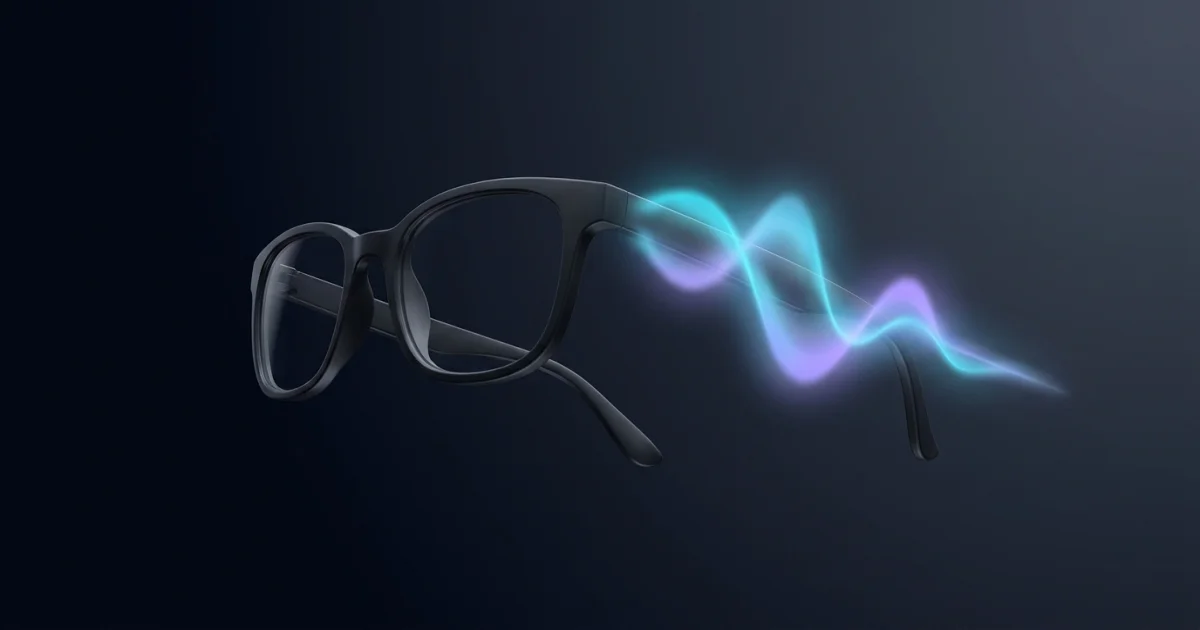
TL;DR: Subvocal makes eyeglasses that turn silent mouthing into typed text at 200+ words per minute, reading your jaw and lips with radio signals instead of a microphone or camera. The company is YC-backed and selling pairs at $499 through a refundable $199 preorder deposit, with the first batch estimated to ship in Q1 2027.
What it is
Subvocal is glasses that type what you mouth. You shape your mouth the way you would speak, but no sound comes out, and the words arrive as text in whatever app has focus on your computer. This is not voice dictation with the volume turned down. It is a different sensing channel, and it stays useful exactly where speaking out loud stops being an option: a crowded train, a shared office table, a cafe where the person next to you is mid-conversation.
The company behind it, The Subvocal Company, is a Delaware corporation at 680 2nd St in San Francisco, and it is backed by Y Combinator. What you can buy right now is a reservation, not a finished device.
How it reads your mouth without a camera
The interesting engineering question is how it senses speech that produces no sound. According to the founders on the launch thread, the answer is radio frequency. The glasses send RF energy through your face and read how your moving tissue changes the signal.
  you mouth words, no sound
            |
            v
  RF energy passes through your face
            |
            v
  moving tissue shifts phase and amplitude
            |
            v
  decoding model turns that into characters
            |
            v
  text lands in the app you were already using
The mechanism is that a mouth is a complex dielectric environment. Tissue, water and air have different permittivity, so the muscle motion involved in articulation changes how the waves behave as they propagate. No camera means no video of your face, no lip-reading model, and no webcam you have to leave switched on.
That last point is the reason this approach can exist at all, and the founders were reasonably open about the alternatives they tried first and rejected:
- Inertial sensors, which measure aggregate face motion and so can only distinguish broad words, not fine phonetic classes
- EMG, which they describe as not carrying enough information for open-ended decoding
- Millimeter wave radar around 60 GHz, which bounces off the mouth instead of passing through it and leaves the model with visemes only
- Camera-based lip reading, where an open model called Auto-AVSR sits at roughly 17 percent word error rate but hits a scaling limit
The viseme ceiling is worth remembering. Speech has around 40 phonemes, but only about 12 to 15 visually separable states. P and B look nearly identical on camera, and no amount of extra training data fixes that limit. RF passing through the face carries more information than a camera does, which is why the company went that direction.
One constraint falls out of the same physics. The RF signal has to pass through the face, so the hardware has to stay close to it. The founders say the approach does not work with the sensor mounted on a laptop screen or on a desk stand, because the signal is heavily attenuated over that distance. A hat or headband form factor is something they are exploring, but not soon.
What the company says it can do
The site answers the obvious questions in a compact FAQ, and the answers are more concrete than the marketing headline.
| Question | Answer |
|---|---|
| Does it use cameras? | No. No video, no webcam, no camera-based lip reading. |
| Does it read thoughts? | No. It only decodes words you deliberately articulate. |
| Does background noise matter? | No, because it never depends on hearing your voice. |
| How accurate is it? | Prototypes decode open-ended silent speech in real time, and the company expects accuracy to improve as it collects data. |
| Do I have to train it? | There is a short personal calibration when you first set it up. |
| Is it always listening? | No. It is built around deliberate articulation, not continuous capture. |
The noise answer is the one that changes daily behavior. Because the device is not listening, a loud room or a loud neighbor does not degrade accuracy the way it degrades dictation.
Subvocal is built to be an input method rather than an app of its own. The surfaces listed on the site are the ones you already type into:
- ChatGPT, Claude and Cursor for AI work
- Slack and other messaging apps
- Email, documents, and anywhere else you would normally type
The founder also demonstrated a glasses-to-glasses mode on the launch thread, where two people wearing them hold a silent conversation across a busy room. It reads as a demo of what the hardware can do rather than a shipping feature.
What it costs and when it ships
Reservations run through the company’s own preorder program rather than a storefront.
{
  "product_price_usd": 499,
  "deposit_usd": 199,
  "deposit_refundable": true,
  "final_payment_window_days": 30,
  "referral_credit_usd": 100,
  "referrals_required": 3,
  "estimated_first_batch_shipping": "Q1 2027",
  "shipping_date_guaranteed": false,
  "prescription_lenses": "optional extra"
}
A few details that are easy to miss. The $199 deposit is credited in full against the $499 price rather than sitting on top of it. You can cancel for any reason and get the whole deposit back at any point before you make the separate final payment, which has a 30 day window. Taxes, shipping and optional prescription lenses all sit outside the $499. If three different people place and keep a paid reservation through your referral link, you get a $100 credit against the remaining balance.
What to watch for
The honest version of this post is that you are funding a prototype. The preorder terms say it plainly: final specifications, appearance, materials, fit, software compatibility, features, packaging and accessories may all change as the product moves toward manufacture, and the company does not guarantee a particular launch date. The Q1 2027 estimate for the first batch is described as a good-faith estimate rather than a commitment.
The privacy policy has a similar gap, though it reads as deliberate rather than sloppy. Right now it covers the website and the preorder program. A future product or app that processes voice, sensor or device data gets its own notice before any of that processing starts, so nobody has to read the current policy as a promise about the shipped device.
Accuracy is the other unknown, and it is the one that decides whether this becomes a daily driver. The company says the prototypes already decode open-ended silent speech in real time and that it expects errors, with the design leaning on context and easy corrections rather than pretending mistakes do not happen. No one outside the company has tested a production unit.
The form factor stays an open question. Plenty of commenters on the launch thread liked the idea and still asked for a hat or headband version, or wondered whether a throat mic or a camera-free lip reading app could do the same job for less.
Source and Accuracy Notes
- Project page: https://subvocal.company/ - verified via direct visit, including the FAQ, preorder terms and privacy policy
- Preorder terms and pricing: https://subvocal.company/preorder - $499 price, $199 refundable deposit, 30 day final payment window, referral credit and the Q1 2027 shipping estimate
- Company registration: The Subvocal Company Inc., Delaware, 680 2nd St, San Francisco, CA 94107
- HN launch thread: https://news.ycombinator.com/item?id=50340088 - 82 points and 55 comments at time of writing, with founder answers on RF sensing and the rejected alternatives
- Product status: prototype and preorder only, no third party review or independent accuracy test found as of November 2026
Related Posts
dev-tools
Dulus Terminal Agent Setup Guide
Set up Dulus as a terminal AI agent with native and Docker paths, installer profiles, WebChat ports, repo safety checks, and shell-access risks.
5/28/2026
dev-tools
OpenSquilla Agent Gateway Setup Guide
Set up OpenSquilla with uv, onboarding, OpenRouter env keys, gateway runtime, Git LFS model files, and migration paths from other agents.
5/28/2026
dev-tools
RMUX Terminal Multiplexer Guide
Set up RMUX for detachable agent terminals, tmux-like sessions, Rust SDK control, diagnostics, migration checks, and terminal automation.
5/28/2026