Sonarly - AI Agent for Production Bug Fixes
Sonarly (YC W26) connects to Sentry and Datadog to triage production alerts, deduplicate noise, and auto-fix bugs with Claude Code. Cut MTTR with AI root cause analysis.
TL;DR
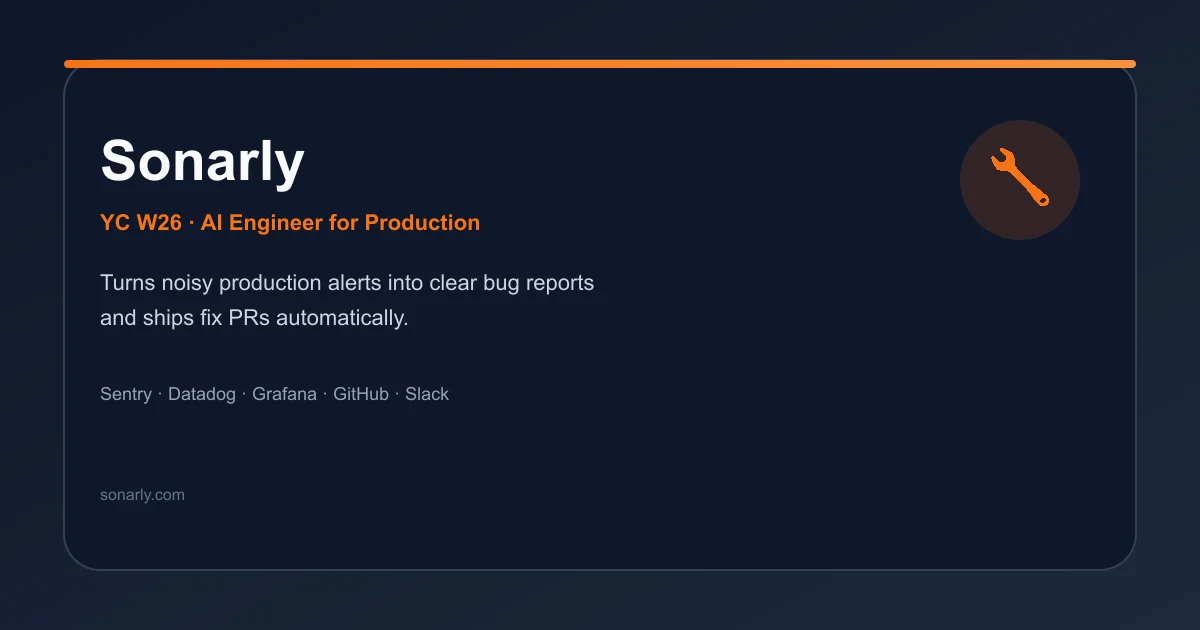
TL;DR: Sonarly is a YC W26 AI agent that connects to your observability stack (Sentry, Datadog, Grafana), triages production alerts by deduplicating noise, performs root cause analysis, and ships fix PRs using Claude Code.
Source and Accuracy Notes
- Project page: sonarly.com
- HN launch thread: news.ycombinator.com/item?id=47049776
- Agent onboarding guide: sonarly.com/llms.txt
- License: Proprietary (SaaS, free tier available)
What Is Sonarly?
Sonarly is an AI engineer for production environments. Instead of adding another monitoring tracker, it sits on top of your existing observability tools and does three things:
- Triage - Groups duplicate alerts and filters false positives
- Root cause analysis - Explains the “what,” “why,” and “how to fix it” in plain English
- Auto-fix - Triggers Claude Code with the exact context needed to ship a fix PR
The founders built Sonarly after running a B2C edtech app where they received up to 50 Sentry alerts per day. With a two-person team, filtering noise from signal was a full-time job. One early user was receiving 180 alerts per day - Sonarly brought that down to 5 actionable issues.
How It Works
Step 1: Connect Your Stack
Sonarly connects to tools you already use:
- Error tracking: Sentry (OAuth integration)
- APM/Logs: Datadog, Grafana (API key)
- Code: GitHub App (repo access)
- Feedback: Slack user feedback channels
The onboarding flow detects your stack automatically by reading your repo’s package.json, requirements.txt, go.mod, or other dependency files.
Step 2: Noise Reduction
When an alert fires, Sonarly:
- Deduplicates identical issues before triggering any agent
- Assigns severity based on user/infrastructure impact
- Groups alerts by root cause
Their triage pipeline runs in three stages: dedup, root cause analysis, and re-grouping by RCA. This is what turns 180 alerts into 5 focused issues.
Step 3: Context Gathering and Fix
Once a confirmed signal is isolated, Sonarly triggers Claude Code with:
- The specific Sentry issue details
- Relevant logs fetched via MCP (using grep on Datadog/Grafana)
- An internal production system map (a dynamically updated
.mdfile showing links between services, logs, and metrics)
This production map is key for multi-repo and multi-service architectures, where understanding cross-service dependencies is critical for correct fixes.
Setup Workflow
Sonarly offers self-serve onboarding at sonarly.com. The setup takes under 2 minutes:
- Sign in with Google or GitHub
- Install the Sonarly GitHub App (select repos)
- Connect Sentry via OAuth
- Add Datadog/Grafana API keys for log context
For coding agents (Claude Code, Cursor), Sonarly provides an llms.txt - a complete onboarding playbook that agents can follow to set up integrations automatically.
Deeper Analysis
What Makes It Different from Sentry Itself?
Sentry catches bugs. Sonarly catches the workflow around bugs. The key distinction:
- Sentry gives you stack traces and alerts
- Sonarly gives you dedup, severity scoring, root cause explanation, and an automated fix PR
They complement each other. Sonarly reads from Sentry (and other tools) rather than replacing them.
The Production System Map
One of Sonarly’s more interesting architectural decisions is maintaining a dynamically updated .md file that maps every link between services, logs, and metrics. When Claude Code needs to fix a cross-service issue, this map provides the context that raw stack traces cannot.
Pricing
Sonarly has a large free tier (the structured data on their site lists price as $0). The focus is on feedback collection rather than revenue at this stage, typical for early YC launches.
Practical Evaluation Checklist
Before adopting Sonarly, verify:
- You use Sentry, Datadog, or Grafana (currently supported integrations)
- Your code is on GitHub (GitLab support is on the roadmap)
- You receive more than 10 production alerts per day (below that, manual triage may suffice)
- Your team has multi-service architecture (where the production map adds the most value)
- You are comfortable with an AI agent pushing fix PRs to your repo
Security Notes
- OAuth is used for Sentry and GitHub connections (no credential storage)
- Datadog/Grafana integrations use API keys posted to Sonarly’s setup endpoint
- The setup session token is short-lived (approximately 30 minutes) and scoped to the new tenant only
- Sonarly reads your code via the GitHub App - review what repo access you grant
FAQ
Q: Does Sonarly replace Sentry? A: No. Sonarly sits on top of Sentry (and other tools) to add triage, dedup, and auto-fix capabilities. You keep your existing monitoring stack.
Q: What integrations are currently supported? A: Sentry (error tracking, via OAuth), GitHub (code access, via GitHub App), Datadog and Grafana (logs/APM, via API key). Slack feedback channels are also supported. GitLab and other providers are on the roadmap.
Q: How does the auto-fix work? A: Sonarly isolates confirmed issues after dedup and root cause analysis, then triggers Claude Code with the specific issue context, relevant logs, and the production system map. Claude Code writes the fix and creates a PR.
Q: Is there a free tier? A: Yes. Sonarly currently has a large free tier as they focus on collecting feedback from engineers. Self-serve onboarding takes under 2 minutes.
Q: Does it work for monorepos? A: Yes. The onboarding detects monorepo structures (multiple sub-packages/workspaces) and the production system map handles cross-service dependencies.
Conclusion
Sonarly addresses a real pain point: the gap between “an alert fired” and “the bug is fixed.” By combining noise reduction (dedup and severity scoring), AI-powered root cause analysis, and automated fix PRs via Claude Code, it turns a flood of production alerts into a manageable workflow.
The production system map is a particularly clever approach to the multi-service context problem that makes AI code fixes fail. For teams drowning in Sentry alerts, Sonarly is worth a look - especially with the current free tier.
Related Posts
ai-setup
Recall – Persistent Memory for Claude Code via MCP Hooks
Recall gives Claude Code a permanent memory store that survives session restarts and context compaction. Four hooks capture and restore context automatically — with cloud SaaS or self-hosted options.
2/28/2026
dev-tools
Automotive Skills Suite for AI Engineering
Evaluate Automotive Skills Suite for APQP, ASPICE, HARA, safety-plan, and DIA workflows with setup notes, governance risks, and SME review guidance.
5/28/2026
dev-tools
awesome-agentic-ai-zh Roadmap Guide
Explore awesome-agentic-ai-zh as a Chinese agentic AI learning roadmap, with setup notes, track selection, study workflow, and evaluation guidance.
5/28/2026