Scrapling: Python scraping from one request to a crawl
Scrapling is a BSD-3-Clause Python framework for web scraping that handles everything from a single request to a full-scale crawl, with 92,968 GitHub stars.
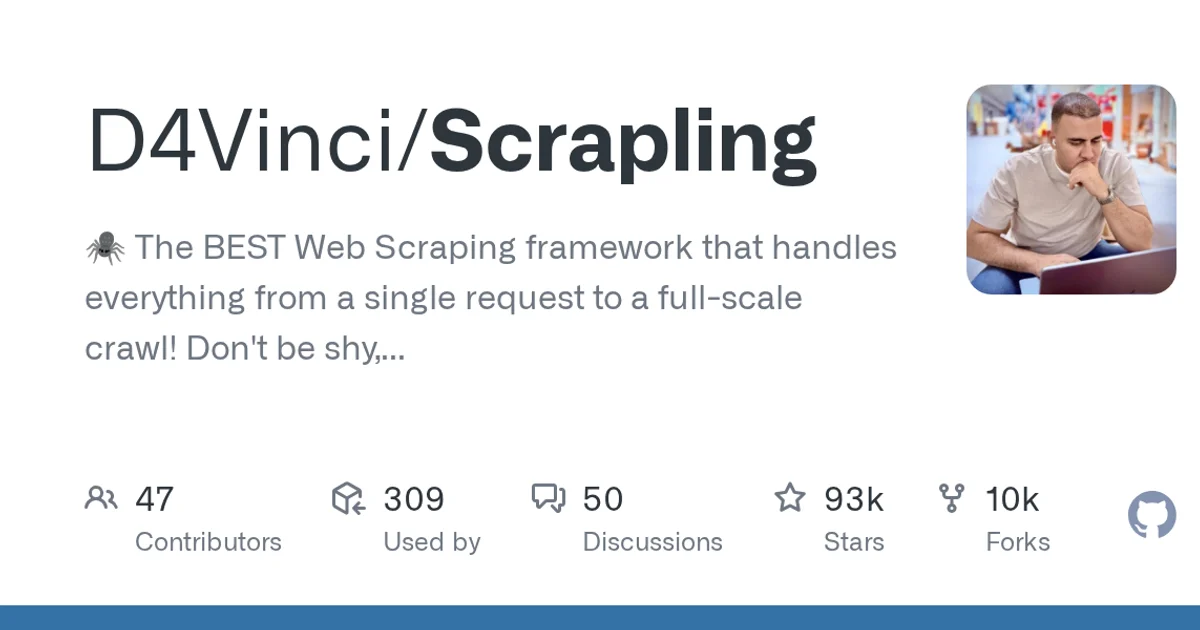
TL;DR: Scrapling is a Python web scraping framework that spans the whole range from a single page fetch to a full-scale crawl. It is BSD-3-Clause licensed, its topics point at AI scraping work, and it has 92,968 stars and 9,786 forks.
What it is
The repository description makes a wide claim: “The BEST Web Scraping framework that handles everything from a single request to a full-scale crawl!”
Most of that sentence is marketing. The last part is the useful one, because it states the scope precisely. Scrapling covers two jobs that usually get separate tools. A single request against one page is a parsing problem: get the HTML, pull the fields you want, get out. A crawl is a scheduling problem: thousands of pages, rate limits, retries, concurrency, deduplication.
The framing tells you what you are installing. You are not choosing between a lightweight parser and a heavyweight crawler. You are picking one framework that claims to serve both, which is exactly why it is worth checking that the half you need is solid.
What the metadata says
| Field | Value |
|---|---|
| Language | Python |
| License | BSD-3-Clause |
| Stars | 92,968 |
| Forks | 9,786 |
| Open issues | 9 |
| Topics | ai, ai-scraping, automation, crawler, crawling, crawling-python |
| Homepage | https://scrapling.readthedocs.io/en/latest/ |
| Created | 2024-10-13 |
| Last push | 2026-11-02 |
Two numbers in that table deserve a second look.
The fork count of 9,786 against 92,968 stars is a ratio you rarely see outside of a project people have actually deployed. Stars are cheap, forks are not. A fork means someone decided to run the code rather than just read about it, and at roughly one fork per ten stars this looks like a project with a real user base rather than a launch spike.
Nine open issues on a repository this size is the other one. A large project with a very small issue queue usually means either strong maintenance or an issue tracker nobody reads. Either way it is a signal worth checking before you build a dependency on it.
The topics point at AI work
Two of the six topics are ai and ai-scraping. That is the project telling you how it wants to be used, as the scraping layer underneath an AI pipeline rather than as a general purpose data collection library.
This is a crowded lane now, and projects add AI topics for the same reason. HTML is noisy and models are good at noise. The claim worth testing is how much of the page Scrapling hands you is signal rather than boilerplate. If it strips navigation and footer markup before the parser sees it, that is a real advantage over raw HTML. If the AI framing only shows up in the topic list, it does not.
BSD-3-Clause and two years of development
BSD-3-Clause is permissive, carries an explicit patent grant, and imposes no copyleft obligation. For a library you intend to embed in a product you sell, that is the easiest license to work with commercially, and it removes a category of legal review from your backlog.
The repository was created on October 13, 2024 and was pushed to as recently as November 2, 2026. A project that has been alive for two years and still lands commits this week sits in a very different position from one that trended on launch and then went quiet.
How to try it
pip install scraplingThe package publishes under the same name as the repository, and the documentation at scrapling.readthedocs.io is the reference for the API.
A minimal fetch and extract looks like this:
from scrapling.fetchers import Fetcher

page = Fetcher.get("https://example.com")
print(page.css_first("h1::text"))
Check the documentation for the exact module paths and method names before you script against that syntax, since the fetch surface has moved between releases. The project ships several fetchers with different tradeoffs between raw HTTP requests and headless browsers, and choosing the right one is the main decision you make up front.
Crawl-scale work runs through the same package:
# Crawl a site and write the extracted fields to disk
scrapling crawl https://example.com --output results.csv
Treat that command line as a sketch rather than a contract, and confirm the flags against the docs for the version you install.
When to use it
Scrapling fits when you need both a quick one-off fetch and something that grows into a crawl, when you want both under a single permissive license, or when you are feeding an LLM pipeline and would rather control the scraping step yourself than pay a hosted API for it.
It does not fit when you are scraping for compliance purposes and cannot afford to verify the current behavior of the project yourself, or when the target site actively fights scrapers and you need a supported commercial product rather than a community framework.
Source and Accuracy Notes
- Project page: https://github.com/D4Vinci/Scrapling
- Source repository: D4Vinci/Scrapling (verified via GitHub API
html_url) - License: BSD-3-Clause (verified via GitHub API
license.spdx_id) - Stars at time of writing: 92968
- Forks at time of writing: 9786
- Open issues at time of writing: 9
- Homepage listed in repository metadata: https://scrapling.readthedocs.io/en/latest/
- Repository created: 2024-10-13
- Last push: 2026-11-02
Related Posts
dev-tools
Automotive Skills Suite for AI Engineering
Evaluate Automotive Skills Suite for APQP, ASPICE, HARA, safety-plan, and DIA workflows with setup notes, governance risks, and SME review guidance.
5/28/2026
dev-tools
awesome-agentic-ai-zh Roadmap Guide
Explore awesome-agentic-ai-zh as a Chinese agentic AI learning roadmap, with setup notes, track selection, study workflow, and evaluation guidance.
5/28/2026
dev-tools
Baguette iOS Simulator Automation Guide
Set up Baguette for iOS Simulator automation, web dashboards, device farms, gesture input, streaming, and camera testing with Xcode caveats.
5/28/2026