Relativity Space: from pad lease to Terran R
Relativity Space won the LC-16 pad lease in 2019 and is still waiting on an FAA launch license in 2026. What changed across seven years at Cape Canaveral.
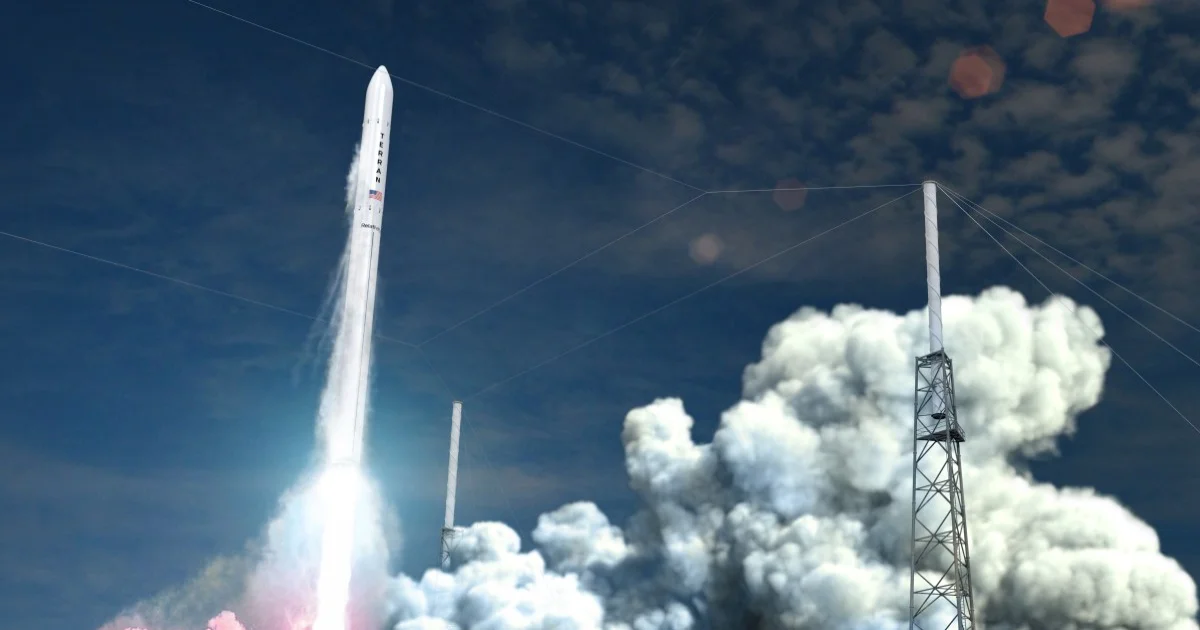
TL;DR: Relativity Space won the Air Force lease on pad LC-16 at Cape Canaveral in January 2019, and seven years later the pad still has no FAA license for Terran R, the rocket the company is now building toward. The 2019 story was about infrastructure and automated printing; the 2026 story is about a license application, a NASA contract that assigns no mission, and a launch date that keeps sliding.
What the 2019 announcement claimed
In January 2019 The Verge reported that Relativity Space had won a lease on LC-16 at Cape Canaveral Air Force Station, a pad that last flew Titan and Pershing ballistic missiles before going dormant in the late 1980s. Co-founder and CEO Tim Ellis called it the last piece of infrastructure standing between the company and a launch: “Getting the launch site agreement was a huge checkmark. That was the final infrastructure piece we need to have a clear path toward launching.”
The rest of the pitch was a manufacturing argument. Ellis wanted roughly 95 percent of the rocket printed rather than machined and assembled, using an in-house metal printer the company called Stargate, large enough to build parts up to 20 feet tall and 10 feet wide. The claim was scale and speed: 100 times fewer parts than a conventional vehicle, with the engine injector and chamber reduced to three printed pieces, and a target of 60 days to manufacture one.
At the time the company had raised more than $45 million, was testing the Aeon engine at NASA Stennis Space Center in Mississippi with 124 test fires behind it, and was aiming for a first flight in 2020. The vehicle was Terran 1, about ten stories tall, designed to put 1,250 kilograms into low Earth orbit. Ellis described the business as two products: the rockets and the factory.
The scorecard
Seven years is long enough to test a thesis against reality. Here is how the specific claims held up.
| January 2019 claim | Where it stands in October 2026 |
|---|---|
| First flight by 2020 | Terran 1 reached space on March 22, 2023 but fell short of orbit. The program was retired and replaced by Terran R. |
| 1,250 kg to low Earth orbit | Terran R is a reusable medium-to-heavy lift vehicle aimed at commercial, government, national security, and telecom missions. |
| 95 percent of the rocket printed | Still the core of the business. May 2026 alone produced 1,455 flight parts. |
| 60 days to manufacture a vehicle | No published replacement figure. The 2026 campaign is structural qualification, not production rate. |
| The pad was the last infrastructure piece | LC-16 now has a structurally complete horizontal integration facility, a 99.8-tonne cleanroom crane, an installed water farm, and an activated liquid oxygen farm. |
| More than $1 billion in potential contracts | The reported launch backlog is now above $3 billion. |
| Mars was the long game | NASA selected Relativity in June 2026 to privately develop the Aeolus Mars orbiter, targeting a 2028 launch. |
The pad did take seven years
What consumed the time was less glamorous than printing. A company operating a federal launch site needs an FAA vehicle operator license, and the environmental basis for that license is a 2024 Space Force supplemental environmental assessment that the FAA did not adopt until September 2026. The public record for the licensing step is short enough to reproduce:
FAA vehicle operator license
  VOL 23-127        Terran 1 flights at SLC-16 (the only Relativity license found)
  FAA-2026-12046    Docket for the Terran R license application
  91 FR 61274       Notice of availability, published September 28, 2026
  FR Doc. 2026-19716
  FONSI and ROD     Signed September 17, 2026 by Stacey Molinich Zee
  2024 Final SEA    USSF supplemental environmental assessment, adopted by the FAA
  Cadence           Maximum 24 launches per year at SLC-16
Two entries in that list are easy to misread. The September 2026 Finding of No Significant Impact and Record of Decision is not a launch license. The Federal Register notice says in plain terms that Relativity is required to obtain a license from the FAA to conduct Terran R commercial launch operations at SLC-16. And the only Relativity license found in the public record is VOL 23-127, which covers Terran 1. A Terran R license is still pending.
The program milestones explain the shape of the delay better than any single announcement does:
Timeline
  2019-01-17   Air Force lease on LC-16 announced
  2023-03-22   Terran 1 reaches space, falls short of orbit
  2024-01-30   USSF FONSI and FONPA for the Terran R program
  2026-06      NASA selects Relativity for the Aeolus Mars orbiter
  2026-07-07   Relativity Federal added to NSSL Phase 3 Lane 1
  2026-07-21   Space Florida expansion, up to $134M in state funding
  2026-09-09   NASA adds Terran R to the Launch Services II on-ramp
  2026-09-17   FAA signs FONSI and ROD for Terran R at SLC-16
  2026-09-28   Federal Register notice of availability published
What the hardware numbers say
| Milestone | Figure | As of |
|---|---|---|
| Flight 1 Aeon R engines on the first-stage thrust structure | 13 | September 2026 company update |
| Stage-one structural qualification campaign | 420 pressure cycles, 62 load cases, 4.3 million lbf of axial compression | 2026 |
| Flight parts released in a single month | 1,455 | May 2026 |
| Second stage | On NASA Stennis A2 with the Aeon V installed, wet dress rehearsal complete, no hot fire reported | September 2026 |
| LC-16 horizontal integration facility | Structurally complete, 99.8-tonne cleanroom bridge crane installed | September 2026 |
The gap between “parts produced” and “vehicle flying” is the whole story of additive manufacturing at aerospace scale. Printing a lot of parts quickly is the easy half. Qualifying them to survive launch loads is the expensive half, and the campaign still in progress at Stennis is doing exactly that.
The contracts are eligibility, not revenue
NASA added Terran R to the Launch Services II contract on September 9, 2026, under the annual on-ramp. NLS II is a multiple-award indefinite-delivery contract with an ordering period through June 2030 and performance through December 2032. It assigns no mission. On July 7, 2026 the Space Force added Relativity Federal to the NSSL Phase 3 Lane 1 national security pool. Both are ways for an unflown vehicle to become eligible to bid, which is not the same as being paid to fly.
Florida’s commitment is more concrete. In July 2026, at the Farnborough Air Show, the state announced an expansion anchored by a planned $350 million manufacturing and research campus in Titusville, with up to $134 million from the FDOT Spaceport Improvement Program for launch and test infrastructure at Cape Canaveral and Kennedy.
What to watch for
Three things decide whether this ends in a launch or another re-schedule.
- The license. Until the FAA issues a vehicle operator license for Terran R, commercial launches from SLC-16 are not permitted. The environmental decision is finished; the licensing step is not.
- The schedule. The Terran R product page still says launches from LC-16 start in late 2026, while industry observers reported in September 2026 that they now expect 2027. No public revision has been issued.
- The vehicle class. Terran 1 was a small launcher at 1,250 kg. Terran R is medium-to-heavy lift and reusable. That is a different rocket with a different regulatory and engineering burden attached, which is the honest reason the 2019 schedule did not survive.
Source and Accuracy Notes
- Project page: https://www.relativityspace.com/ and https://www.relativityspace.com/terran-r - verified via direct visit, the Terran R page still lists late 2026 for LC-16 launches
- Source article: The Verge, “Aerospace startup making 3D-printed rockets now has a launch site at America’s busiest spaceport” by Loren Grush, published January 17, 2019 - https://www.theverge.com/2019/1/17/18185136/relativity-space-3d-printing-terran-1-rocket-cape-canaveral-florida
- HN thread: https://news.ycombinator.com/item?id=18935765 (43 points, 8 comments at time of writing)
- FAA Finding of No Significant Impact and Record of Decision, signed September 17, 2026 - https://www.faa.gov/space/environmental/nepa_docs/FINAL-Relativity-at-CCSFS-FONSI-ROD.pdf
- Federal Register notice of availability, Docket FAA-2026-12046, 91 FR 61274, September 28, 2026 - https://www.govinfo.gov/content/pkg/FR-2026-09-28/html/2026-19716.htm
- Vehicle and program status: Relativity Space company updates and the Terran R product page
- Thumbnail: the launch complex rendering published by The Verge with the source article
Related Posts
news
StartupLaunchDay – Daily Startup Launches & Funding
Track daily product launches, trending startup topics, and funding opportunities. List your startup and get discovered by investors and users.
6/10/2026
dev-tools
Heimdall – Real-Time Satellite Tracking Dashboard
Heimdall tracks 27,000+ objects in Earth orbit with a live 3D visualizer pulling from Space-Track.org and planet4589.org. Open beta, no account needed.
7/7/2026
ai-setup
HNSignals – AI Chief of Staff for Hacker News
HNSignals transforms HN comment threads into executive-level intelligence briefs with structured Hook, Gist, Debate, and Verdict sections.
7/10/2026