Kandelo – POSIX Kernel for WebAssembly in the Browser
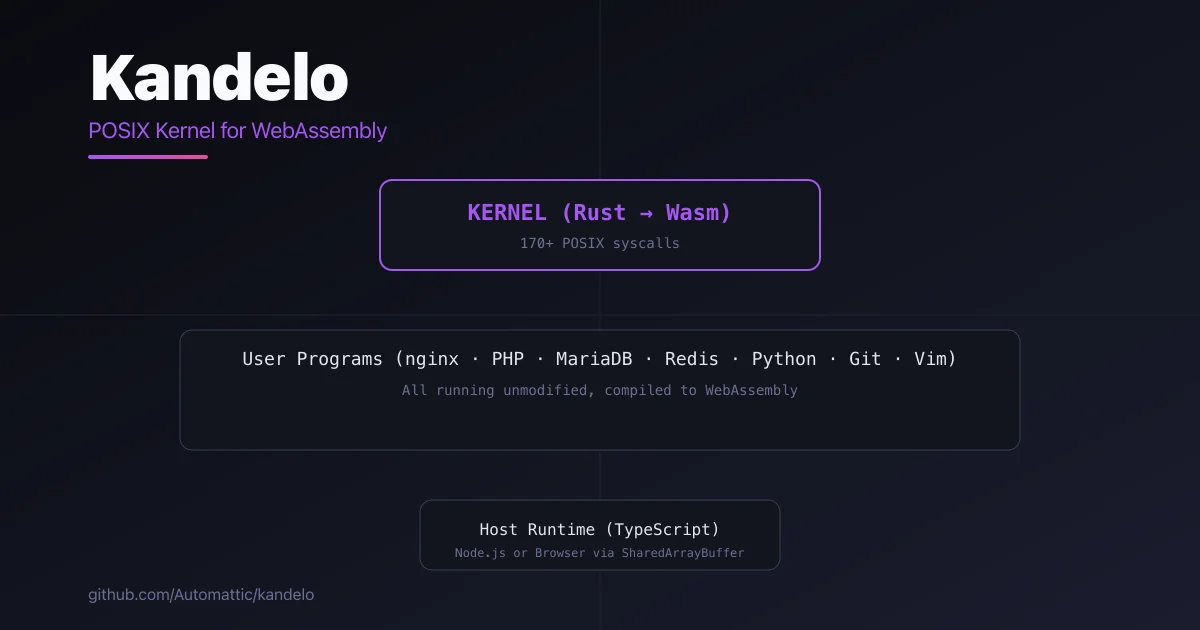
Kandelo runs a full POSIX kernel compiled to WebAssembly, letting nginx, PHP, MariaDB, Redis, Python, Git and Vim execute unmodified inside any browser with SharedArrayBuffer support.
TL;DR
TL;DR: Kandelo compiles a POSIX-compatible kernel from Rust to WebAssembly, then runs real, unmodified software — nginx, PHP, MariaDB, Redis, Python, Git, Vim — inside the browser via a TypeScript host runtime backed by SharedArrayBuffer.
Source and Accuracy Notes
- Project page: kandelo.dev (live demo)
- Source repository: github.com/Automattic/kandelo
- License: GPL v2+ (kernel, host runtime, SDK); MIT (libc overlay / syscall glue linked into user programs)
- HN launch thread: news.ycombinator.com/item?id=49378305
- User guide: automattic.github.io/kandelo/guide
- POSIX syscall status: automattic.github.io/kandelo/docs/posix-status
What Is Kandelo?
Kandelo is an experimental research project from Automattic that implements a POSIX-compatible multi-process kernel in WebAssembly. Unlike projects like JSLinux that emulate individual programs, Kandelo emulates the entire OS layer — processes, syscalls, pipes, PTY, signals, and networking — so that software compiled natively for POSIX runs without modification.
From the README:
Kandelo is a POSIX-compatible multi-process kernel for WebAssembly that runs command-line tools, server stacks, and early graphical demos in the browser or Node.js with syscall-level compatibility.
The architecture is three-tier:
┌─────────────────────────────────────────┐
│  User Programs (C → Wasm)               │
│  Each in its own Web Worker             │
│  Linked against musl libc + glue        │
├─────────────────────────────────────────┤
│  Kernel (Rust → Wasm)                   │
│  One instance, all processes            │
│  Syscalls, fd table, pipes, signals,    │
│  sockets, PTY, memory management        │
├─────────────────────────────────────────┤
│  Host Runtime (TypeScript)             │
│  Node.js: fs, net, crypto               │
│  Browser: SharedArrayBuffer FS, fetch  │
└─────────────────────────────────────────┘
```bash

### What Runs on Kandelo

Real, unmodified software compiled to WebAssembly. The README ships a table of tested software:

| Software | Version | Notes |
|----------|---------|-------|
| nginx | 1.27 | Static serving, reverse proxy, FastCGI, multi-worker fork |
| PHP | 8.4 | CLI + PHP-FPM, FastCGI protocol |
| MariaDB | 10.5 | SQL database, Aria storage engine, 5 threads |
| Redis | 7.2 | In-memory store, 3 background threads |
| WordPress | 6.7 | Full CMS: nginx + PHP-FPM + SQLite or MariaDB |
| CPython | 3.13 | REPL, script execution, stdlib |
| Git | 2.47 | Core version control operations |
| Vim | 9.1 | Full editor with ncurses terminal UI |
| NetHack | 3.6.7 | Classic roguelike with curses UI |
| SpiderMonkey | 140 ESR | JavaScript engine with Intl, SharedArrayBuffer, worker_threads, npm |
| GNU nano | 8.3 | Terminal text editor |
| dash | 0.5.12 | POSIX shell with pipes, redirects, job control |
| GNU coreutils | 9.6 | 50+ utilities (ls, cat, sort, wc, etc.) |
| curl | 8.11 | HTTP client with TLS |
| Ruby | 3.3 | Interpreter with core stdlib |
| Perl | 5.40 | Interpreter with core modules |

All run in both Node.js and the browser with no source modifications.

## How the Syscall Layer Works

Every user program is compiled against musl libc and a thin "glue" layer. When a program calls a syscall (e.g., `open`, `read`, `fork`), musl routes it through this glue instead of to the host kernel. The glue serializes the syscall arguments and writes them to a channel (backed by SharedArrayBuffer in the browser, or a Rust `Port` in Node.js). The kernel reads the channel, executes the operation, and writes the return value back.

This means Kandelo does not implement syscalls by patching or recompiling software. The glue layer is generic — it works with any program that uses standard POSIX file I/O, process management, and networking.

## Running the Live Demo

The [live demo](https://kandelo.dev) runs entirely in the browser. No installation required. Open the URL and you land in a pre-configured environment with a shell prompt.

Keybindings for navigation:

```bash
# The VFS is persistent across reloads via IndexedDB
# Take a snapshot of your environment
# The README notes: "No writable state to encode — link is a preset."
# Snapshot mode auto-selects: delta for small changes, inline for medium, manifest for large
Practical Evaluation Checklist
- Does it require SharedArrayBuffer? Yes. This means COOP/COEP headers must be set correctly in production deployments.
- Is it open source? Yes, GPL v2+ for platform code, MIT for the runtime glue.
- Is it production-ready? No — it is explicitly labeled a research project on GitHub. Do not use it for production workloads.
- How does it compare to JSLinux or v86? Those emulate single programs in a single address space. Kandelo emulates the kernel itself, so software runs in independent processes with proper fork/exec semantics.
- What browser features does it need? SharedArrayBuffer, Web Workers,
Atomics.waitAsyncfor async-syscall bridging.
Security Notes
Because Kandelo runs real server software (nginx, MariaDB, PHP-FPM) in the browser, it inherits the security considerations of that software. The host runtime acts as the syscall backend — a compromised or malicious WebAssembly kernel binary could theoretically exploit host capabilities. The project does not currently advertise a sandboxing model beyond what the browser’s security boundaries already provide.
The README notes this is research/exploration: “The idea is to default to completeness and allow developers to explicitly choose which parts of compliance are removed or compromised for the sake of performance and practicality.”
FAQ
Q: Can I run a full WordPress site in the browser with Kandelo? A: Yes — the README includes WordPress (nginx + PHP-FPM + MariaDB) as a tested software combination. The live demo at kandelo.dev can boot a WordPress instance.
Q: How does this differ from Docker or Wasmtime? A: Docker containers share the host kernel. Wasmtime runs WebAssembly modules but does not provide a POSIX process model. Kandelo implements the kernel interface in WebAssembly itself, so the software believes it is running on a real POSIX system.
Q: What is the performance like? A: No formal benchmarks are published. The HN thread comment from a maintainer suggests they had not yet fully characterized performance trade-offs. Expect significant overhead compared to native execution — every syscall crosses a channel boundary between the user program WebAssembly and the kernel WebAssembly, then a second boundary to the host runtime.
Q: Is there a Python interpreter? A: Yes, CPython 3.13 is listed as a tested software package. The interpreter runs unmodified, compiled to WebAssembly via the standard Emscripten or similar toolchain path.
Conclusion
Kandelo is a technically ambitious project that pushes WebAssembly beyond single-program emulation toward a full OS-in-the-browser. Whether it is practical depends on your use case — running a local development stack or a sandboxed demo in the browser is compelling; using it for production workloads is not what the project currently targets.
The live demo at kandelo.dev is the best way to understand what it does. If you have ever wanted to run nginx, MariaDB, and WordPress entirely in a browser tab without a server, it is worth 5 minutes of your time.
Related Posts
dev-tools
Automotive Skills Suite for AI Engineering
Evaluate Automotive Skills Suite for APQP, ASPICE, HARA, safety-plan, and DIA workflows with setup notes, governance risks, and SME review guidance.
5/28/2026
dev-tools
awesome-agentic-ai-zh Roadmap Guide
Explore awesome-agentic-ai-zh as a Chinese agentic AI learning roadmap, with setup notes, track selection, study workflow, and evaluation guidance.
5/28/2026
dev-tools
Baguette iOS Simulator Automation Guide
Set up Baguette for iOS Simulator automation, web dashboards, device farms, gesture input, streaming, and camera testing with Xcode caveats.
5/28/2026