Headroom: compress context before it reaches the LLM
Headroom compresses tool outputs, logs, files and RAG chunks before they reach the model. It ships as a library, an HTTP proxy and an MCP server.
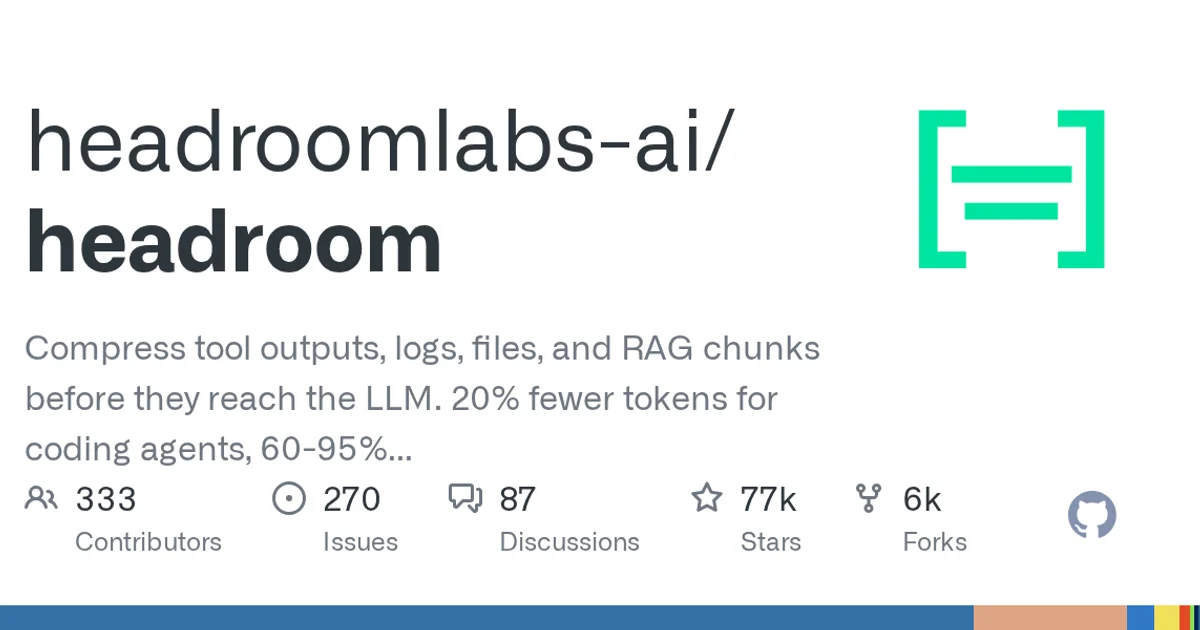
TL;DR: Headroom compresses tool outputs, logs, files and RAG chunks before they reach the model. The project claims 20% fewer tokens for coding agents and 60-95% fewer for JSON payloads, and it ships in three shapes: a library, an HTTP proxy and an MCP server.
What it is
Context window pressure is the problem. Every tool call a coding agent makes returns a wall of JSON or a log dump, and all of it lands in the context window whether or not the model needs it. Headroom sits in front of that traffic and compresses it before the tokens are spent.
The repository is Python under Apache-2.0, owned by an organization, and it was created on 2026-01-07. It has 77,288 stars, 5,996 forks and 528 open issues, with documentation hosted at docs.headroomlabs.ai. The topic list is telling: agent, ai, anthropic, claude-code, compression and context-engineering.
Three ways to install it
The description names three delivery shapes, and the difference between them matters in practice.
| Shape | Where it sits | What it compresses |
|---|---|---|
| Library | Inside your own process | Whatever you pass through it |
| Proxy | Between your agent and the model API | Requests and responses in flight |
| MCP server | As an MCP tool your agent can call | Tool output the agent pulls on demand |
The proxy is the drop-in option, since it needs no code change in the agent, only a base URL change. The library is the option when you want to control exactly which payloads get compressed. The MCP server fits setups where your agent already speaks MCP and you would rather compression be a tool than a transparent layer.
The numbers
The repository description makes three specific claims, and the gap between the first two is the interesting part:
| Workload | Claimed token reduction |
|---|---|
| Coding agent tool output | 20% |
| JSON payloads | 60% to 95% |
Structured data compresses hardest because its redundancy is mechanical. Coding agent output sits in between because it mixes structured results with prose that carries meaning on its own. The third claim in the description is that the answers come back the same, which is the part you need to verify on your own data rather than take on faith.
How to try it
Start by reading the code, since the three delivery shapes share a core:
git clone https://github.com/headroomlabs-ai/headroom.git
cd headroom
ls
If you want the MCP server, register it in your client config. The binary path is whatever you installed it to:
{
  "mcpServers": {
    "headroom": {
      "command": "<path-to-headroom-mcp-server>"
    }
  }
}
When to use it
Headroom pays off when you pay per token on long agent sessions and your tool output is mostly machine-readable. Compression at the boundary means the model sees the same answer with fewer tokens attached, and on JSON-heavy workloads the reduction is large enough to change what a session costs.
When to skip it
Skip it when your payloads are mostly prose that has to survive verbatim, since that is where the claimed reduction shrinks. Also skip it if you cannot tolerate a component sitting in the request path that rewrites content before the model sees it. The project is young, created in January 2026, and carries 528 open issues against 77,288 stars, so expect the edges to be sharp.
Source and Accuracy Notes
- Project page: https://github.com/headroomlabs-ai/headroom
- Source repository: headroomlabs-ai/headroom (verified via GitHub API
html_url) - License: Apache-2.0 (verified via GitHub API
license.spdx_id) - Stars at time of writing: 77288
Related Posts
dev-tools
Automotive Skills Suite for AI Engineering
Evaluate Automotive Skills Suite for APQP, ASPICE, HARA, safety-plan, and DIA workflows with setup notes, governance risks, and SME review guidance.
5/28/2026
dev-tools
awesome-agentic-ai-zh Roadmap Guide
Explore awesome-agentic-ai-zh as a Chinese agentic AI learning roadmap, with setup notes, track selection, study workflow, and evaluation guidance.
5/28/2026
dev-tools
Baguette iOS Simulator Automation Guide
Set up Baguette for iOS Simulator automation, web dashboards, device farms, gesture input, streaming, and camera testing with Xcode caveats.
5/28/2026