Handy: offline speech-to-text that stays on your machine
Handy is a free, MIT-licensed, offline speech-to-text app built with Rust and Tauri, extensible by design, with 36,609 GitHub stars across macOS, Windows and Linux.
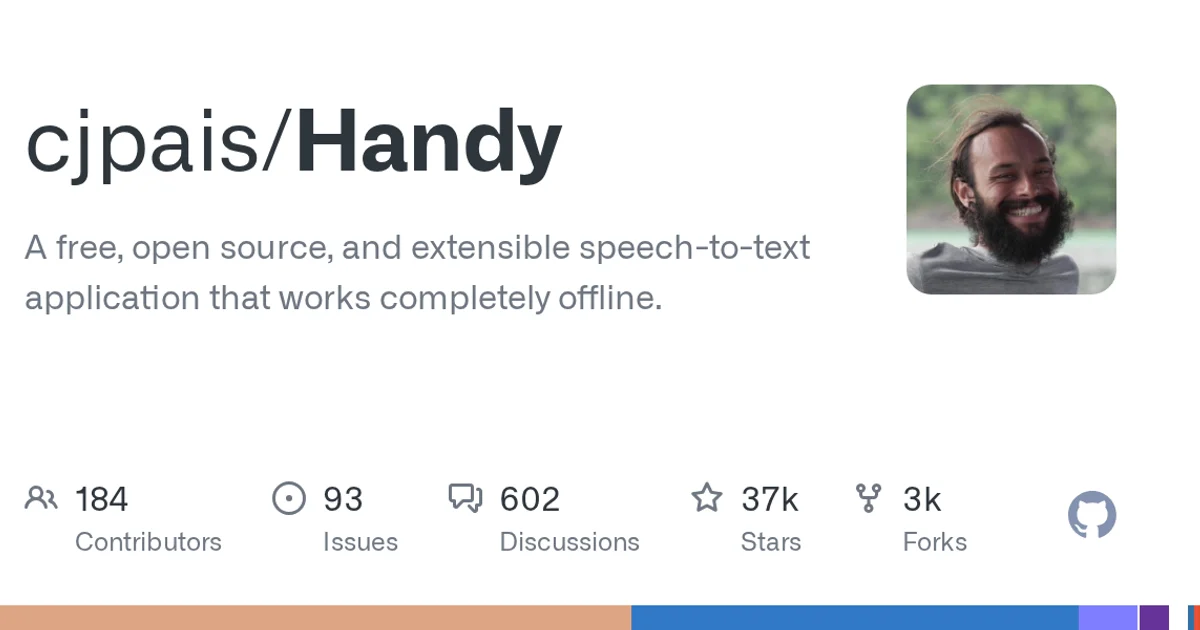
TL;DR: Handy is a speech-to-text application that works completely offline, and the repository says so directly: “A free, open source, and extensible speech-to-text application that works completely offline.” It is written in Rust with a Tauri v2 shell, MIT licensed, and the topics include
accessibility,cross-platformandspeech-to-text. It has 36,609 stars and 3,455 forks.
What it is
Handy is a dictation tool, and the description is unusually honest about what that means: “A free, open source, and extensible speech-to-text application that works completely offline.”
Two words carry the weight. “Completely offline” rules out the cloud transcription API that most speech tools use, which means your voice never leaves the machine. “Extensible” tells you the project expects people to build on it rather than just run it.
The topic list reads accessibility, cross-platform, speech-to-text and tauri-v2. The accessibility tag is the one that tells you who actually uses this. Dictation is a primary input method for a lot of people, and a tool that runs offline works for them in places a cloud dependency would fail, including a hospital machine with no outbound network.
Why Rust and Tauri
Rust is the application logic, and Tauri v2 is the desktop shell. That combination gives a small install footprint, because you ship the webview the operating system already has rather than bundling Chromium.
For a speech-to-text tool this is more than a download-size argument. Audio transcription is compute-heavy, and a native binary that does the decoding locally will behave more predictably than one bouncing between a web layer and a server.
Extensible is the interesting promise
Most applications treat extension as a settings screen. Handy’s description names extensibility as a headline feature, which suggests plugins or a documented extension surface rather than a preference pane.
If you are the kind of person who wants to pipe dictation into a specific vocabulary, a specific editor, or a specific workflow, this is the dimension to evaluate first. A tool that is explicitly extensible is usually one where the community has already built the piece you were about to write.
How to try it
The project homepage in the metadata is handy.computer, which is where the packaged builds for each platform live. Cloning the repository gives you the source:
git clone https://github.com/cjpais/Handy.git
cd Handy
A Rust and Tauri project builds the usual way, but read the project instructions before you start, since Tauri needs a platform toolchain that is not present by default:
cargo tauri buildWhisper-style model files are typically fetched separately on first run. Expect that download to be the slow part of your first session, and plan for it before you need dictation mid-sentence.
When to use it
Handy fits if you dictate regularly, if you do not want audio leaving the machine, if you work on a platform where a cloud dependency would be a problem, or if you want to extend the behaviour rather than just use it.
It is a poor fit if you want meeting recording with speaker separation, or if you need a polished consumer experience more than you need the offline guarantee. It is also a poor fit if you are on Linux and your distribution’s package is not maintained, because the Tauri dependency chain varies more there.
Source and Accuracy Notes
- Project page: https://github.com/cjpais/Handy
- Source repository: cjpais/Handy (verified via GitHub API
html_url) - License: MIT (verified via GitHub API
license.spdx_id) - Stars at time of writing: 36609
- Homepage listed in repository metadata: https://handy.computer
- Repository created: 2025-02-13
Related Posts
dev-tools
Automotive Skills Suite for AI Engineering
Evaluate Automotive Skills Suite for APQP, ASPICE, HARA, safety-plan, and DIA workflows with setup notes, governance risks, and SME review guidance.
5/28/2026
dev-tools
awesome-agentic-ai-zh Roadmap Guide
Explore awesome-agentic-ai-zh as a Chinese agentic AI learning roadmap, with setup notes, track selection, study workflow, and evaluation guidance.
5/28/2026
dev-tools
Baguette iOS Simulator Automation Guide
Set up Baguette for iOS Simulator automation, web dashboards, device farms, gesture input, streaming, and camera testing with Xcode caveats.
5/28/2026