Explo: embedded analytics for customer-facing dashboards
Explo puts customer-facing dashboards and AI reports inside your SaaS app. Here is the embed code, the real pricing, and why Omni's acquisition matters.
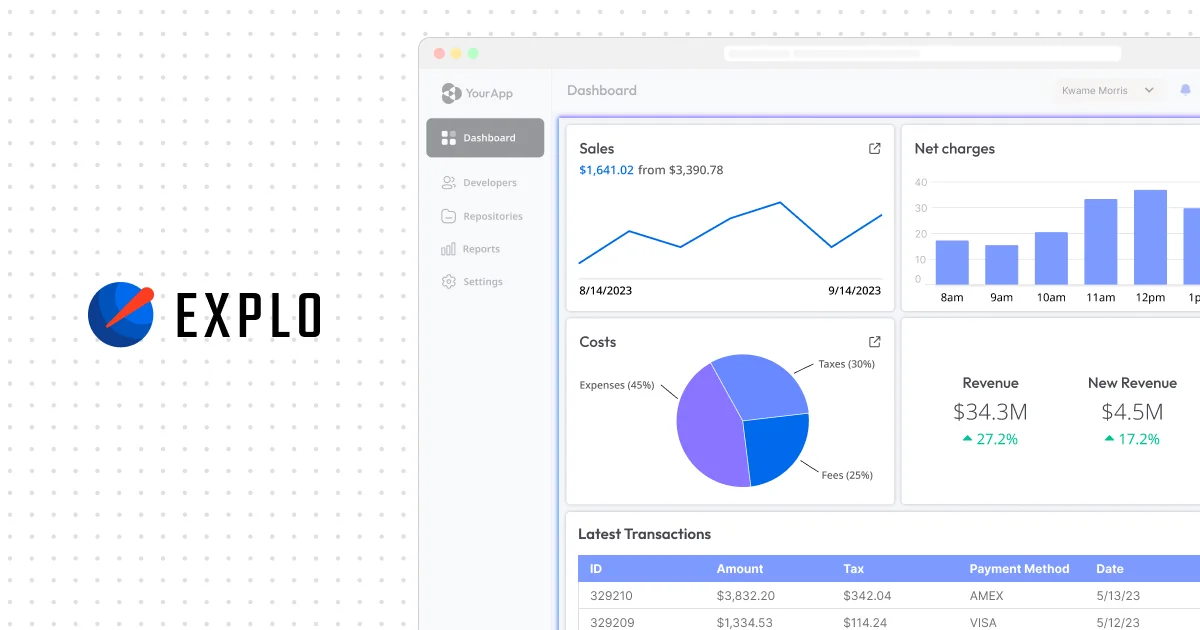
TL;DR: Explo turns your SQL database into customer-facing dashboards that you drop into your app with one script tag and one custom element. The Pro plan starts at $1,995 per month. The catch is that Omni bought Explo in October 2025 and is moving its customers onto its own platform, so this is a tool to adopt carefully rather than one to build a new product on.
What it is
Explo is an embedded analytics platform for SaaS products. You connect a database, build dashboards and report builders in a hosted editor, then embed those surfaces into your own app so customers see their own data without logging into a separate analytics portal.
The problem it targets is specific. Most BI tools are built for internal analysts who live in a tab all day. Explo is built for the person who signs into your SaaS app, opens the “Usage” tab, and expects to see a chart. That means white-labeled styling, per-customer data scoping, and embedding that survives a theme change in your product.
The product line covers more than dashboards. Report Builder gives end users a self-service way to slice data. Explo AI generates reports from natural language. Data Share delivers files on a schedule over S3 or SFTP. Email sends scheduled reports. Host is a white-labeled portal for customers who have no app of yours to embed into.
How embedding works
Two options, and the docs recommend the first.
The web component approach loads a script from Explo’s CDN, then you place a custom element in your markup:
<script src="https://embed.explo.co/bundle.js"></script>

<explo-dashboard dash-jwt="your-embed-secret"></explo-dashboard>
Because it is a custom element, the same markup works in plain HTML, vanilla JS, React, Vue, or Angular.
The iframe approach builds a URL instead:
<iframe
  src="https://app.explo.co/iframe/<dashboard-id>?jwt=<embed-secret>"
  width="100%"
  height="600"
></iframe>
Authentication is the part worth understanding. Explo recommends embed secrets, which are a key id and key value pair your server uses to mint a JWT. The token carries a JWE body, expires on a cadence you set (one day by default), and keeps the underlying dashboard id and customer token out of what your customers can read from the page. The older dash-customer-token and userGroupToken attributes still work, but the docs steer new work toward the embed secret.
Connecting your data
You point Explo at your database directly. There is no copy of your data to maintain and no separate modeling layer to keep in sync. The connector list covers most of the SQL landscape:
| Category | Supported sources |
|---|---|
| Warehouses | Snowflake, BigQuery, Redshift, Databricks, ClickHouse, Athena, Azure |
| Postgres family | PostgreSQL, Timescale, Supabase, ParadeDB, Materialize |
| Other relational | MySQL, SQL Server, CockroachDB, SingleStore, CrateDB |
The team calls this its Data Connector, and it is the reason the product sits thinner than a warehouse-first BI stack. Your data stays where it is.
What it costs
Two tiers, and the pricing page is public.
| Plan | Price | What you get |
|---|---|---|
| Pro | $1,995+ per month | Unlimited dashboard templates, unlimited creators, tiering that scales per customer, white-labeled dashboards, CSV/PDF/Excel exports, multiple data sources |
| Enterprise | Contact sales | Everything in Pro, custom visualizations, dedicated Slack channels with priority support, custom on-premise deployment, white-labeled viewer portal |
There is a 7-day trial, and you request it through a form rather than a self-serve signup. Pro is priced per month with tiering that scales as you add customers, so a product with a large free tier can get expensive quickly.
A year-long migration window
Omni acquired Explo, announced in a post by Omni CEO Colin Zima on October 22, 2025. The stated plan was a 12-month transition during which Explo keeps operating while customers migrate to Omni, with founders Andrew and Gary staying on to run the transition.
Twelve months from that announcement is now. Explo’s own site still carries an “Explo is joining Omni!” banner, the documentation is live, the trial request form is still on the site, and the pricing page still lists both tiers. Nothing is broken today.
What has changed is who you are buying from and how long the road looks like. Omni runs a dedicated Explo transition page for customers, which tells you where existing accounts are being steered. A platform with a published end-of-life date is a different proposition from one without, even if the code keeps working for another year. If you are starting a new customer-facing analytics surface now, buying inside a competitor’s migration window is a choice worth making on purpose.
What to watch for
If you already run Explo, the advice is simple. Your embed code does not break, the docs are still there, and the platform still works. Have the migration conversation with Omni before that conversation starts for you.
If you are evaluating it fresh, compare it against the alternatives on the same axis. The trade-off against building your own dashboard layer is developer time. The trade-off against a heavier BI vendor is price, and how much of the platform you actually need.
Two operational notes. Explo supports self-hosting on-premise through the Enterprise tier, which matters if your customers sit in regulated industries. The trial form also states the platform is SOC 2 and HIPAA certified, while the security page itself is thin and routes questions to [email protected], so ask for the actual reports rather than trusting a badge on a marketing page.
Source and Accuracy Notes
- Product site: https://www.explo.co/ (verified via direct visit, HTTP 200, 2026-10-22)
- Pricing: https://www.explo.co/pricing-two-tier (verified via direct visit, 2026-10-22)
- Embedding documentation: https://docs.explo.co/ (verified via direct visit, 2026-10-22)
- Data connectors: https://www.explo.co/integrations (verified via direct visit, 2026-10-22)
- Acquisition announcement: https://omni.co/blog/omni-acquires-explo/ (Colin Zima, 2025-10-22, verified via direct visit)
- HN launch thread: https://news.ycombinator.com/item?id=27447086 (YC W20 launch, 112 points, 2021-06-09)
- Licensing: proprietary commercial product, no open-source release
Related Posts
dev-tools
Superset – Orchestrate 100+ Coding Agents in Parallel
Superset runs Claude Code, Codex, Cursor, and other AI coding agents simultaneously in parallel workspaces. Orchestrate agents, automated workflows, and code.
5/28/2026
dev-tools
Frigade – Build Product Onboarding That Actually Works
Frigade is a developer tool that makes it easy to build polished, interactive product onboarding flows without the usual headache.
5/28/2026
review
Mosaic – Agentic Video Editing With a Node-Based Canvas
Mosaic lets you build and run multimodal AI video editing agents on a node-based canvas. Upload raw footage, design a workflow, and let AI handle the heavy.
5/28/2026