Betterlytics - Cookieless Privacy-First Web Analytics
Self-hostable web analytics that needs no cookies, is GDPR/CCPA ready, and tracks Core Web Vitals alongside sessions, funnels, and custom events.
TL;DR
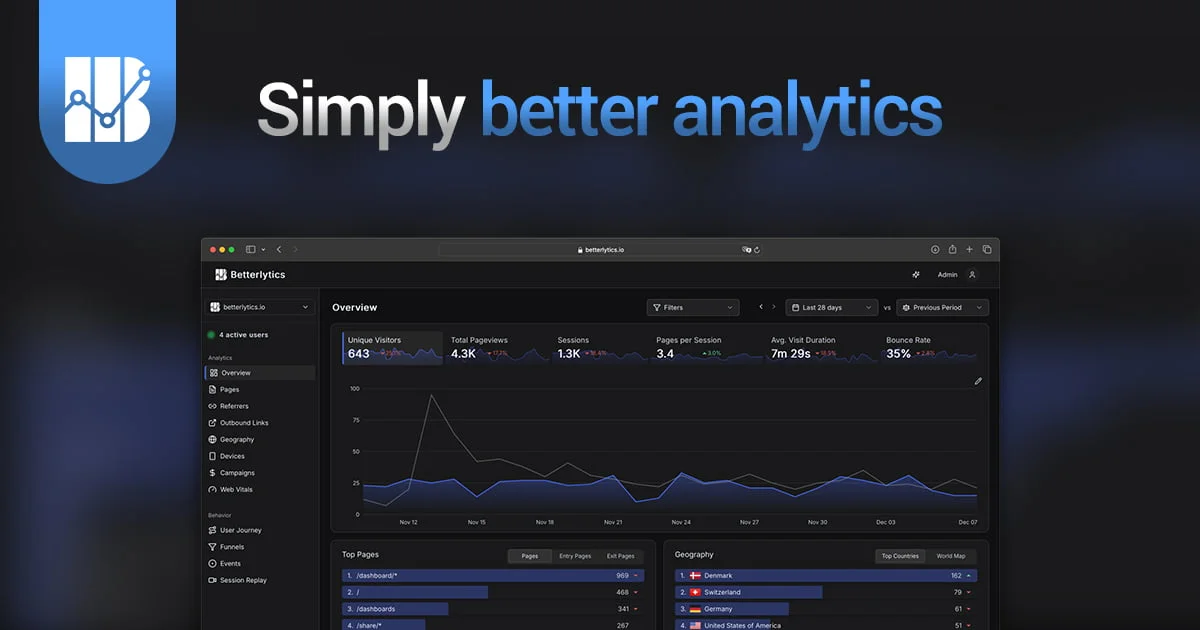
TL;DR: Betterlytics is an AGPL-licensed, privacy-first web analytics platform built with Rust and ClickHouse that you can self-host or use as a managed cloud service — tracking page views, sessions, funnels, and Core Web Vitals without cookies.
Source and Accuracy Notes
- Project page: betterlytics.io
- Source repository: github.com/betterlytics/betterlytics
- License: AGPL-3.0 (verified via GitHub API
license.spdx_id) - Latest release: v1.3.5 (2026-02-19)
- HN launch thread: news.ycombinator.com/item?id=44570303
What Is Betterlytics?
Betterlytics is a modern, cookieless web analytics platform that prioritizes user privacy while delivering the analytics depth teams expect from tools like Google Analytics or Plausible. It is built on Rust for the tracking core and ClickHouse for high-performance data storage, with a Next.js dashboard on the frontend.
The project positions itself as a privacy-first alternative that is GDPR, CCPA, and PECR compliant out of the box. No cookie banners are required, no third-party data is shared, and tracking payloads come in under 2KB.
From the README: “A modern take on cookieless, privacy-focused web analytics”
Betterlytics ships in two variants:
| Cloud | Self-Hosted | |
|---|---|---|
| Setup | Instant (30 seconds) | Manual via Docker |
| Infrastructure | Managed (EU-based) | Your own servers |
| Updates | Automatic | Manual |
| Cost | Free tier + paid plans | Infrastructure only |
Setup Workflow
Option 1: Cloud (managed)
- Sign up at betterlytics.io/signup
- Add your domain and receive a tracking script
- Paste the script into your site HTML
The tracking script is under 2KB and uses a script tag — no SDK required for basic tracking.
Option 2: Self-Hosted (Docker)
The self-hosted variant requires Docker. Below is the standard setup:
# Clone the repository
git clone https://github.com/betterlytics/betterlytics-selfhost.git
cd betterlytics-selfhost

# Copy environment configuration
cp .env.example .env

# Start with Docker Compose
docker-compose up -d
The self-hosted setup uses PostgreSQL for metadata and ClickHouse for analytics data. The dashboard runs as a Next.js application.
After startup, access the dashboard at http://your-server:3000 and configure your first domain.
Features Overview
Betterlytics organizes its feature set across six categories:
Core Analytics
- Page views, unique visitors, bounce rate
- Traffic sources and geographic insights
- Device and browser breakdown
- Real-time data view
Advanced Analytics
- Session replay
- User journey tracking
- Funnel analysis
- Custom event tracking
- Time period comparisons with annotations
Performance Monitoring
- Core Web Vitals: LCP, INP, CLS, TTFB
- Uptime monitoring
- SSL certificate monitoring
- Public status pages with custom domain support
Privacy & Compliance
- Cookieless tracking (no cookie banner needed)
- GDPR/CCPA/PECR compliant
- EU hosting option
- Data anonymization
- Open source (auditable)
Access & Security
- Role-based access control (RBAC)
- Two-factor authentication
- OAuth support (Google, GitHub)
Developer Experience
- Simple script tag (
<2KBpayload) - Framework SDKs for React and Next.js
- REST API for custom integrations
Practical Evaluation Checklist
Self-hosting viability:
- Runs on a single VPS with Docker
- PostgreSQL + ClickHouse (both open source)
- Docker Compose setup available
- Alternative: managed cloud with free tier
Privacy compliance:
- No cookies required
- GDPR/CCPA/PECR out of the box
- No third-party data sharing
- Self-host option keeps all data internal
Comparable tools: Plausible Analytics, Umami, Ackee, Shynet
Security Notes
The self-hosted version keeps all analytics data on your own infrastructure — no data leaves your servers. The cloud version stores data on EU-based infrastructure.
Role-based access control and two-factor authentication are built in for multi-user teams. The source code is publicly auditable (AGPL-3.0), meaning privacy-conscious organizations can verify the tracking behavior independently.
FAQ
Q: Does Betterlytics require a cookie banner? A: No. Because it uses cookieless tracking, it falls outside the scope of EU cookie consent laws like PECR. GDPR compliance is also built in.
Q: How does it track users without cookies? A: It uses a fingerprint-free session model based on anonymized IP hashing and user agent parsing, which does not identify individual users and therefore does not require consent under GDPR.
Q: What is the resource footprint for self-hosting? A: The minimum stack is one Docker host with PostgreSQL and ClickHouse. The the project docs show Docker as the install path. A small VPS (2GB RAM) is sufficient for low-to-medium traffic sites.
Q: Is there a free tier? A: Yes. The cloud version has a free tier. Self-hosting is free (you pay for your own infrastructure).
Q: How does it compare to Plausible? A: Both are privacy-first, cookieless, and open source. Betterlytics has a broader feature set including session replay, funnel analysis, and Core Web Vitals monitoring. Plausible has been around longer and has a larger community.
Conclusion
Betterlytics fills a specific gap for teams that want Google Analytics-level insights without the privacy baggage. Its cookieless architecture sidesteps the GDPR banner problem entirely, while ClickHouse under the hood keeps query performance fast even on high-traffic sites.
The self-hosted option is the key differentiator for privacy-sensitive deployments — your analytics data never leaves your infrastructure. The AGPL-3.0 license means the code is auditable, which matters for regulated industries.
If you are currently running Google Analytics or a GDPR-gray tool and want a clean, self-hostable alternative, Betterlytics is worth evaluating. The cloud tier gets you started in 30 seconds; the Docker setup handles self-hosting for those who need full data ownership.
- Project page: betterlytics.io
- Self-host guide: betterlytics.io/docs/installation/self-hosting
- GitHub: github.com/betterlytics/betterlytics
Related Posts
dev-tools
AgentMesh – Define AI Agent Teams in YAML
Define multi-agent AI workflows in YAML and run them locally with one command. AgentMesh brings Docker Compose patterns to AI agent orchestration.
5/28/2026
ai-setup
IonRouter – Fast Low-Cost AI Inference API
IonRouter is a YC W26 inference API routing open-source and fine-tuned models via an OpenAI-compatible endpoint, built on a C++ runtime optimized for GH200.
5/28/2026
dev-tools
Cicada – FOSS CI/CD That Replaces YAML With a Real Language
Cicada replaces GitHub Actions and GitLab CI YAML configs with a custom functional DSL, letting you write pipelines using variables, functions, and shell.
5/29/2026