TL;DR: 3 & Done takes everything you dump into it and emails you three tasks each morning, each with the reason it made the cut. You speak or type the pile into the browser, and the app does the triage that usually eats your evening. It runs $99 a year or $9.99 a month after a 14 day trial that wants a card up front.
What it is
3 & Done is a paid web app from Plezentek, Inc. built on one idea: a task list fails when nobody wants to maintain it. Instead of a board, an inbox or a backlog you are responsible for curating, you dump in whatever is on your mind and the app decides what today actually needs.
The founder is Douglas Mayle, who spent about 25 years writing software, mostly at YouTube, Facebook and Google, on things like Facebook’s News Feed, Google’s billion-account Wallet migration and voice controls in cars running Android. He says he abandoned roughly 25 task tools along the way, starting with a TODO file in 2003, and each one died for the same reason: the tool let him manage the list, but the managing was still his job.
He started on the version that shipped on 11 June 2026, and the app has been choosing his three every morning since late June. It reached Hacker News on 19 October 2026 as “Show HN: I built a task system to handle the drudgery so I could focus on tasks”, taking 61 points and 55 comments.
How the three get picked
The flow is three steps and stops there.
- Brain dump. You add anything, whenever it occurs to you, by typing or speaking. Messy input is expected, and the field is built for it.
- Distill. Each morning the app reads everything open and picks three.
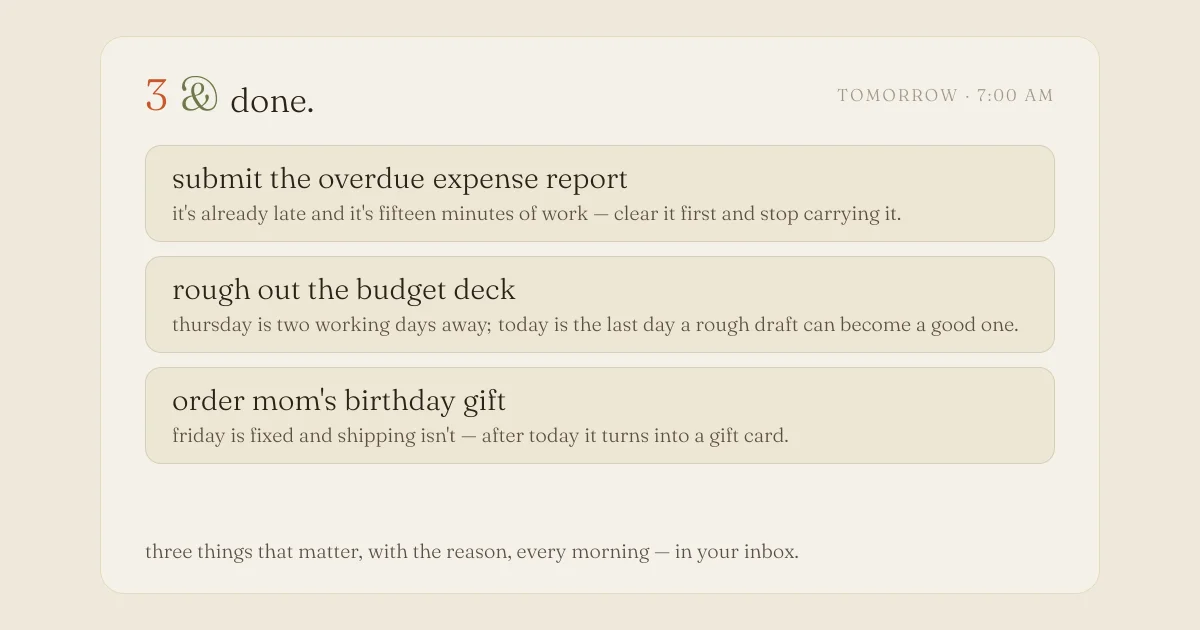
- Deliver. One email lands at 7:00 am with those three, each with a reason attached and a button to mark it done.
Everything you dump is kept. The site says tasks are organized into projects, resurfaced when they matter and retired when they stop mattering, so the three are the visible surface rather than the whole store.
The reasoning behind a choice is a real part of the product rather than a label. On the HN thread Mayle explained that the ranking prompt considers a deadline if you gave one, urgency if you mentioned it, the text of the task, its age, its activity and its project, and it sees the entire open list each morning. The sample email on the site shows the tone. “Submit the overdue expense report” comes with the note that it is already late and only fifteen minutes of work.
If the three are wrong, one click opens the whole picture so you can set the day yourself, and the app does not reshuffle behind your back.
Trying it without an account
The demo needs no signup. You type or speak, press choose my three, and it answers. You can skip the browser entirely and call the same ranking endpoint the demo uses:
curl -s -X POST https://3anddoneapp.com/api/distill \
  -H 'Content-Type: application/json' \
  -d '{"input":"take the car in for its service\nemail the landlord about the lease\nfinish expense report"}'
The answer comes back as three tasks with the reasoning attached:
{
  "tasks": {
    "first": {
      "task": "Email the landlord to confirm the lease terms and any renewal or end-date details.",
      "why": "Lease matters usually carry a hard deadline and neglect could cost you your housing or a better rate."
    },
    "second": {
      "task": "Finish and submit the expense report.",
      "why": "Unsubmitted expenses block reimbursement and may hold up others in finance or your manager."
    },
    "third": {
      "task": "Book the car service appointment today by calling or going online to pick a slot.",
      "why": "Booking is a quick step that prevents a deferred service from turning into a costly breakdown."
    }
  }
}
Watch the rewrite. You said “email the landlord about the lease” and it turned that into a specific task with a deadline angle attached. That rephrasing is the substance of the product. The endpoint is unauthenticated and rate limited, so treat it as a demo rather than a free API.
After the trial, the paid tiers are:
| Plan | Price | Notes |
|---|---|---|
| Yearly | $99 per year | Two months free, the default selection |
| Monthly | $9.99 per month | Cancel any time |
| Trial | 14 days | Card required up front, nothing charged until it ends |
| Team | On request | Handled by email, no self-serve option yet |
Cancellation happens in settings, in the billing section, without emailing anyone, and you keep access through the period you have paid for.
What your list is worth to them
Two details from the founder’s own answers on HN matter more than the marketing copy. First, your list is sent to Anthropic to be ranked, under commercial terms that exclude training on it. Second, the privacy policy, effective 17 August 2026, names AI model providers as data processors alongside Stripe for payments and the email delivery provider.
The app claims your tasks are private to you and that nobody at the company reads them. Mayle backs that with a rule he describes as no access unless a user explicitly grants it, then only temporarily and only to solve the problem at hand, and says the support tooling was built around that rule rather than around convenience. Export was one of the first things he built, in JSON and plain text, on the principle that taking your data out should be easier than putting it in.
Your voice never leaves the browser, according to the demo page, while what you type does leave to be ranked. The demo sends a plain list of strings to the ranking endpoint, which is exactly how the curl above works.
What to watch for
The real risk here is the business model rather than the software. On the same HN thread, jedberg described a prior attempt at the same thesis: an app that triaged the list with machine learning and rules, found that people would not pay for it even at $2 a month, and shut it down. Mayle’s answer was that a subscription changes who will use it and how many people will use it, and that he avoided ads on purpose because interruptions wreck a tool you reach for while thinking.
Other things worth knowing before you pay:
- The free trial wants a card up front. Nothing is charged for 14 days and the site says it emails you before the trial ends, but the card has to be there for day 15.
- It is a web app, and the morning email is the actual product. The company describes it as one email a day, and that is the whole deal.
- One person built the product with AI assistance, and the ranking is a prompt plus a set of rules tuned on his own usage and that of his testers over roughly four months. Mayle calls the design a knife’s edge between simplicity and utility.
- There is no self-serve team plan. Team interest goes through an email address.
If a list you maintain yourself already works, the honest comparison is $99 a year against the evenings you spend rereading your own notes. If you keep meaning to start using a todo system and never do, that is the case the founder is making, and it is a reasonable one.
Source and Accuracy Notes
- Product page: https://3anddoneapp.com/ (verified via direct visit on 24 October 2026)
- Ranking endpoint used above: https://3anddoneapp.com/api/distill (verified by direct request)
- Press kit and product screenshots: https://3anddoneapp.com/press (verified via direct visit)
- Privacy policy: https://3anddoneapp.com/privacy (effective 17 August 2026)
- HN launch thread: https://news.ycombinator.com/item?id=50151980 (61 points, 55 comments, 19 October 2026)
- Pricing, ranking rules, export formats and the Anthropic processing detail come from the site’s own pages and from Douglas Mayle’s replies in the HN thread
Related Posts
dev-tools
Dulus Terminal Agent Setup Guide
Set up Dulus as a terminal AI agent with native and Docker paths, installer profiles, WebChat ports, repo safety checks, and shell-access risks.
5/28/2026
dev-tools
OpenSquilla Agent Gateway Setup Guide
Set up OpenSquilla with uv, onboarding, OpenRouter env keys, gateway runtime, Git LFS model files, and migration paths from other agents.
5/28/2026
dev-tools
RMUX Terminal Multiplexer Guide
Set up RMUX for detachable agent terminals, tmux-like sessions, Rust SDK control, diagnostics, migration checks, and terminal automation.
5/28/2026